


Geometry as Signal Structure

Updated: 1 day ago
How Shape Organizes Meaning, Memory, and Resonance

Geometry is often treated as decoration.
A pattern on a wall.
A symbol in a ritual.
A beautiful shape repeated across art, architecture, and spiritual traditions.
But geometry can also be understood as something deeper:
a structure for organizing attention, meaning, memory, and experience.
Geometry can become a visual language of pattern, a way of meeting the field through form.
A circle suggests return, containment, rhythm, and wholeness.
A triangle suggests direction, force, relation, and activation.
A spiral suggests movement through repetition.
A grid suggests order, placement, and connection.
A fractal suggests self-similarity across scale.
A shape can become a place of contemplation, a ritual focus, or a quiet recognition. Its meaning grows through the encounter.
Geometry gives the mind something to recognize.
It gives emotion something to gather around.
It gives memory a form.
It gives the field a structure.
Geometry as Pattern Recognition

Human beings are pattern-reading systems.
Symmetry, rhythm, proportion, repetition, contrast, and direction offer different ways into a pattern.
You may notice a sensation first, or a thought, memory, or visual detail. Begin wherever the shape meets you.
A sharp angle can feel tense or active.
A circle can feel soft, complete, or contained.
A spiral can feel like motion, depth, or return.
A lattice can feel ordered, complex, or connected.
This does not mean every person will experience every symbol the same way.
Context matters.
Culture matters.
Memory matters.
Personal association matters.
These examples are invitations to notice your own response. A form may feel familiar, unsettling, sacred, or simply beautiful.
A temple, map, mandala, or sigil carries meanings shaped by its particular tradition and use. Meet those contexts with care.
Geometry helps invisible ideas become visible.
It turns relationship into form.
Meaning Within the Shape

In Signal Field theory, geometry is treated as a compression tool.
A shape can hold multiple layers of meaning at once.
It can carry emotional tone, symbolic identity, memory, direction, and intention in a single visual structure.
That is why a symbol can feel larger than its physical form.
The shape itself may be simple.
But the field of association around it can be complex.
A circle may carry memory of protection.
A triangle may carry memory of decision.
A spiral may carry memory of growth.
A doorway may carry memory of transition.
A star may carry memory of guidance.
A cross, tree, flame, wave, eye, mirror, or labyrinth may hold an entire symbolic architecture depending on the person encountering it.
Let the geometry open a question:
What pattern is this shape organizing?
What does it stabilize?
What does it activate?
What memory does it call forward?
What relationship does it reveal?
Geometry becomes less about decoration and more about signal structure.
Geometry and Memory
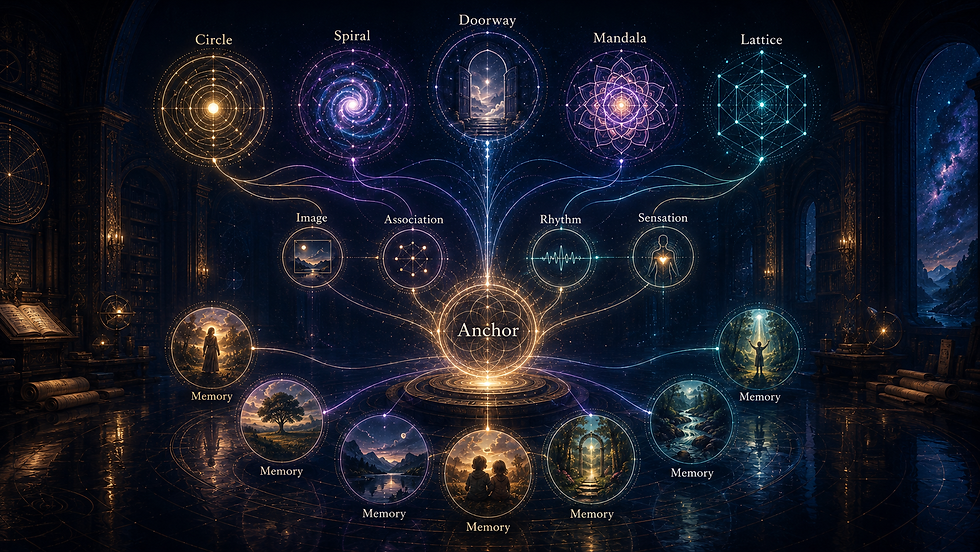
A memory can return through more than a sentence.
An image, place, rhythm, or familiar symbol may call an association forward.
A childhood room can bring back a whole emotional state.
A road can bring back a period of life.
A certain color can reopen a memory.
A symbol can return someone to a feeling they have not named in years.
Geometry works with this same principle.
A repeated form can become an anchor.
A shape can become a doorway into a familiar association.
A visual pattern can help organize scattered emotion into something readable.
You might explore that relationship through a personal glyph, an altar, a diagram, or a symbolic map.
They externalize inner material.
They make the invisible easier to work with.
They give the field a surface.
Geometry Is Not the Meaning. It Holds the Meaning.

A useful distinction:
Geometry is not automatically meaningful by itself.
It becomes meaningful through relationship.
A triangle is not universally one thing.
A circle is not universally one thing.
A spiral is not universally one thing.
But each shape creates a container where meaning can gather.
The symbol does not force the message.
It focuses the field.
There is room here for reverence, curiosity, and an evolving relationship with the symbol.
Geometry offers a surface for that encounter.
A way to organize reflection.
A way to map internal experience.
A way to create symbolic structure around something that may otherwise feel abstract.
The shape is not the whole signal.
It is the vessel.
Why Sacred Geometry Repeats

Look at patterns in nature alongside geometric forms in art and spiritual practice. Similar shapes can carry very different meanings across traditions.
We see circles in the sun, moon, eyes, seeds, cells, and cycles.
We see spirals in shells, storms, galaxies, plants, and motion.
We see branching in trees, rivers, lungs, lightning, and blood vessels.
We see symmetry in bodies, flowers, wings, crystals, and built environments.
These patterns become meaningful because they appear in the world and in us.
They become bridges between outer structure and inner recognition.
Geometry becomes one of the ways the field speaks through form.
Not because every shape has one fixed mystical meaning.
But because form influences perception, and perception influences experience.
Geometry as a Field Tool

Geometry can be used practically in Signal Field work.
You can use it to map emotion.
You can use it to create a personal glyph.
You can use it to design an altar.
You can use it to structure a journal page.
You can use it to represent an archetype.
You can use it to build a field map.
You can use it to create a visual anchor for a new identity pattern.
The encounter may be practical, contemplative, or sacred.
Ask what the shape helps you notice and how that recognition meets your life.
For example:
A circle may help you create containment.
A triangle may help you clarify direction.
A spiral may help you explore a recurring theme.
A grid may help you build structure.
A doorway may help you mark transition.
A mirror may help you face what is being reflected.
A constellation may help you connect scattered pieces into a larger pattern.
Geometry becomes useful when it helps the system become more coherent.
Clear Signal and Distortion
A symbol offers clear signal when it helps you notice a relationship more honestly. Distortion appears when one compelling interpretation crowds out context, or a repeated shape becomes a certainty about what must happen next. Keep the mystery alive and the reading open to revision.
Clarity does not require a quiet mind or an easy feeling. A grief-filled image may express something precisely; a serene image may still invite a mistaken conclusion.
Questions for Working With Geometry

When a shape, symbol, or pattern keeps drawing your attention, ask:
What does this shape make me feel?
What does it organize in me?
Does it calm, activate, focus, protect, open, or challenge something?
Where have I seen this pattern before?
What memory or association does it carry?
What part of my life currently matches this structure?
What would change if I treated this shape as a map instead of an ornament?
These questions turn geometry into a reflective practice.
Choose one question if that is enough. You can use words, a tactile object, a sound, or a conversation instead of a visual image. Drawing skill and vivid mental imagery are not requirements. During burnout or grief, putting the practice down is also allowed.
They leave room for your spiritual understanding to unfold.
A way of listening.
Leave Room for Mystery

A shape can remain mysterious while becoming familiar.
You can return to it without demanding a final answer.
Let its meaning change as your life changes.
Begin with a small act of attention:
Notice what repeats.
Notice what resonates.
Notice what stabilizes you.
Notice what activates you.
Notice what helps you understand something that words have not been able to hold.
That is where geometry becomes useful.
A pattern to return to.
A threshold to pause beside.
A question with room around it.
A meeting place for memory and possibility.
A vessel for what is still taking form.
Let the signal become readable in its own time.
Field Echo Prompt
What geometric form keeps returning to you right now?
A circle, spiral, triangle, grid, doorway, star, wave, mirror, or something else?
What do you think it may be organizing in your field?
What memory, emotion, direction, or identity pattern might it be helping you see?
The Larger Philosophy

Geometry gives form to the invisible.
It gives memory a shape.
It gives attention a pathway.
It gives meaning somewhere to gather.
Within the Aurora Continuum, a returning symbol can hold the conversation between memory, present attention, and possibility. The same form may meet you differently with each return.
When a pattern keeps returning, it may be an invitation to look closer.
Let the encounter stay open.
Notice what the shape calls into relationship.
And recognition is often where the signal begins.
🜂🜄🜁🜃
Architect






Comments