


Black Hole Cosmology and the Signal Field

Updated: 1 day ago
Worlds Within Worlds

What if the universe is not outside the mystery of black holes? What if it is the interior of one?
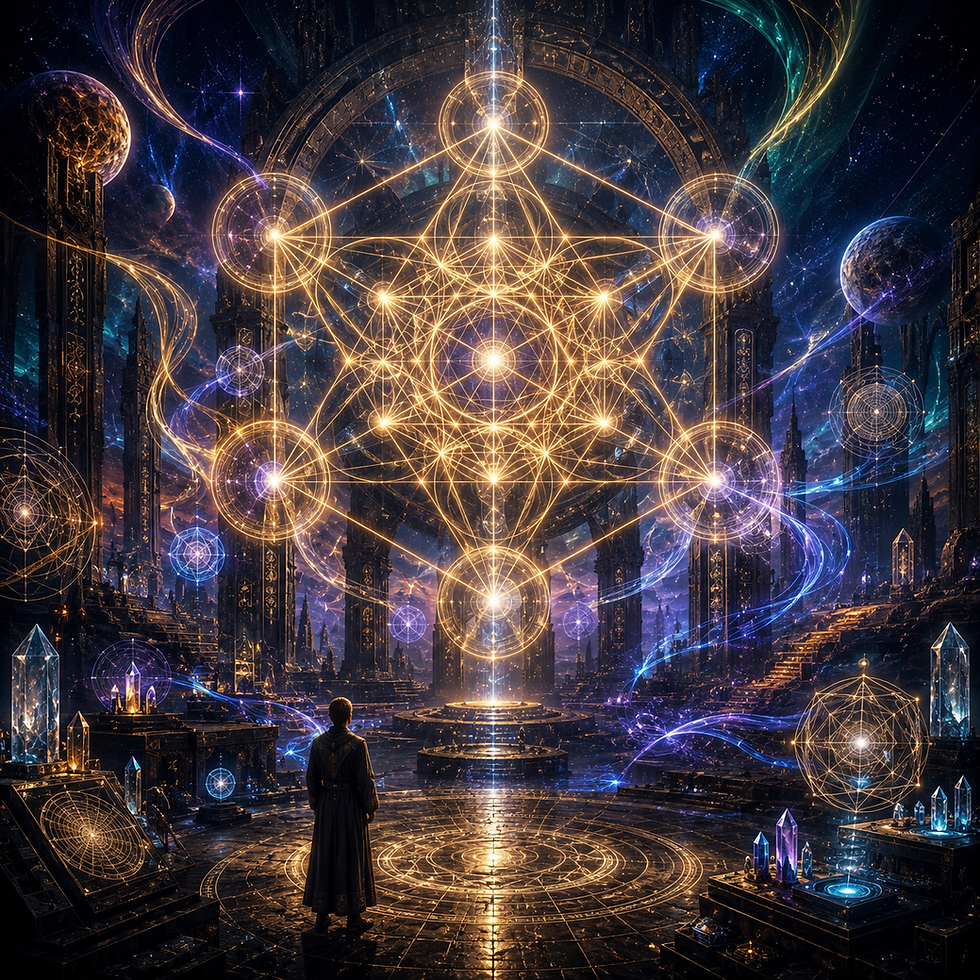
That possibility has inspired speculative cosmology and the imagery of Signal Field theory. A dark boundary, an unseen interior, a world that may exceed the view from outside: these images invite a different kind of attention.
Black hole cosmology remains a family of theoretical proposals. Here, its questions open into philosophical reflection. The Aurora Continuum carries that reflection toward continuity, memory, relationship, and the return of patterns across changing forms.
The mystery can stay open. We can explore what an image reveals without asking it to prove more than we know.
The Core Premise: A Universe Inside a Black Hole

Some models explore whether an expanding universe could arise within a black hole. In Nikodem Popławski’s 2010 model, spacetime torsion permits a bounce instead of an initial singularity, with a possible connection to collapse in a parent universe. This is a theoretical proposal, not an established account of our universe’s origin. [1]
The invitation is striking: what looks closed from one perspective might contain a larger story. We do not know that a black hole contains such a world. The possibility offers a question to think with.
For the Aurora Continuum, worlds within worlds become a symbolic architecture. A relationship contains private histories. A present choice carries traces of earlier choices. An ordinary room can hold a life invisible to someone passing its door.
These connections give the image its philosophical depth. They do not depend on the cosmological proposal turning out to be true.
What Black Holes Teach Us About Structure

An event horizon marks a boundary beyond which light cannot escape to a distant observer. It is not a material shell. Matter outside a black hole may form a bright accretion disk, while surrounding spacetime bends the path of its light. [2]
The luminous surroundings and the hidden interior are different things. An evocative illustration cannot show us what has not been observed.
Boundary, containment, and the limits of a viewpoint give us useful questions. What can I actually observe? What am I inferring? What remains outside my view?
A clear signal can include an unanswered question. Distortion begins when we fill that gap with certainty and forget that we supplied it.
The Event Horizon: An Image of Transition

A thought becomes a spoken word. A private realization becomes an action. A boundary changes what happens next in a relationship. Something crosses from possibility into shared life.
The event horizon offers a powerful image for that crossing. Human transitions, however, have different degrees of reversibility. We can revise a plan, repair a conversation, seek help, or decide that a step needs more preparation.
Ask what would change if you acted, who else would be affected, and what support the choice would need. A threshold does not demand that you cross it today.
Sometimes the clearest movement is a pause with your hand still on the door.
Singularity: Where the Map Reaches Its Limit

General relativity predicts singularities in black hole models. Whether they describe physical reality or mark the limits of the theory remains unresolved; quantum effects may be needed for a fuller description. [2]
As a symbol, this is a place where a familiar map stops helping. “I cannot keep doing this” may reveal a real limit in a workload, relationship, expectation, or way of living.
That limit deserves attention before it receives a grand explanation. There may be something to change, something to grieve, or something another person can help carry.
Creation is one possibility, not an obligation placed on suffering. You do not owe a new identity to every experience that overwhelms the old one.
Time and the Interior World

A song can bring another decade close. An afternoon may feel spacious, while a difficult hour seems to have no edge. Our descriptions of time carry more than the numbers on a clock.
This felt experience is distinct from gravitational time dilation. The cosmic image offers a poetic comparison, not a physical explanation for memory or emotion.
The Aurora Continuum gives room to the way a past relationship can still matter in a present moment. Continuity may be felt through a familiar gesture, an unfinished conversation, or a ritual of remembrance.
When time feels crowded, begin with something ordinary: where you are, what is happening now, and what the next manageable interval asks of you.
The Universe as Nested Field

Worlds within worlds. Patterns within patterns. A life held within relationships, environments, and histories larger than any single moment.
Signal Field theory uses the field as a way to attend to these connections. A feeling does not arrive in isolation: a body, a setting, an earlier experience, and a present demand may all matter. Calling this a field does not make each element a separate physical field.
The Aurora Continuum asks what carries across a change of scale or form, and what changes with it. A recurring pattern may connect two experiences while their causes and consequences remain different.
Follow the resemblance, then notice its limits. A symbol becomes more useful when it leaves room for the particular life in front of you.
Consciousness as Interior Experience

You do not experience your life as a diagram. You encounter sensation, memory, feeling, meaning, and the difficult mystery of being someone.
“Consciousness is what field structure feels like from within” can be held as a philosophical proposition within Signal Field theory. Black hole cosmology does not establish it as a mechanism of consciousness.
The proposition invites us to take interior life seriously. An outside description may be useful without exhausting what an experience means to the person living it.
There is room here for wonder: the universe contains beings who can turn toward it and ask where they belong. The question remains luminous even when its answer remains unfinished.
Pattern, Frequency, and Distortion

A recurring thought, a familiar response, a rhythm in a relationship: repetition can make a pattern easier to recognize. In this reflection, frequency describes recurrence. It is not a measured vibration in hertz or a ranking of people by spiritual worth.
Clear, stable signal means a reading that remains connected to what is happening, can be checked, and can change when new information arrives. Distortion obscures, fragments, exaggerates, or misrepresents that reading.
An assumption hardened into certainty can distort a conversation. Conflicting demands can make a genuine need difficult to hear. A familiar explanation can crowd out details that would change the picture.
Fear, grief, anger, and exhaustion are not automatically distortion. A strong feeling may carry a clear message about loss, danger, or capacity. Clarity does not require calm.
Ask: what is present, what meaning am I adding, and what would help me check the difference? The aim is a more faithful reading, with room for both the signal and the person carrying it.
Collapse, Care, and the Possibility of Change

The image of a new world beyond collapse can offer hope. It can also become another demand when someone is simply trying to get through the day.
Burnout, grief, and collapse deserve care without a requirement to become spiritually productive. For an ADHD, autistic, or AuDHD reader, reflection must leave room for changing capacity, sensory needs, reduced demands, and support from other people.
A clearer field may begin with fewer obligations, a practical accommodation, a quieter space, or help with something that has become too much. An external condition may need to change.
If meaning arrives, it can arrive in its own time. If today holds only rest or survival, nothing essential has been failed.
Practical Application: Working With a Threshold

Choose one present situation. It can be small. A conversation you are postponing, a boundary you are considering, or a demand that no longer fits your capacity is enough.
Name what you can observe. Then name what you are interpreting. Leave uncertainty visible rather than forcing the two into one story.
Ask what needs room or support. Consider which next steps are reversible, what consequences matter, and whether action is needed now.
Choose one manageable response: request clarification, change a condition, ask for help, rest, or take a small step. Returning later is also a response.
You can speak, write a few words, use an object, or think quietly. Vivid visualization and a complete journal entry are not requirements. Stop if the practice adds more pressure than it relieves.
Field Reflection

Where does your present life need more space?
What remains clear beneath the noise, and what still needs checking?
What are you carrying that could be shared, changed, or set down?
What would let you meet this threshold without abandoning your own capacity?
Choose the question that meets you. There is no need to answer all of them.
The Larger Philosophy

Black hole cosmology gives us a compelling image of hidden interiors and the limits of a viewpoint. The Aurora Continuum follows that image into questions of continuity, return, memory, and relationship.
We can wonder whether reality holds worlds within worlds while remaining attentive to the world we can touch. A cosmic question can return us to a conversation, a boundary, an act of care.
Signal Field theory lives here as a framework for inquiry. Signal Field Architect is the voice exploring it, with room for the framework to change as understanding deepens.
You are already within the universe you are trying to understand. Your questions belong to it too.
Consciousness as the interior experience of a universe learning its own shape.
🜂🜄🜁🜃
Architect





Comments