


Bioelectricity Beyond Neurons: How Cells Coordinate Across Tissues

Updated: Oct 21
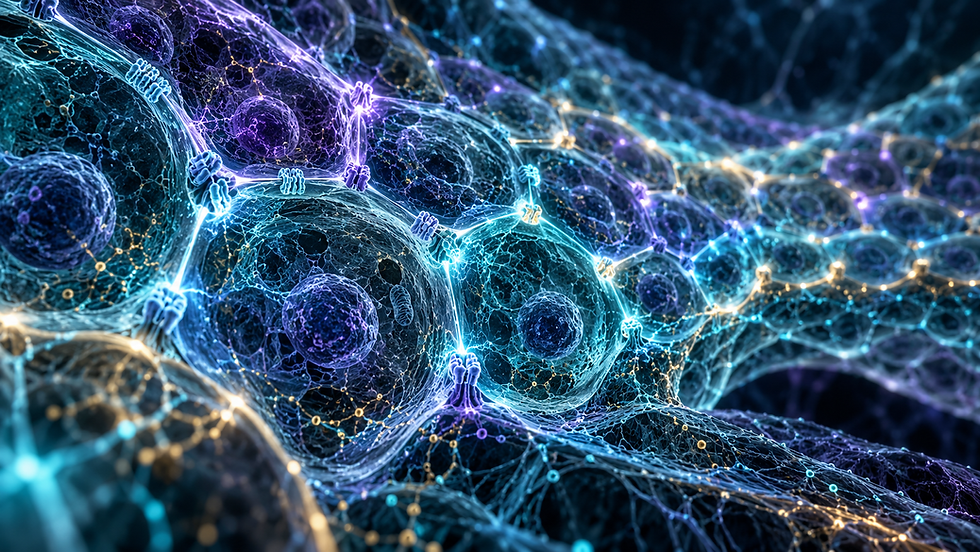
Long before nervous systems evolved, living cells were already maintaining electrical differences across their membranes.
Every living cell depends on the movement of charged particles. Ion gradients help regulate transport, metabolism, and the conditions under which cells grow, divide, and communicate.
In neurons, electrical activity becomes a remarkably fast signaling system capable of coordinating sensation, movement, and information processing.
But neurons didn't invent the electrical architecture of life.
They emerged from a much older biological foundation.
And that foundation reveals something extraordinary: electrical signaling can help coordinate cells that have no nervous system at all.
Life Was Electrical Before Nervous Systems

Picture a single living cell.
A membrane separates its interior from the surrounding environment. On either side of that boundary, electrically charged particles exist in different concentrations.
Potassium, sodium, chloride, calcium, and other ions help establish and maintain these differences.
Because the charges are distributed unevenly, an electrical potential develops across the membrane.
This is called the membrane potential.
It's a fundamental feature of cellular physiology.
Specialized proteins continually influence this electrical state. Ion pumps use energy to maintain concentration differences, while channels and transporters regulate how ions move.
Different cells maintain different electrical conditions depending on their roles, environments, and current activity.
A nerve cell uses rapid voltage changes to transmit information over distance.
A skin cell, developing embryonic cell, or migrating cell may use slower electrical changes as part of its ongoing regulation.
The mechanisms and timescales differ.
The underlying physical principle is shared.
Electrical organization was already part of life before specialized nervous systems appeared.
A Cell Is an Electrical Boundary

The cell membrane is more than a protective wall.
It's an active interface between internal and external conditions.
The proteins embedded within it continually influence what enters, what leaves, and how the cell responds.
When channels open or close, the movement of ions can change membrane voltage.
Those changes can also affect other biological processes.
Calcium signaling, for example, connects electrical changes with the activity of proteins involved in cellular movement, secretion, and regulation.
Membrane voltage can also influence pathways associated with cell proliferation and differentiation.
This is where the biology becomes especially interesting.
The electrical state of a cell is connected to its biochemical activity.
Voltage influences signaling pathways. Chemical processes influence ion channels. Metabolic activity supplies energy to maintain gradients.
Each process becomes part of the conditions shaping the others.
A cell is constantly maintaining a dynamic relationship with its surroundings.
Its electrical boundary participates in that relationship.
From Local Voltage to Tissue Coordination

Now imagine thousands of cells working together.
During development, cells must divide, differentiate, move, and organize into tissues with recognizable structure.
During repair, cells must respond to damaged conditions and coordinate the restoration of a barrier.
Chemical signals and genetic regulation are central to these processes.
Electrical signaling adds another layer.
One particularly fascinating example appears during wound healing.
When an epithelial barrier is damaged, the disruption changes the electrical conditions across the tissue.
Naturally occurring electrical fields form around the wound.
Research has shown that epithelial cells can respond to these fields by changing the direction of their migration.
In experimental settings, entire sheets of connected cells can move collectively in response to electrical cues.
Think about what that means.
A damaged tissue isn't simply a collection of independent cells trying to close an opening.
The surrounding conditions provide multiple forms of information that help organize a collective response.
Chemical signals, physical forces, cell junctions, and electrical gradients all participate.
The electrical component is particularly revealing because it demonstrates how the state of a tissue can provide directional information.
Individual cells respond locally.
Together, their responses contribute to a larger pattern of repair.
Networks Change What Local Signals Can Do

Cells don't always operate as isolated electrical units.
Many tissues contain specialized connections called gap junctions.
These connections form channels between neighboring cells, allowing certain ions and small molecules to pass directly from one cell to another.
That creates opportunities for electrical and chemical states to influence a wider group.
A change in one location can become relevant somewhere else.
The arrangement of the connections matters.
Which cells are connected? Which channels are open? How quickly can a change spread? What other signals are present?
Those details influence how local cellular activity contributes to larger tissue behavior.
Researchers studying developmental bioelectricity have explored how these relationships help regulate anatomical patterning.
Some especially striking experiments involve planarian flatworms, animals capable of regenerating missing body parts.
Under carefully controlled experimental conditions, manipulating electrical communication between their cells can change the anatomical patterns they regenerate.
In certain studies, temporary alterations to bioelectric signaling have influenced the forms produced during later rounds of regeneration.
The remarkable part is that cellular electrical organization can participate in determining large-scale biological outcomes.
The cells contain genetic instructions, but the developing tissue also depends on how those cells communicate and respond together.
That relationship creates a powerful research question:
How does a network of individual cells organize itself into a recognizable anatomical whole?
Electrical communication appears to be one important part of the answer.
The Systems Question

A single cell can maintain a membrane potential.
A connected tissue can organize electrical states across many cells.
But the behavior of the larger system depends on far more than the electrical activity of any one component.
It depends on connectivity, timing, geometry, chemical signaling, mechanical forces, and the changing conditions of the tissue itself.
A local signal may remain local.
Under different conditions, it may become part of a coordinated response.
That difference is fundamental to systems biology.
The arrangement of the parts changes what the parts can do together.
Developmental bioelectricity provides a particularly interesting way to study this principle.
Researchers can observe membrane voltage patterns, manipulate ion channels, alter cellular connectivity, and examine how those changes influence growth or anatomical organization.
Each experiment offers a different window into the relationship between electrical state and living structure.
And the field continues to develop.
Many of its most ambitious applications, including new approaches to tissue regeneration and disease, remain areas of active investigation.
But the foundational discovery is already compelling.
Electrical signaling belongs to the broader machinery of biological organization.
Through the Signal Field Lens

Signal Field theory approaches living systems through the relationship between signal, structure, and response.
Bioelectricity gives that relationship a tangible biological form.
An ion gradient creates an electrical condition.
A membrane channel changes how that condition is regulated.
A connection between cells allows influences to move across a wider network.
The surrounding tissue responds according to its structure and current state.
As those responses accumulate, the system can organize new patterns.
The field is found in the relationships.
Consider the journey from one electrically active cell to a coordinated tissue.
At the cellular level, we can examine voltage and ion movement.
At the network level, we can examine coupling and communication.
At the tissue level, we can examine collective movement, development, and repair.
Each scale reveals something that may be difficult to understand by examining the others in isolation.
That's one of the ideas at the heart of Signal Field architecture.
Structure changes how signal moves. Connection changes what a system can accomplish.
And as the scale changes, new forms of coordination become possible.
The same curiosity can lead us outward into wider questions about how biological systems maintain order, respond to disruption, and preserve patterns across time.
Field Observation: Follow the Connection
Choose a biological example, such as wound repair, development, or the coordinated activity of a tissue.
Ask three questions:
What is the local signal?
Identify the physical change, such as a shift in membrane voltage or ion movement.
How does it become part of a larger system?
Look for connections between cells, chemical pathways, tissue structure, or shared environmental conditions.
What coordinated response emerges?
Consider how local activity contributes to movement, regulation, repair, or anatomical organization.
The exercise is a way to follow a biological mechanism across scales.
What begins at a membrane can become part of a much larger pattern.
The Architecture Was Already Alive
We often associate electricity in the body with neurons, thoughts, and conscious experience.
But electrical organization reaches much deeper into the history and structure of life.
Cells maintain gradients.
Membranes regulate charge.
Networks allow electrical conditions to interact.
Tissues respond through collective patterns that no isolated cell could produce alone.
This is where the science becomes genuinely extraordinary.
Living systems are built from parts that continually influence one another, and electrical signaling is one of the ways those relationships take form.
Long before the nervous system could interpret the world, cells were already responding to electrical information within it.
Life didn't become electrical when thought appeared. Thought emerged from a world that was electrical all along.
🜂🜄🜁🜃
Architect







Comments