


Emotional Pattern Mapping

Updated: 2 days ago

Reading the Feelings That Return
Most people experience emotions as isolated moments.
A stressful day.
A sudden reaction.
A wave of sadness.
A burst of anger.
A feeling they cannot explain.
But when emotional states repeat across different situations, relationships, environments, or timelines, the emotion may no longer be random.
It may be patterned.
Emotions can be read as signals: invitations to notice what carries charge, what needs care, and what asks for a different response.
An emotion that repeats often contains structure.
Emotional Pattern Mapping is the practice of recognizing that structure before the pattern unconsciously repeats itself again.
Emotion Is Not Just Reaction
One of the biggest misunderstandings around emotion is the idea that feelings appear in isolation.
In reality, emotions are usually connected to:
memory
perception
nervous-system conditioning
symbolic association
relational history
environmental triggers
repeated thought loops
unresolved experiences
anticipated outcomes
A reaction in the present may actually be linked to an older emotional architecture still active beneath awareness.
For example:
A small disagreement may trigger abandonment fear.
A delayed message may trigger panic.
A crowded room may trigger hypervigilance.
A compliment may trigger distrust.
Success may trigger guilt.
Stillness may trigger anxiety.
The current event is often only the surface activation point.
The pattern underneath is older.
Emotional Pattern Mapping helps separate the immediate trigger from the deeper structure sustaining the reaction.
The Difference Between Feeling and Pattern
Every emotion is not a pattern.
A pattern forms when emotional states begin repeating with recognizable structure.
Look for:
recurring emotional tones
repeated relational dynamics
familiar nervous-system responses
recurring internal narratives
repeated environmental triggers
cyclical emotional timing
similar emotional outcomes across different situations
For example:
“I keep feeling dismissed in different relationships.”
Or:
“Every time I begin making progress, I suddenly lose motivation.”
Or:
“I become emotionally overwhelmed whenever expectations increase.”
Or:
“I keep recreating the same conflict with different people.”
The repetition matters.
Patterns reveal underlying field organization.
Why Patterns Persist
Patterns persist because systems tend to repeat what remains unresolved, reinforced, or structurally familiar.
The nervous system prefers predictability over uncertainty.
Even painful emotional states can become familiar enough that the system unconsciously recreates them.
This is why people sometimes repeat:
similar relationships
similar conflicts
similar fears
similar emotional reactions
similar self-sabotage cycles
similar identity loops
Not because they consciously want suffering.
But because the emotional architecture underneath has not fully reorganized.
Listen for the recurring tone:
An unresolved feeling can echo through new situations. Naming the pattern may open a different response, even when the feeling takes time to change.
Emotional Signals Often Begin in the Body
You may notice a sensation, a thought, or something happening around you first. Begin with whichever part of the experience is clearest.
You may notice:
chest tightness
shallow breathing
stomach tension
heat
numbness
fatigue
restlessness
pressure behind the eyes
jaw tension
nervous-system activation
collapse responses
Emotional Pattern Mapping starts by noticing what the body repeatedly reports.
For example:
“My chest tightens every time I anticipate criticism.”
Or:
“My nervous system becomes exhausted after extended social masking.”
Or:
“I feel physically heavy after certain conversations.”
The body is not separate from the emotional field.
It is part of the transmission system.
Track the Emotional Tone, Not Just the Story
Many people become trapped inside the explanation of their emotions while never tracking the emotional tone itself.
Instead of asking only:
Why do I feel this?
Ask:
What emotional state keeps repeating?
Examples:
pressure
fear
defensiveness
guilt
resentment
loneliness
shame
emotional numbness
grief
hyper-responsibility
anticipation
inadequacy
emotional contraction
emotional flooding
Tracking the tone helps identify the pattern beneath changing situations.
Different events may activate the same emotional frequency.
That is the map beginning to reveal itself.
Emotional Triggers Are Pattern Doorways
A trigger is not proof that you are weak.
A trigger is a signal activation point.
It reveals where emotional charge already exists inside the system.
When a reaction feels disproportionately intense compared to the event itself, there is often a deeper layer connected to the response.
For example:
A delayed reply may trigger abandonment memory.
Being interrupted may trigger invisibility wounds.
Criticism may activate survival conditioning.
Uncertainty may trigger control patterns.
Silence may activate rejection anticipation.
The present event becomes linked to older emotional architecture.
This is why emotional responses sometimes feel larger than logic alone can explain.
The system is not only reacting to now.
It is reacting to accumulated emotional memory.
Mapping Emotional Loops
An emotional loop happens when the same emotional cycle repeats without resolution.
The sequence often looks like this:
Trigger → Emotional Response → Thought Loop → Behavioral Pattern → Outcome → Reinforcement
Example:
Criticism → shame → self-attack → withdrawal → isolation → increased sensitivity to criticism
Or:
Connection → vulnerability → fear → distancing → loneliness → craving connection again
The emotional loop sustains itself because each stage reinforces the next.
Mapping the loop can make a familiar reaction easier to notice before choosing your next step.
Once seen clearly, the pattern becomes easier to regulate intentionally.
The Logbook Emotional Mapping Model
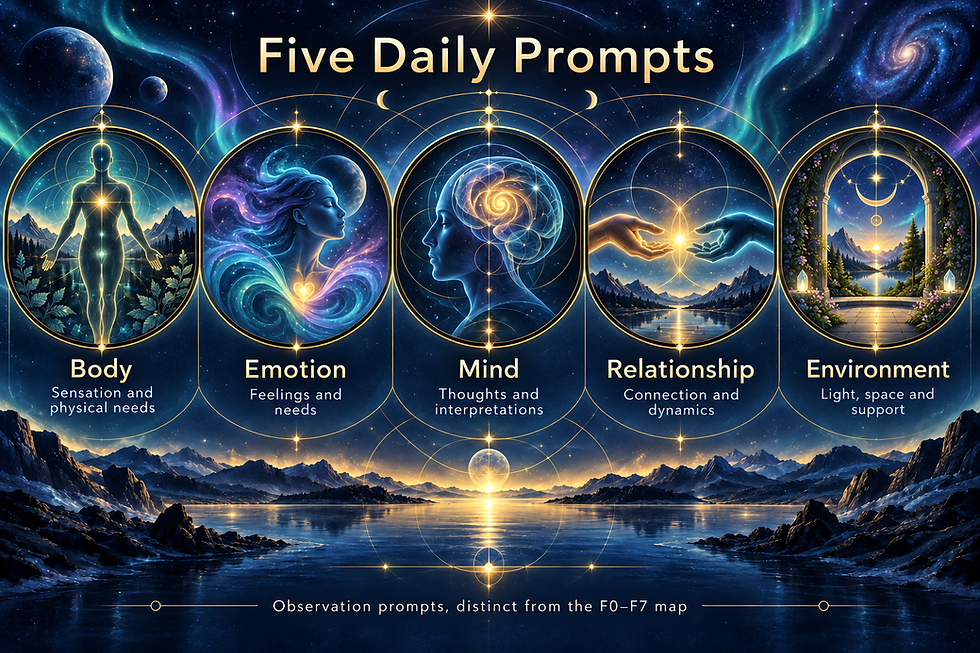
Use the Signal Field Logbook’s five daily observation fields: Body, Emotion, Mind, Relationship, and Environment.
Body
What is the body reporting?
exhaustion
tension
hypervigilance
collapse
nervous-system overload
Emotion
What feeling tone is active?
grief
fear
irritation
shame
openness
emotional constriction
Mind
What thought loop accompanies the emotion?
“I’m not enough.”
“I need to prove myself.”
“Something bad is about to happen.”
“Nobody understands me.”
Relationship
Which interactions or relationship dynamics accompany the pattern?
authority figures
emotional distance
criticism
unpredictability
emotional invalidation
Environment
What is happening in your surroundings when the pattern appears?
Notice noise, light, crowding, digital input, available privacy, and the pace of the space.
These observations can inform several layers of the F0–F7 map. Add symbols, dreams, or recurring images as an optional reflection alongside the five daily fields.
Emotional Mapping Is Not Self-Attack
This practice is not about pathologizing yourself.
The goal is not:
“What is wrong with me?”
The goal is:
“What is repeating, and what is the pattern trying to reveal?”
There is a major difference.
Shame freezes awareness.
Observation creates movement.
A pattern observed clearly loses some of its unconscious control.
Environmental Emotional Mapping
Environments also influence emotional patterns.
Some spaces create regulation.
Some create overstimulation.
Some create contraction.
Some create clarity.
Track how your emotional state changes around:
clutter
noise
digital overload
crowds
certain rooms
certain lighting
nature
social media
work environments
silence
specific music
symbolic objects
You may discover:
“My emotional reactivity increases after too much information exposure.”
Or:
“I regulate faster near water.”
Or:
“Certain environments keep my nervous system in defense mode.”
This is not imagination.
Systems respond to conditions.
Emotional Patterns and Compatibility
Some emotional patterns are reinforced through incompatible relational systems.
For example:
A person seeking emotional safety may repeatedly enter emotionally unpredictable environments.
A person seeking validation may repeatedly enter conditional relationships.
A person afraid of abandonment may overextend themselves emotionally to prevent disconnection.
Compatibility matters because relational systems amplify emotional patterns already active inside the field.
Some environments stabilize the nervous system.
Some continuously destabilize it.
Mapping emotional compatibility is part of emotional coherence.
The Goal Is Recognition Before Reaction
Emotional Pattern Mapping strengthens one critical ability:
Recognizing the pattern before fully entering it.
This may look like:
noticing activation earlier
pausing before reacting
identifying the emotional tone quickly
detecting familiar thought loops
recognizing nervous-system escalation
seeing relational repetition
interrupting automatic behavior
Awareness creates interruption points.
And interruption points create choice.
Emotional Patterns Often Carry Intelligence
Not every emotional pattern is distortion.
Some patterns are protective adaptations.
Some were survival responses.
Some were attempts to create safety, belonging, control, or stability during difficult conditions.
The problem begins when an old survival strategy continues running inside conditions where it no longer serves the system.
For example:
Hypervigilance may once have protected you.
Emotional shutdown may once have reduced pain.
People-pleasing may once have prevented conflict.
Perfectionism may once have created safety.
Pattern Mapping helps distinguish between:
protective adaptation
present necessity
unconscious repetition
That distinction matters.
Beginner Emotional Mapping Questions
Start simple.
At the end of the day, ask:
What emotion showed up most strongly today?
What triggered it?
What body sensation accompanied it?
What thought repeated with it?
What behavior followed it?
What environment intensified it?
What helped regulate it?
Does this pattern feel familiar?
When have I felt this before?
What might this emotion be trying to protect?
You are not trying to diagnose yourself.
You are learning to read the signal.
Example Entry
Emotional Tone:
Pressure and emotional fatigue.
Body Signal:
Chest tightness and shallow breathing.
Trigger:
Feeling responsible for too many things at once.
Thought Loop:
“If I slow down, everything will fall apart.”
Behavioral Pattern:
Overworking and emotional withdrawal.
Environmental Influence:
Too much digital noise and no recovery time.
Pattern Recognition:
This feels similar to earlier periods where I carried excessive responsibility.
Stabilizing Action:
Reduce input, simplify tasks, and create one uninterrupted quiet hour.
This is Emotional Pattern Mapping in practice.
Simple. Structured. Observable.
Patterns Change Through Repeated Awareness
Most patterns do not disappear instantly.
They reorganize gradually through repeated recognition, regulation, and intentional interruption.
Every time you:
identify the pattern sooner
regulate instead of escalate
choose differently
leave an incompatible environment
challenge a thought loop
create nervous-system safety
stop reinforcing an old cycle
…the field changes slightly.
Over time, those small changes become structural.
The Larger Philosophy
Emotional Pattern Mapping is not about eliminating emotion.
It is about understanding emotional architecture.
Your emotions are not random punishment.
They are part of a signaling system carrying information about memory, safety, perception, environment, compatibility, and unresolved structure.
When emotional patterns remain unconscious, they repeat automatically.
When they become visible, the system gains the possibility of reorganization.
That is the purpose of the map.
Not perfection.
Recognition.
Because once the pattern becomes visible, the field no longer has to repeat it blindly.
🜂🜄🜁🜃
Architect





Comments