


Environment + Meaning

Updated: 3 days ago

How Space and Interpretation Shape the Field
The pattern does not live inside us alone.
What repeats in us is often shaped by what surrounds us and what we believe it means.
The room.
The feed.
The lighting.
The sound.
The pace.
The person.
The silence.
The symbol.
The routine.
The story.
These are not separate from the pattern.
They help shape it.
Environment + Meaning is a practical lens for the conditions around a pattern and the stories woven through it. It can connect several F0–F7 perspectives without becoming another numbered layer.
It shows us that the field is not built only from body, emotion, or thought.
It is also built from context and interpretation.
A cluttered space can reinforce friction.
A chaotic feed can reinforce urgency.
A quiet room may help one person settle; another may need familiar sound or movement.
A harsh environment can keep the body braced.
A safe conversation can soften defense.
And meaning shapes the path too.
“This always happens.”
“I am too much.”
“I am not safe.”
“This proves something is wrong with me.”
“I have to handle this alone.”
The event may happen once.
But the meaning can keep repeating.
This is why environment and meaning matter.
The same pattern can be strengthened by both the environment around us and the interpretation inside us.
The space can influence what we expect and how much we have to manage.
The meaning tells the mind what the experience is.
Together, they help shape what becomes easier to repeat.
Environment + Meaning asks:
What space supports this pattern?
What input reinforces it?
What story keeps attaching to it?
What interpretation keeps making the pattern feel true?
What would create a more coherent field?
The goal is not to blame the room.
The goal is not to blame the mind.
The goal is to read the architecture more clearly.
Because once we can see what the environment is teaching and what the meaning is organizing, the pattern becomes easier to work with.
The Field Is Not Only Internal

A pattern does not happen in a vacuum.
It happens somewhere.
In a room.
Inside a conversation.
Under a deadline.
In a family system.
At work.
On a feed.
In a cluttered space.
In a quiet space.
In a body that has not rested.
In a rhythm that keeps repeating.
We often treat our reactions as purely internal.
As if the whole pattern lives only inside our personality, mindset, discipline, or emotional history.
But field reading shows something wider.
Conditions participate.
Sound, light, pace, people, expectations, routines, and digital input can all be part of the experience.
The environment may not create the entire pattern.
But it can amplify it.
It can reduce it.
It can make it easier to repeat.
It can make it easier to interrupt.
This layer asks us to stop isolating the person from the field they are inside.
Sometimes the question is not only:
“What is wrong with me?”
Sometimes the better question is:
“What field am I inside right now?”
For ADHD, autistic, and AuDHD readers, a useful environment may include movement, familiar objects, visible reminders, or a chosen sound. Burnout and grief can change those needs. Begin with what supports you now.
What the Environment Invites

Repeated conditions can shape expectations.
A noisy space may feel demanding or energizing, depending on the person and moment.
A fast-moving feed may keep attention shifting.
Visible objects may create friction or help you remember what you need.
A rushed schedule may leave little room to recover.
A conflict-heavy group may make connection feel costly.
A comfortable room may offer a place to settle.
A clear routine may teach the system that it does not have to hold everything at once.
A safe conversation may teach the body that truth does not always lead to punishment.
This is not weakness.
It is responsiveness.
We meet the field through our own histories, senses, and needs.
Environment + Meaning helps us notice what a setting repeatedly asks of us.
Some spaces say:
Hurry.
Perform.
Defend.
Scan.
Do not relax.
Stay useful.
Do not need anything.
Other spaces say:
Breathe.
Pause.
You can hear yourself here.
You do not have to perform.
There is room to return.
The environment does not have to be perfect.
But it matters.
An interpretation may be incomplete, but it may also identify a real problem. Meaning work should leave room for evidence, practical help, and changes outside you.
Meaning Tells the Field What the Experience Is

Environment shapes the conditions.
Meaning shapes the interpretation.
Meaning is the story the system attaches to experience.
The same event can become several different patterns depending on the meaning attached to it.
A delayed reply can mean:
“They are busy.”
Or:
“I am being ignored.”
A difficult conversation can mean:
“We are trying to understand each other.”
Or:
“This relationship is unsafe.”
A mistake can mean:
“I am learning.”
Or:
“I am failing.”
A boundary can mean:
“This is becoming clearer.”
Or:
“I am being rejected.”
A quiet room can mean:
“I can rest.”
Or:
“I am alone with too much.”
Meaning can influence the path the signal takes next.
The event matters.
But the meaning tells the field how to carry it.
This is why this layer is not only about outer space.
It is also about inner interpretation.
Environment and Meaning Reinforce Each Other

Environment and meaning often work together.
A messy room can become:
“I am behind.”
A slow reply can become:
“I am unwanted.”
A stressful workplace can become:
“I have to stay constantly available.”
A tense family dynamic can become:
“I am only safe if I perform the right role.”
A social feed can become:
“Everything is urgent.”
A quiet morning can become:
“I have space to hear myself.”
A supportive group can become:
“My voice can exist here.”
The environment provides the condition.
Meaning gives that condition a story.
Then the story shapes the response.
This is how environment and meaning become powerful together.
A pattern can be reinforced from the outside and the inside at the same time.
The field says one thing.
The mind interprets it.
The body prepares for it.
The behavior follows.
Environment + Meaning asks:
What is the environment reinforcing?
What meaning is organizing the response?
The Feed Is an Environment

A digital feed is not just information.
It is an environment.
It has pace.
Tone.
Repetition.
Reward systems.
Emotional weather.
Conflict loops.
Comparison cues.
Urgency signals.
Identity pressure.
The feed becomes part of what we attend to, feel, and carry.
A chaotic feed can reinforce scanning.
A conflict-heavy feed can reinforce threat.
A comparison-heavy feed can reinforce shame.
A speed-driven feed can reinforce fragmentation.
A fear-heavy feed may leave you distressed or depleted.
A meaningful feed can support learning.
A well-curated feed can support coherence.
Environment + Meaning asks:
What do I come to expect while spending time here?
What meaning does it keep attaching to the world?
What emotional state does it make easier to repeat?
This is not about rejecting all digital spaces.
It is about reading them accurately.
A feed is not neutral if it repeatedly changes the field.
Rooms Carry Signal
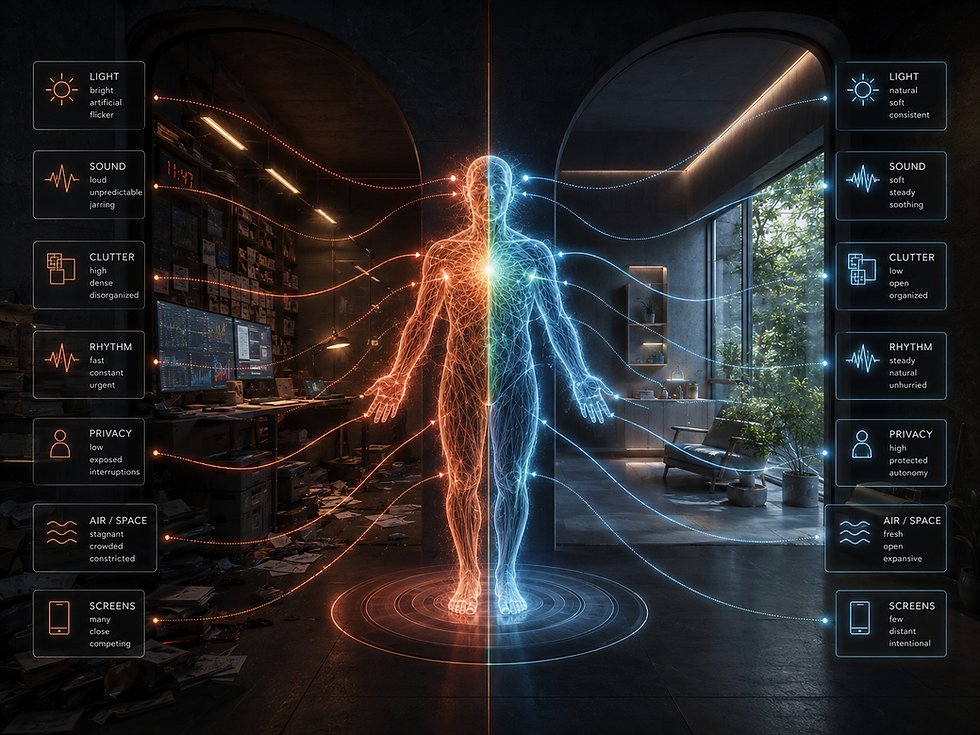
Rooms shape patterns too.
Through texture, rhythm, memory, and association.
A room can hold an atmosphere.
Light affects state.
Sound affects state.
Clutter affects state.
Air affects state.
Temperature affects state.
Objects affect memory.
Screens affect attention.
Privacy affects emotional safety.
A room can make a pattern louder.
A room can make a return easier.
This is why environment is part of field design.
A supportive space does not need a particular aesthetic.
It needs to support contact.
A clear surface.
A glass of water.
A window opened.
A softer light.
A chair that invites the body to settle.
A reduced sound field.
A place that reduces an unwanted demand.
A space that reminds you who you are becoming.
Small environmental shifts can give the body a different signal.
Environment + Meaning teaches us that coherence is not only internal effort.
Sometimes coherence begins by changing what the system keeps having to respond to.
Meaning Can Become a Trap

Meaning helps us organize experience.
But meaning can also trap the field.
A repeated meaning can become a fixed path.
“I am always the problem.”
“People always leave.”
“I cannot trust anyone.”
“I have to stay useful.”
“I am only safe when I am in control.”
“My needs are too much.”
“If I rest, I am failing.”
“If someone is upset, I have to fix it.”
These meanings may have formed for a reason.
They may have been protective.
They may have helped the system survive earlier fields.
But when a meaning becomes too rigid, it starts shaping every new experience into the old structure.
The present becomes filtered through the past.
New information gets ignored.
Old expectations keep winning.
This layer asks:
Is this meaning still current?
Is it complete?
Is it protective?
Is it too absolute?
Is it stabilizing the field?
Or is it keeping the pattern locked inside an old design?
Meaning Can Also Stabilize

Not all meaning distorts.
Some meaning stabilizes.
“This is uncomfortable. I can check whether I need time, support, or a way out.”
“This feeling is real, but it is not the whole truth.”
“A boundary can clarify a relationship. I can ask what this one means.”
“A pause may have several explanations.”
“This mistake is information.”
“This rest is part of the system.”
“This conversation is hard, but it can still be honest.”
“This pattern is familiar. I can look for support with what comes next.”
A stabilizing meaning does not deny reality.
It gives the field a clearer way to carry reality.
This matters because the goal is not to invent pleasant interpretations to avoid discomfort.
The goal is to find meanings that are accurate enough, honest enough, and coherent enough to help the system respond better.
Meaning architecture asks for honesty.
A story that can make room for new information.
The meaning attached to an experience becomes the shape through which the signal travels.
How to Read Environment + Meaning

When useful, choose one question:
What environment am I in?
What conditions are shaping this state?
What input keeps repeating?
What does this space do to my body?
What does this field reward?
What does this field make harder?
What meaning did I attach to the experience?
Is that meaning current?
Is it inherited?
Is it protective?
Is it incomplete or no longer helpful?
What meaning would be more honest and coherent?
What environmental adjustment would support a better response?
You do not need to answer every question at once.
Start with the clearest signal.
Sometimes the environment is loudest.
Sometimes the meaning is loudest.
Sometimes the two are reinforcing each other.
The point is to read both.
Environment + Meaning in a Field Map

One possible map may look like this. These are connected observations, not a required sequence or replacement for the F0–F7 map.
Body Signal:
Tight chest and restless hands.
Emotion:
Anxiety and pressure.
Thought:
“I am behind.”
Environment:
Messy room, open tabs, constant notifications, no clear stopping point.
Meaning:
“If everything is not handled right now, I am failing.”
Behavior:
Rushing, scrolling, avoiding the hardest task, then feeling more behind.
Response:
Close unnecessary tabs.
Make one needed item easier to reach.
Write down one next step, or ask someone to help.
Let breathing remain comfortable and natural.
Attach a new meaning: “I do not have to solve everything at once. I can make one coherent adjustment.”
This is Environment + Meaning.
The environment is not blamed.
The meaning is not shamed.
They are read.
Reading them may reveal an adjustment, a need for accommodation, or a condition you cannot change alone.
Redesigning the Environment

Environment does not need a total overhaul to change the field.
Small shifts matter.
Turn down the volume.
Adjust ventilation if comfortable and possible.
Clear one surface.
Move to another space if accessible.
Close the feed.
Put the phone across the room.
Add water.
Change the lighting.
Create a start ritual.
Create a stopping ritual.
Remove one repeated trigger.
Add a cue you find supportive.
Choose one room or corner that helps the body return.
The goal is not to create a perfect environment.
The goal is to identify support that fits the person. Work, housing, money, disability, and other people's choices can limit what is possible; that is not a failure of coherence.
Environment + Meaning teaches that environment is not decoration.
It is scaffolding.
Reworking the Meaning

Meaning can also be redesigned.
Not by lying to ourselves.
Not by bypassing pain.
Not by pretending everything is fine.
But by asking whether the current meaning is complete.
A meaning shift might sound like:
Old meaning: “This discomfort means I am failing.”
New meaning: “This discomfort deserves attention. I may need rest, support, a different approach, or a change in conditions.”
Old meaning: “Their silence means rejection.”
New meaning: “Silence is information, but not enough information to become a conclusion.”
Old meaning: “Rest means I am falling behind.”
New meaning: “Rest is a need. I do not have to earn it through productivity.”
Old meaning: “I have to handle this alone.”
New meaning: “I can ask for clarity before carrying the whole field by myself.”
A new meaning does not erase the original signal.
It gives the signal a more coherent pathway.
Small Environment + Meaning Adjustments

When environment and meaning are active, small adjustments can help.
Change one environmental cue.
Reduce one source of noise.
Name the meaning attached to the pattern.
Ask if the meaning is current.
Ask what the environment is reinforcing.
Pause before turning a condition into a conclusion.
Move to a more supportive space.
Simplify the next step.
Create one visual cue for coherence.
Clean one surface.
Close one tab.
Step out of one field that is amplifying the pattern.
Choose one more accurate interpretation.
Environment + Meaning work is often quiet.
But quiet changes can alter the whole field.
Field Practice: The Environment + Meaning Check

If you have capacity, choose one ordinary repeated pattern.
Then ask:
What environment does this pattern usually appear in?
What does that environment do to my body?
What input keeps reinforcing the pattern?
What meaning keeps attaching to the experience?
Is that meaning accurate, partial, old, protective, or no longer helpful?
What condition could I change?
What interpretation could I update?
What small adjustment would make coherence easier?
One observation is enough. You can leave the map unfinished.
Just read the relationship between space and meaning.
That is the Environment + Meaning practice.
Field Echo Prompt

What environment keeps strengthening the same pattern?
What meaning keeps making the pattern feel true?
What would change if you redesigned one condition…
and updated one interpretation?
The Larger Philosophy

The field gathers shape through both the world around us and the story glowing within it.
Environment offers conditions, possibilities, and limits.
Meaning gathers experience into a story.
Together, they shape the path the signal takes next.
This is why field work is not only inner work.
And it is not only outer design.
It is the relationship between condition and interpretation.
Between space and story.
Between what surrounds us and what we believe it means.
When environment becomes readable, we can name both its support and its strain.
When meaning becomes readable, a familiar story can open to another possibility.
Environment + Meaning teaches us to ask:
What is this field reinforcing?
What is this story organizing?
And what would help the pattern move through a more coherent design?
The pattern does not live inside us alone.
Neither does the return.
Work with the conditions around the pattern in a Structure Signal Calibration... a guided session with a written recap and personalized Logbook prompts to continue afterward.
🜂🜄🜁🜃
Architect




Comments