


Field States: State Is Information, Not Identity

Updated: Oct 25
Some days, everything seems to connect.
You can follow a conversation, move between responsibilities, and make decisions without having to rebuild your attention at every step.
A task begins when you expect it to. An interruption doesn't erase your place. You have enough room to respond to something unexpected without losing the rhythm of the entire day.
Other days, those same activities feel unusually difficult.
A simple message requires several attempts. Your attention keeps moving between unfinished responsibilities. One unexpected conversation changes the pace of everything that follows.
You know what needs to happen.
Your intentions haven't necessarily changed.
But the conditions you're operating within have.
Attention, energy, sensory input, expectations, and available support are interacting differently.
The pattern of the day has another shape.
It's easy to interpret that difference as a change in character.
I'm inconsistent.
I'm losing my discipline.
Why can't I function the way I did yesterday?
But the current arrangement may explain more than the judgment does.
A difficult state doesn't define who you are. It reveals something about the conditions you're moving through.
This is the central principle of Field States.
State is information, not identity.
Before the Label, See the Configuration

We often describe people through the behavior we can observe.
Someone is scattered.
Someone is disengaged.
Someone is productive.
Someone is calm.
Someone is inconsistent.
These descriptions can begin as observations and quietly become identities.
A person struggles to concentrate, and the difficulty becomes a statement about their attention.
Someone withdraws from conversation, and the silence becomes a judgment about their interest.
An exhausted person misses a responsibility, and the moment becomes evidence of who they supposedly are.
But behavior emerges within conditions.
Imagine trying to complete an important task after interrupted sleep, in a noisy environment, while several other responsibilities remain unfinished.
Your attention may become fragmented.
Now imagine approaching the same task after adequate recovery, with clearer expectations and fewer competing demands.
The experience may look entirely different.
Your underlying knowledge hasn't necessarily changed.
The surrounding arrangement has.
In Signal Field Architecture, a Field State describes the current configuration of a person, activity, relationship, or system.
It helps us examine how several conditions are interacting at a particular time.
The amount of activation.
The demands being carried.
How well activities are coordinated.
Whether information and support can move where they're needed.
What boundaries are available.
And whether the pattern is temporary or becoming familiar.
These dimensions don't produce a diagnosis or a permanent classification.
They help us describe what is happening closely enough to choose a more appropriate response.
Before deciding what someone needs to become, understand what they're currently trying to operate within.
Stability Can Move

A living system doesn't remain functional by becoming perfectly still.
The body continually adjusts.
Temperature changes.
Circulation responds to different demands.
Breathing varies with activity.
Internal regulatory processes work to maintain viable conditions while the environment changes.
Physiology describes some of these processes through homeostasis and allostasis.
The details matter scientifically, but one important distinction carries into our philosophical inquiry.
Stability and motionlessness aren't the same.
In dynamical-systems research, organized patterns can persist while their components remain active. Researchers also distinguish different ways systems respond to disturbances, including resistance and recovery.
The same broad insight changes how we imagine coherence.
A person can be moving, emotional, creative, or intensely engaged while their activities remain well coordinated.
Someone else can appear completely still while experiencing considerable internal difficulty.
A familiar routine can remain supportive through small adjustments.
And a structure can become more resilient by allowing its responses to change.
Coherence isn't the absence of movement. It's the presence of relationships that can work together.
Nor does stability guarantee that an arrangement is healthy.
Some harmful patterns are remarkably persistent.
A person may repeatedly overextend themselves because everyone expects them to.
A team may maintain an inefficient process simply because everyone has become familiar with it.
An old identity role may remain stable long after its original purpose has changed.
The pattern holds.
Whether it still serves the people living within it is another question.
That distinction becomes especially important when examining the six Field States.
The Six Field States
Field States names six recognizable patterns of organization:
Coherent. Fragmented. Overloaded. Dormant. Transitional. Stabilized.
These aren't stages of personal development.
They aren't personality types or clinical measurements.
And they don't form a ladder with one ideal state at the top.
A person can experience several states across different parts of life.
Someone may have a stabilized work routine while feeling fragmented in their personal responsibilities.
A creative project may be dormant while relationships remain active and supportive.
An emotional transition may unfold alongside familiar routines that continue providing stability.
The purpose of the map is to recognize the arrangement and respond to what it needs.
Coherent: The Parts Can Work Together

A coherent state has enough coordination and support for the present demand.
Imagine preparing dinner while listening to music.
You know what you're making. The ingredients are available, the next steps are familiar, and a small interruption doesn't cause the entire sequence to fall apart.
You might still be tired.
You may need to pause.
The activity may require effort.
But the relevant parts are working together well enough.
Coherence can also appear during demanding experiences.
A difficult conversation may remain coherent when people communicate clearly and respect boundaries.
Someone navigating grief may have enough support to manage an important responsibility without needing to suppress what they're feeling.
A person may concentrate better through movement rather than stillness.
Coherence doesn't require a perfect emotional state. It requires a workable relationship among the relevant parts.
When those relationships are supportive, participation may become easier.
And when the conditions change, the arrangement may need to change with them.
Fragmented: The Parts Are Competing
A fragmented state emerges when attention, information, needs, or activities are pulling in different directions.
Imagine working on a project while mentally tracking several other responsibilities.
An unfinished conversation keeps returning.
A notification interrupts your thought.
You remember another obligation just as you're beginning to concentrate.
Each demand might be manageable by itself.
Together, they make continuity difficult.
You begin something.
Lose your place.
Return.
And have to reconstruct where you were.
The difficulty may not be the individual activities.
It may be the lack of coordination between them.
Fragmentation can also occur in a team.
Several people understand their responsibilities, but information doesn't reliably move between them.
Work gets repeated.
Important details disappear during handoffs.
No single person is necessarily incapable.
The relationships between activities aren't functioning effectively.
Fragmentation doesn't mean the parts are broken. It means their connections deserve attention.
A useful adjustment might involve clarifying priorities, reducing interruptions, externalizing unfinished thoughts, or improving how information is handed from one person to another.
The response is directed toward coordination rather than judgment.
Overloaded: Demand Exceeds Available Support

An overloaded state occurs when current demands exceed the resources or support available to manage them comfortably.
Imagine entering a crowded store after a long day.
The lighting is uncomfortable.
Conversations overlap.
You're remembering what to buy while managing fatigue, time pressure, and several unfinished responsibilities.
Then someone asks another question.
The question is simple.
But the system receiving it is already carrying substantial load.
Overload can emerge through sensory input, emotional strain, information, responsibilities, or several demands interacting.
What makes this state particularly difficult is that adding effort may increase the burden.
Another reminder.
Another decision.
Another expectation to remain composed.
Another task to manage the existing tasks.
Sometimes the useful response is to reduce what the system is being asked to carry.
Lower the input.
Share a responsibility.
Change the environment.
Postpone a nonessential demand.
Or make practical support available.
Overload is information about the relationship between demand and capacity. It isn't proof that the person lacks ability.
Sometimes the conditions must become lighter before another strategy can become useful.
Dormant: Activity Has Quieted
A dormant state describes a pattern of reduced activation or activity within a particular area.
Imagine a creative project you haven't touched in several weeks.
The materials are still there.
The ideas may still matter.
But other parts of life have required your attention, and the project remains quiet.
Dormancy can describe waiting, conservation, rest, or a period when an ability or interest isn't being actively expressed.
Not everything needs to remain in motion.
A garden has seasons when little is visible above the soil.
An unfinished idea can remain meaningful without being actively developed.
A relationship can remain important during a quieter period of contact.
But low activity can also accompany exhaustion, illness, or difficulty accessing essential functions.
The meaning depends on the circumstances.
Sometimes rest is restorative.
Sometimes an important need is going unmet.
Sometimes support is necessary before activity can resume.
Dormancy isn't automatically stagnation. A pause can preserve something that continuous demand would exhaust.
The useful question is what the quiet period represents and whether it is supporting or restricting the life around it.
Not every dormant pattern needs to be reactivated.
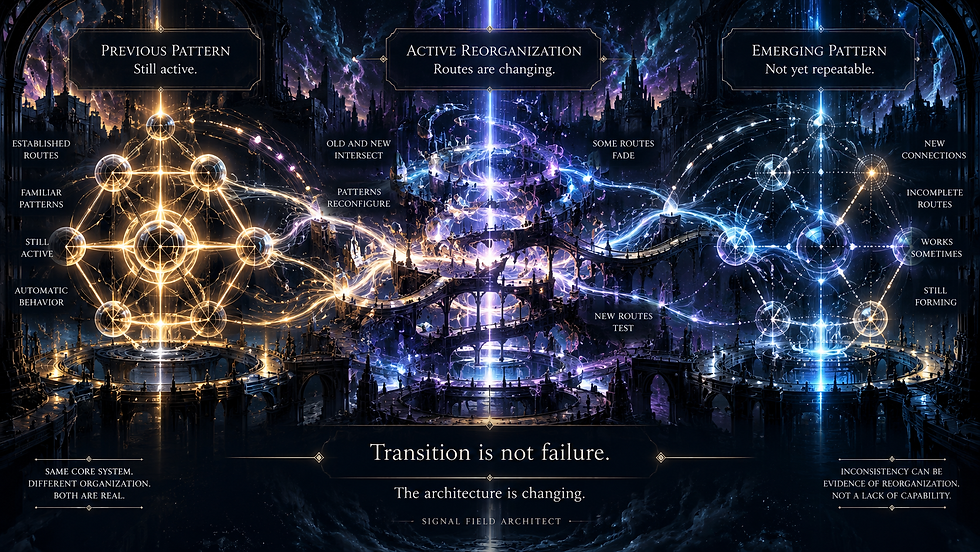
Transitional: The Arrangement Is Changing

A transitional state appears when an established pattern no longer fits but another arrangement hasn't yet become familiar.
Imagine changing your work schedule.
The previous routine disappears.
Your old habits still activate at familiar times.
The new schedule works some days and feels difficult to manage on others.
You understand the change intellectually.
But your everyday systems are still adjusting.
Transitions can appear through new responsibilities, relationships, environments, routines, and forms of identity.
A familiar way of living may become less workable before another has fully developed.
That period can feel inconsistent.
Something works one day and fails the next.
An earlier expectation continues influencing a situation that has already changed.
An old role remains recognizable, even as the person begins living differently.
Transition is the space where familiar structure and emerging possibility coexist.
It may require preserving useful supports while allowing new arrangements to develop.
Sometimes that means smaller experiments.
Clearer expectations.
More recovery between changes.
Or patience with a process that hasn't become repeatable yet.
A transitional state can contain uncertainty and meaningful movement at the same time.
Not everything unfinished is failing.
Stabilized: The Pattern Has Become Repeatable
A stabilized state describes an arrangement that persists across time or similar circumstances.
Imagine developing a reliable routine for preparing for work.
The necessary materials have familiar places.
The sequence requires fewer decisions.
Interruptions are easier to manage because you know where to return.
Over time, the pattern becomes repeatable.
The structure supports continuity.
But stabilization can occur around less helpful arrangements, too.
Someone may reliably sacrifice their recovery time to meet every expectation.
A relationship may repeatedly return to the same unresolved conflict.
A team may preserve an inefficient process because it has become familiar.
The pattern is stable.
Its consequences may still be costly.
This is the distinction between stabilization and coherence.
Stabilization tells us that a pattern holds. Coherence asks how well its parts are working together.
A stabilized arrangement may be supportive, restrictive, or somewhere between the two.
And it may change when the surrounding conditions change.
Stability isn't a guarantee of permanence.
It gives us an opportunity to ask whether the pattern is worth preserving, adjusting, or allowing to evolve.
One Project, Six Different States

Consider the same unfinished project across several days.
On Monday, the next steps are clear. You have enough time, the materials are ready, and interruptions are manageable.
The activity is relatively coherent.
On Tuesday, several responsibilities begin competing for attention. You keep switching between them and losing your place.
The work becomes fragmented.
On Wednesday, poor sleep combines with unexpected demands. Even opening the project feels like more than you can manage.
The system is overloaded.
On Thursday, you leave the project alone and use the available time for recovery.
Activity around the project becomes dormant.
On Friday, you try a different workflow. The new arrangement feels unfamiliar, but some parts are beginning to work better.
The pattern is transitional.
Over the following weeks, the new process becomes more dependable.
The arrangement has stabilized.
The project didn't necessarily become six different kinds of work.
And the person didn't become six different identities.
The conditions changed.
The available support changed.
The relationship between the activity and the person changed.
Different responses became useful at different times.
Monday's strategy might have added pressure on Wednesday.
Thursday's rest might have been unnecessary on Monday.
Friday's experimentation might have been difficult without the recovery that came before it.
The same activity can require a different kind of support when the state surrounding it changes.
State Changes What a Strategy Can Do

Imagine creating a detailed planning system.
It contains priorities, reminders, categories, color codes, and a schedule for reviewing everything.
When you have enough capacity, it may provide useful structure.
But during overload, maintaining that system could become another responsibility.
The planning tool hasn't necessarily become ineffective.
The cost of using it has changed relative to what is available.
The same principle applies to many familiar strategies.
When an activity is fragmented, clarifying priorities or creating a reliable handoff may help.
When it is overloaded, reducing demands may matter more than introducing another technique.
When something is dormant, the question may be whether it needs to become active at all.
During transition, flexibility and experimentation may be more useful than rigid consistency.
When a pattern is stabilized, we can examine whether its persistence is actually serving its purpose.
And in a coherent state, there may be room to build, participate, and expand without losing the support that makes the activity workable.
The strategy isn't automatically right or wrong.
Its usefulness depends partly on the state in which it's being applied.
Notice the state. Understand the demand. Choose the response.
Sometimes that response involves action.
Sometimes simplification.
Sometimes recovery.
Sometimes allowing a meaningful activity to wait until its entrance becomes more accessible.
And sometimes the important change needs to happen in the surrounding structure rather than within the individual.
State Is Not the Whole Person

This distinction matters especially when exploring neurodivergent experience.
Someone may have well-developed abilities that become difficult to access under particular conditions.
Sensory input may interfere with concentration.
Unexpected transitions may make familiar tasks harder to enter.
Social adaptation may consume attention that would otherwise remain available.
Prolonged exhaustion may change how much someone can manage.
The visible result can look inconsistent.
But the state may explain part of the difference.
This is why the language we use matters.
"I'm scattered."
May become:
"My attention is fragmented under these conditions."
"I'm bad at this."
May become:
"This process has too many competing demands right now."
"I'm not functioning."
May become:
"The support available today doesn't match what I'm being asked to do."
These alternatives don't automatically solve the difficulty.
They make the difficulty more specific.
They reveal relationships we can examine.
Sometimes an adjustment becomes possible.
Sometimes the circumstances remain restrictive and additional support is needed.
Either way, a changing state doesn't need to become a judgment about a person's worth or entire capacity.
For a fuller exploration, see Neurodivergent Signal: Ability Is Not the Same as Access.
You are more than the configuration required to get through one difficult moment.
Your abilities, relationships, history, and meaning extend beyond what happens to be accessible today.
The F0–F7 Layers Behind a State
A Field State gives us a broad view of the current arrangement.
The F0–F7 Layer Map can help us examine where particular relationships are taking shape.
At F1 Emotion Signal, we can notice the emotional tone of the experience.
Urgency.
Frustration.
Anticipation.
Grief.
Relief.
Or the absence of a clear emotional response.
What is present, and what does it require?
At F2 Perception Signal, we can examine how the situation is being interpreted.
Which demands seem most urgent?
What stands out?
What expectations are shaping the experience?
Is a temporary difficulty being interpreted as a permanent failure?
At F5 Structure Signal, we examine the routines, boundaries, tools, relationships, and environmental conditions influencing the response.
Where are the interruptions?
What support is missing?
Which processes are creating unnecessary effort?
What can be changed without requiring the person to carry more?
These layers aren't separate compartments.
Emotion can influence interpretation.
Interpretation can influence action.
And structure can change what becomes possible.
The state gives us a temporary view of those relationships.
The wider architecture continues beyond the moment.
A state describes the present arrangement. The field includes the relationships through which that arrangement can change.
Field Practice: State Before Strategy

Choose one area of life that has felt different recently.
It could involve work, communication, relationships, a creative project, daily responsibilities, or a personal practice.
Before deciding what you should do about it, describe the current state.
You can begin with six observations.
Activation: Do I feel mobilized, restless, tired, quiet, or relatively steady?
Load: How much sensory input, responsibility, uncertainty, or unfinished material am I carrying?
Coordination: Are the relevant parts working together, or are they competing?
Connection: Can I access the information, communication, or support I need?
Boundary: Is the current arrangement allowing too much demand to enter at once? Is something important being kept out?
Repeatability: Is this a passing experience, or does a similar pattern keep returning?
You don't need to answer all six questions.
Choose the one that helps you understand the moment.
Then consider which Field State seems most useful for describing the situation.
Coherent.
Fragmented.
Overloaded.
Dormant.
Transitional.
Stabilized.
More than one may apply.
The description is a starting point, not a verdict.
Now ask:
What response fits this state better than the one I was trying to force?
Perhaps the answer is a clearer first action.
A reduced demand.
Help from another person.
Fewer interruptions.
A different environment.
Permission to rest.
Or time for an unfamiliar arrangement to become more workable.
If an adjustment is available, try it and notice what changes.
If nothing can be changed immediately, recognizing the state can still clarify what support is missing.
You can record one sentence in the free Signal Field Logbook.
"The task wasn't unclear. I was carrying too many competing demands."
Or:
"This routine is stable, but it requires more effort than I can sustain."
A few words may be enough to preserve the pattern for another day.
A Pattern Can Hold Without Becoming Permanent

Some patterns persist for a long time.
Others hold only briefly.
In scientific research, concepts such as metastability and multistability describe particular forms of organization in defined systems.
They help demonstrate that persistence, stability, and change aren't always opposites.
The six Field States remain a symbolic and practical framework rather than a scientific taxonomy derived from those models.
But the philosophical insight matters.
Something can become organized without becoming finished.
A routine can remain familiar while its circumstances evolve.
A relationship can preserve continuity through changing expectations.
A person can experience a recognizable emotional pattern without being confined to it forever.
Some structures endure because they remain supportive.
Others endure because repetition has made them familiar.
And some begin changing when a different relationship becomes possible.
Within the Aurora Continuum, continuity doesn't require every arrangement to remain unchanged.
Memory can preserve a recognizable thread while its meaning evolves.
Identity can remain connected across different roles, capacities, and seasons of life.
A person may recognize something essential about themselves even as the circumstances surrounding their expression change.
The form moves.
The relationships reorganize.
The unfolding continues.
A familiar state is part of your history. It doesn't have to become the boundary of your future.
The State Is Part of the Signal
Field States gives us another way to encounter the moments when life feels unexpectedly difficult or unusually accessible.
We can look beyond the outcome.
We can examine the conditions that shaped it.
The load.
The coordination.
The connections.
The available support.
The expectations that have become familiar.
Sometimes the most meaningful response is to change what we're doing.
Sometimes it's to change how we're doing it.
And sometimes it's to recognize that the present moment requires something different from the one before it.
There may be a season for building.
A season for recovery.
A transition that needs time.
A stable pattern worth preserving.
Or an old arrangement that can finally begin changing.
No single state contains the entire story.
The field remains in motion.
And wherever meaningful participation is possible, understanding the current arrangement can help us choose how to meet what comes next.
The state is not the verdict. It is part of the information.
You are not only what today's conditions allow you to express.
You are also the history, relationships, possibilities, and emerging forms that continue beyond them.
The architecture is larger than this moment.
And this moment is still part of what can be shaped.
🜂🜄🜁🜃
Architect






Comments