


Nested Realities: Dimensional Map

Updated: 3 days ago
Understanding the F0–F7 Field Model as a Layered Map of Consciousness

Consciousness is layered.
Your emotions, thoughts, sensations, choices, dreams, memories, relationships, and symbolic patterns do not exist in isolation.
They echo through nested fields.
A physical sensation may connect to an emotional state.
An emotional state may connect to a thought pattern.
A thought pattern may connect to an old identity story.
A relationship conflict may reveal an archetypal pattern.
A dream may carry a signal your waking mind has not yet organized.
A collective event may activate something personal before you know why.
This is why Signal Field theory uses a dimensional map.
The goal is not to turn every experience into a complicated theory.
The goal is to make the invisible structure of experience easier to read.
The F0–F7 Field Model is a practical reflection tool for tracking the layers of your field: what is active, what is looping, what is stabilizing, what is distorting, and what is trying to reorganize underneath the surface.
It is not just a journal system.
It is a field mirror.
Each entry gives you a snapshot of your multidimensional resonance field.
Not because you are trying to control every layer.
Because you are learning how to listen with more precision.
This is the scaffolding of inner architecture.
Why a Dimensional Map Matters

Most people experience life as a single stream.
Something happens.
You feel something.
You think something.
You react.
Then you move on.
But underneath that sequence, several layers may be active at once.
The body may be bracing.
The emotional field may be grieving.
The mind may be explaining.
The relationship field may be mirroring an old pattern.
The symbolic layer may be repeating through dreams, images, songs, or synchronicities.
The identity layer may be trying to update.
The collective field may be amplifying pressure.
When all of that gets blurred together, it is easy to misread the signal.
You may think the issue is discipline when the body is overloaded.
You may think the issue is motivation when the emotional field is unresolved.
You may think the issue is a person when the real pattern is relational repetition.
You may think the issue is confusion when the old identity structure is breaking down.
This is why the map matters.
It separates the layers enough to make them readable.
A dimensional map does not remove mystery.
It gives mystery a structure.
F0–F7: The Current Layer Map
The Layer Map offers eight connected perspectives on experience. They are places to begin a reflection, not ranks or a fixed sequence everyone must complete. Body sensations, memories, and relationships can inform several layers. Illustrations of these everyday experiences show what you might notice; their unnumbered labels are not additional F-layers.
F0: Void Signal
Begin with the pause before an explanation takes shape. Notice what is present and what remains uncertain. You can leave a question open while gathering more information. Ask: what can I observe before deciding what this means?
F1: Emotion Signal
Name the feeling and the urge that comes with it. Worry may bring an urge to seek reassurance; anger may bring an urge to act immediately. Notice the charge without treating it as your identity. Ask: what am I feeling, and what response would fit the situation?
F2: Perception Signal
Separate the event from your interpretation. An unanswered message is observable; the belief that someone is rejecting you needs checking. Ask: what happened, what story am I adding, and what could change that reading?
F3: Identity Signal
Explore the role or self-story that repetition makes familiar. Being dependable can become a rule that you must always say yes. Ask: what role am I rehearsing, and where could I respond with more flexibility?
F4: Archetypal Signal
Use a symbolic theme such as Protector, Seeker, or Architect as a flexible mirror for a recurring role. A symbol can help you ask a question; it does not establish another person's motives or a hidden fact. Ask: what theme helps me understand this pattern without fixing me inside it?
F5: Structure Signal
Examine the habits, tools, environments, schedules, and agreements that support repetition. A clearer deadline or a visible limit on capacity may help more than another promise to try harder. Ask: what condition can I change to support a different response?
F6: Dimensional Signal
Widen the view to family expectations, community, culture, work, and patterns across life chapters. Use known context and leave uncertain connections open. Ask: what larger conditions influence this situation, and which part is within my reach?
F7: Source Field Signal
Open the question of Source: the origin, ground, or deeper unity of existence. Let that mystery meet ordinary life through a guiding value and an action. Ask: what do I sense as fundamental, and how might I live in relationship with it?
Choose the perspective that makes the situation clearer. A body observation belongs in your notes without becoming a separate numbered layer. A memory or relationship can connect emotion, perception, identity, and context at once.
How the Layers Interact

The layers do not operate separately.
They echo.
An interpretation at F2 may be shaped by an earlier experience; compare it with what is happening now.
A disagreement may involve an F2 interpretation, an F3 role, and an F5 agreement that needs changing.
A body sensation can accompany an F1 emotion while wider F6 conditions help explain the pressure.
A change in an F3 self-story may alter how you respond to an F1 emotion.
An image from a dream may offer an F4 reflection on a familiar F3 role; its meaning remains open to interpretation.
Without a map, all of this becomes blurred.
With the model, the pattern becomes easier to read.
This is one of the core principles of Signal Field theory:
the layer where a signal appears is not always the layer where it began.
A tight chest may look physical, but it may connect to emotional pressure.
A relationship conflict may look interpersonal, but it may connect to an old identity role.
A dream may look random, but it may connect to symbolic memory.
A thought loop may look mental, but it may be driven by nervous-system activation.
A collective event may look external, but it may activate personal grief, fear, anger, or purpose.
The map helps you stop fixing the wrong problem.
When you locate the right layer, the response becomes more coherent.
From Map to Practice
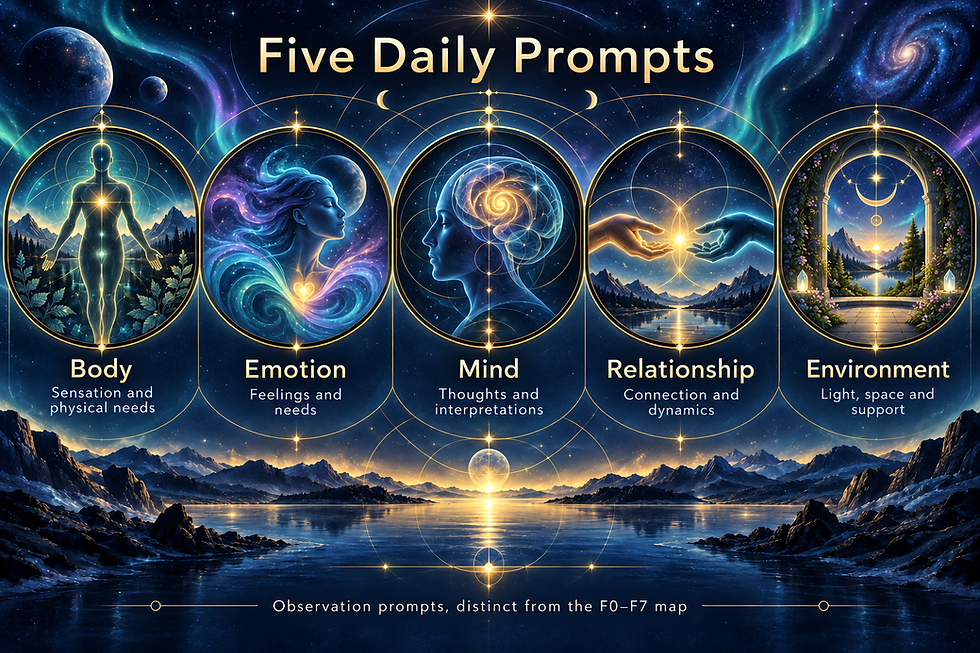
The F0–F7 model can also be used as a daily reflection tool through the Signal Field Logbook.
The Logbook begins with five daily observation prompts. From there, the F0–F7 map can help you explore the pattern in more depth.
Begin with the five daily prompts:
Body
Emotion
Mind
Relationship
Environment
Memories, identity stories, and the wider collective context can enter through any of these observations. Dreams and symbols have their own optional space in the Logbook.
The five prompts are doorways into the day, distinct from the numbered F0–F7 layers.
This helps you notice which layers are active, where distortion is showing up, and what small adjustment may restore coherence.
But the Logbook is its own practice.
This article is the map.
The Logbook is how you walk it.
For the full daily method, use the dedicated guide:
Field Reflection

Which perspective makes your experience clearer: pause, emotion, perception, identity, archetype, structure, wider context, or your relationship with Source?
Which layer do you usually ignore?
Where might a current problem be misread because you are interpreting it from the wrong layer?
What pattern becomes clearer when you separate the field into F0–F7?
What small adjustment would bring one layer back into coherence today?
The Larger Philosophy

Nested Realities begins with a simple recognition:
You are not one flat self.
You are a layered field.
Your body carries signal.
Your emotions carry signal.
Your thoughts carry signal.
Your relationships carry signal.
Your memories carry signal.
Your identity carries signal.
Your collective environment carries signal.
When these signals collapse into one undifferentiated experience, life feels confusing.
When they are mapped, the pattern becomes readable.
The F0–F7 model is not meant to trap you in analysis.
It is meant to give your becoming a structure.
A map does not walk the path for you.
But it helps you see where you are.
And sometimes that is the first act of coherence.
🜂🜄🜁🜃
Architect




Comments