


Building A Personal Resonance Practice

Updated: 2 days ago

How to Create a Daily System for Stability, Clarity, and Signal Awareness
A personal resonance practice does not need to be complicated.
It does not need to look mystical.
It does not need to take an hour.
It does not need perfect silence, perfect discipline, or perfect belief.
It only needs one thing:
A repeatable way to return to yourself.
Most people move through the day absorbing signals without realizing it. They pick up emotional residue from conversations, pressure from digital spaces, tension from unfinished tasks, noise from their environment, and old patterns from memory.
By the end of the day, they may feel scattered, heavy, reactive, or disconnected without knowing why.
A personal resonance practice gives you a structure for noticing what entered your field, what shifted your state, what stabilized you, and what needs to be cleared before it becomes a pattern.
Resonance practice is not about escaping life.
It is about learning how to stay coherent inside it.
Resonance Practice Is Not Performance
The first principle is simple:
Your practice should support your life, not become another system you use to judge yourself.
A resonance practice is not a spiritual performance. It is not about proving discipline. It is not about appearing calm, enlightened, healed, or perfectly aligned.
It is a daily structure for asking:
What is active in my field?
What is affecting my signal?
What needs attention?
What supports coherence?
What can be released?
What pattern is repeating?
The practice is not the goal.
Coherence is the goal.
The practice is simply the pathway.
Start With the Field You Already Have
Many people delay starting because they think they need the right tools first.
A better journal.
A quieter room.
A cleaner house.
A full routine.
A candle.
A playlist.
A perfect morning.
But resonance practice begins exactly where you are.
With the body you have.
The emotions present today.
The room you are sitting in.
The unfinished thoughts already looping.
The environment already influencing you.
You do not build coherence by waiting for perfect conditions.
You build coherence by learning how to notice the conditions you are already inside.
The Core Purpose
A personal resonance practice helps you develop three abilities:
Recognition
You learn to notice what is happening before it takes over.
Stabilization
You learn what helps your system return to steadiness.
Recalibration
You learn how to make small adjustments that shift the direction of the day.
That is enough.
You are not trying to fix every pattern immediately. You are building a relationship with your own signal.
The Three-Part Practice
A beginner resonance practice can be built around three simple phases:
1. Check the signal
What is active right now?
2. Clear the distortion
What needs to be released, named, moved, or simplified?
3. Choose the alignment
What small action supports coherence today?
This structure can take five minutes.
It can also become a deeper ritual when you have more time.
The point is repeatability.
Step One: Check the Signal
Start by pausing long enough to ask:
What is my field reporting?
Do not begin with analysis.
Begin with observation.
Notice:
body tension
emotional tone
mental noise
relational residue
environmental pressure
symbolic fragments
repeating thoughts
energy level
nervous-system state
You might write:
My body feels tense, my mind feels scattered, and I am still carrying yesterday’s conversation.
Or:
I feel calm, but there is a low pressure underneath the surface.
Or:
My signal feels fragmented after too much input.
This is not about judging the state.
It is about identifying it.
A signal named clearly becomes easier to work with.
Step Two: Clear the Distortion
Distortion is anything that disrupts your ability to sense clearly, respond cleanly, or remain connected to yourself.
Distortion can come from:
emotional overwhelm
unresolved conflict
digital overstimulation
clutter
fatigue
avoidance
resentment
unspoken truth
too much noise
pressure loops
old identity patterns
relational static
Clearing distortion does not always require a dramatic ritual.
Sometimes it is simple.
Drink water.
Clean one surface.
Step outside.
Breathe slower.
Write the unsaid sentence.
Move your body.
Turn off the feed.
Take a shower.
Name the feeling.
Set one boundary.
Stop responding while activated.
The point is not to erase discomfort.
The point is to reduce interference.
Step Three: Choose the Alignment
Alignment does not have to be huge.
It is the next coherent action.
Not the perfect life plan.
The next clean movement.
Ask:
What would help me return to coherence today?
Examples:
simplify the task list
answer one message honestly
rest before deciding
take ten quiet minutes
finish one small task
stop explaining myself to an incompatible field
journal before reacting
organize the workspace
walk outside
return to the body
choose clarity over urgency
Your alignment should be small enough to complete.
A personal resonance practice works best when it teaches your system that coherence is accessible.
Not theoretical.
Accessible.
The Daily Resonance Check-In
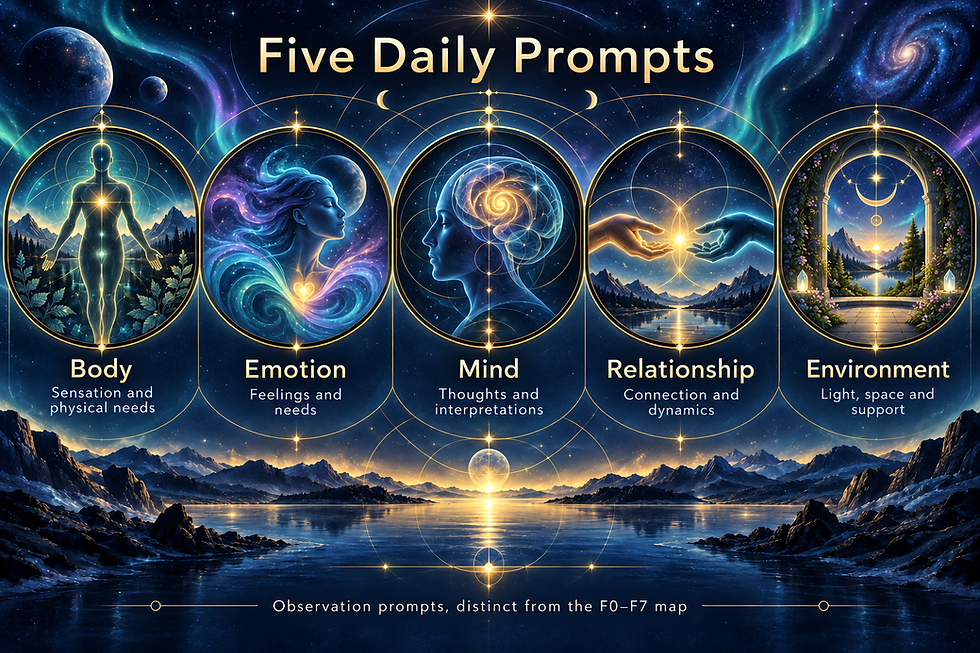
Use the Logbook's five daily observation prompts, then choose one small response. Add a symbol or dream fragment when it feels meaningful.
Body
What is my body reporting?
Emotion
What feeling is most active?
Mind
What thought keeps repeating?
Relationship
What interaction, connection, or boundary is staying with me?
Environment
What do I notice about the place, noise, light, digital input, or demands around me?
Alignment Choice
Where does the signal feel tangled, and what small action might create more room today?
This is enough for a daily practice.
You can use it in the morning, evening, or whenever your system feels overloaded.
Morning Practice
Morning resonance work helps you enter the day intentionally.
It asks:
What am I carrying into the day?
A simple morning practice might look like this:
Sit quietly for one minute.
Notice your body.
Name the emotional tone.
Identify one repeating thought.
Choose one stabilizing action.
Write one sentence of alignment.
Example:
Today my field feels slightly compressed. I will move slowly, avoid unnecessary conflict, and focus on one clear task at a time.
Morning practice creates orientation.
It keeps the day from being dictated entirely by incoming noise.
Evening Practice
Evening resonance work helps you review what the day revealed.
It asks:
What affected my field today?
A simple evening practice might look like this:
Notice what stayed with you.
Identify where you felt clear.
Identify where you felt distorted.
Track any repeated pattern.
Choose what needs to be released before sleep.
Example:
Today I noticed my signal dropped after too much scrolling, but stabilized after walking outside. Tomorrow I need less input before noon.
Evening practice builds pattern recognition.
It teaches you what your system responds to over time.
Use the Version 3 Logbook
Daily Observation on page 4 records body signal, emotional tone, mental loop, relational signal, and environmental influence. These observations can inform several layers. Use Daily Integration on page 5 to record your personal state, the repeated pattern, what shifted, what supported you, and one intention for tomorrow.
Choose a layer when it helps
Version 3 uses the current framework: F1 Emotion Signal, F2 Perception Signal, F3 Identity Signal, F4 Archetypal Signal, and F5 Structure Signal. Pages 8–12 offer a deeper worksheet for each. The daily observation fields gather material that can inform several layers; they do not assign body, emotion, mind, relationship, and environment to separate F-numbers.
F0 Void Signal offers a grounding pause. Page 13 includes that grounding practice and a brief F6 Dimensional Signal and F7 Source Field Signal preview of the planned Expanded Logbook. Choose the lens that helps this entry; completing every layer is not required.
Build a Practice That Matches Your Capacity
A resonance practice should be designed around your actual life.
Not your fantasy version of yourself.
If you are overwhelmed, start with three minutes.
If you are tired, use one sentence.
If you are consistent, expand gradually.
If you miss a day, return without punishment.
A sustainable practice is better than an impressive practice.
The goal is not intensity.
The goal is continuity.
The Five-Minute Version
Use this when you are busy:
Minute 1: Breathe and notice the body.
Minute 2: Name the emotional tone.
Minute 3: Identify the repeating thought.
Minute 4: Notice one relationship and one influence from your surroundings.
Minute 5: Choose one alignment action.
That is a complete practice.
Small does not mean weak.
Small repeated signals become structure.
The Fifteen-Minute Version
Use this when you have more space:
Light a candle or sit somewhere quiet.
Write Logbook observations.
Identify one distortion point.
Track one repeating pattern.
Choose one stabilizing action.
Close with one sentence of alignment.
Example closing sentence:
I do not need to solve the entire field today. I only need to return to one coherent signal.
This keeps the practice grounded instead of turning it into pressure.
Weekly Pattern Review: page 16
Use the worksheet's four fields: What repeated; What supported me; What I am still learning; and One experiment for next week. Review the entries you actually have. Notice repeated conditions, useful supports, and alternative explanations, then choose one small change and what you will record. A missed day does not require catching up.
Create a Resonance Anchor
A resonance anchor is a simple object, phrase, sound, or action that reminds your system to return.
It might be:
a journal
a candle
a specific pen
a glass of water
a tuning fork
a small stone
a short phrase
a breathing pattern
a song
a chair by the window
a daily walk
The object is not magic by itself.
It becomes meaningful through repetition.
Each time you use it to return to coherence, it becomes part of the practice structure.
The anchor teaches the body:
This is where we come back.
Do Not Turn the Practice Into Another Loop
Some people use self-awareness to create more pressure.
They track everything.
Analyze everything.
Judge every reaction.
Try to decode every symbol.
Turn every mood into a project.
That is not resonance practice.
That is control wearing spiritual language.
A healthy practice creates more space, not more surveillance.
Track enough to recognize the pattern.
Not so much that you become trapped in constant self-monitoring.
The field needs attention.
It also needs room.
Signs the Practice Is Working
You may notice:
you react less automatically
you name emotions sooner
you recover faster
you understand your triggers more clearly
you notice which environments affect you
you make cleaner decisions
you stop forcing incompatible spaces
you catch old loops earlier
you feel more honest with yourself
you become less afraid of difficult signals
Progress is not constant calm.
Progress is increased awareness, faster recovery, and cleaner alignment.
Resonance Practice and Relationships
A personal resonance practice also changes how you relate to others.
You begin noticing:
who amplifies clarity
who creates contraction
where you overexplain
where you abandon yourself
where you feel safe enough to be honest
where old patterns get activated
where compatibility exists
where distortion repeats
This does not mean cutting everyone off.
It means becoming more conscious of the fields you participate in.
Relationship is not separate from resonance.
It is one of the strongest places resonance is tested.
Resonance Practice and Creativity
For creators, resonance practice becomes a way to protect the signal.
Before writing, posting, designing, or building, ask:
What state am I creating from?
Am I transmitting from clarity or reaction?
Am I forcing output from depletion?
Am I creating from alignment or pressure?
Am I trying to be seen, or am I stabilizing the signal? Is this the right field for this transmission?
Creative work carries the state it was built from.
A resonance practice helps you create from coherence instead of collapse.
When the Practice Feels Difficult
Some days, resonance practice will feel uncomfortable.
Let that discomfort be a reason to listen more gently.
You may be noticing something that was already present, or the practice may need to change.
Shorten the check-in, turn toward your surroundings, or leave the page open for another day.
You may realize how tired you are.
How much noise you carry.
How often you override your body.
How much certain environments affect you.
How many old loops are still running.
You do not have to push through to make the practice count.
Return can include rest, company, or a simpler question.
You cannot reorganize what remains invisible.
The Larger Philosophy
A personal resonance practice is not about escaping difficulty.
It is about building a stable relationship with your own field.
You learn to notice what enters.
You learn to track what repeats.
You learn to clear what distorts.
You learn to strengthen what stabilizes.
You learn to choose what supports coherence.
Over time, this creates a different way of moving through life.
Less reaction.
More recognition.
Less unconscious absorption.
More intentional participation.
Less forcing.
More alignment.
The practice does not make you untouchable.
It makes you more readable to yourself.
And that changes everything.
Because when you can read your own signal, you can stop living at the mercy of every field you enter.
You can pause.
You can listen.
You can adjust.
You can return.
That is the foundation of personal resonance.
Not perfection.
Return.
🜂🜄🜁🜃
Architect






Comments