


Frequency tracking For Beginners

Updated: 2 days ago

How to Notice Your Signal Without Turning Awareness Into Pressure
Frequency tracking begins with a simple idea:
Your state can be observed without needing an immediate explanation.
Your body, emotions, thoughts, relationships, environment, and symbols are constantly transmitting information. Most people feel these signals every day, but they do not always have a structure for observing them.
They know when something feels off.
They know when a room feels heavy.
They know when a conversation lingers.
They know when their energy drops after scrolling.
They know when a memory keeps returning.
But without a tracking practice, those signals often remain scattered.
Frequency tracking gives the signal a pattern.
Here, frequency is a symbolic name for the felt quality and recurrence of experience. Tracking means noting what you notice, how intense it feels, and when it returns.
You are not trying to become perfectly high-frequency.
You are learning to recognize what changes your signal.
Frequency Is State, Not Status
The first thing to understand is that frequency is not a moral ranking.
You are not “better” when you feel calm.
You are not “worse” when you feel grief.
You are not failing when anxiety appears.
You are not spiritually advanced because you feel peaceful for one afternoon.
Frequency tracking is not about judging your state.
It is about identifying it clearly.
A low-energy day may contain important information.
A difficult emotion may reveal an unresolved pattern.
A moment of anger may show where a boundary has been crossed.
A quiet mood may be restoration, not stagnation.
The goal is not to force yourself upward.
The goal is to understand what your current signal is reporting.
What Are You Actually Tracking?
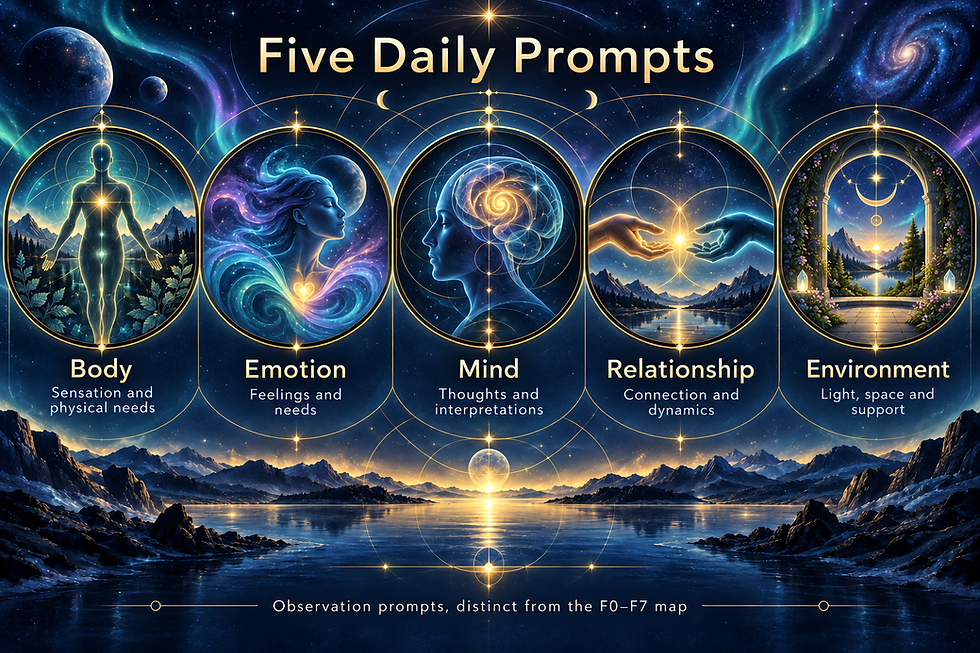
For beginners, frequency tracking can focus on five simple areas:
body state
emotional tone
mental pattern
relational effect
environmental influence
These are enough to begin.
You do not need complex charts, perfect language, or advanced symbolic interpretation.
Start by asking:
What changed my state today?
That question is the doorway.
Notice the Body
A body sensation may be the first thing you notice. At other times, a thought, feeling or change around you comes first.
Before asking what something “means,” ask what your body is reporting.
Notice:
tightness
heaviness
warmth
fatigue
restlessness
calm
tension
numbness
breath depth
energy level
sensory overload
A simple entry might say:
My body felt heavy after the meeting.
Or:
My breathing slowed after I went outside.
Or:
My shoulders tightened while reading messages.
These observations matter because your body is part of your signal architecture.
It is not separate from awareness.
Body is one observation field, not a separate numbered layer of the F0–F7 map.
Track Emotional Tone
Next, name the emotional quality of the day.
Not the full story.
Just the tone.
You might write:
calm
anxious
irritated
sad
open
guarded
hopeful
numb
tender
pressured
clear
scattered
The emotional tone helps you understand the field condition you are moving through.
For example:
Today felt emotionally compressed.
Or:
I felt more open after talking with someone who understood me.
Or:
I felt reactive most of the afternoon.
Over time, emotional tone reveals patterns.
You may notice irritation, tension or steadiness returning in certain situations. Record exceptions too, and leave room for more than one explanation.
That is frequency data.
Track Mental Loops
Frequency also shows up in thought patterns.
A mental loop is a thought that repeats with charge.
It might sound like:
I’m behind.
I need to figure this out now.
They are upset with me.
I’m not ready.
I always mess this up.
What if this falls apart?
I should have done more.
I need to prove myself.
You do not need to argue with every thought.
Just notice the repetition.
A Logbook entry might say:
Mental loop: I kept thinking I was running out of time.
Or:
Repeating thought: I need approval before I move forward.
This helps separate signal from story.
The signal is the presence of the loop.
The story is what the loop is trying to convince you is true.
Track Relational Frequency
People affect frequency.
Some interactions clarify your field.
Some destabilize it.
Some energize you.
Some drain you.
Some make you more honest.
Some make you perform.
Some leave you feeling more settled.
Some pull you into old versions of yourself.
This does not mean people are “good” or “bad” based on how you feel around them.
It means relational fields carry signal.
Track the effect.
You might write:
I felt more grounded after that conversation.
Or:
I noticed I became smaller around them.
Or:
I felt defensive before they even said anything.
Or:
That interaction stayed in my body for hours.
Relational frequency helps you understand compatibility, boundaries, emotional residue, and signal exchange.
Track Environmental Influence
Environment shapes frequency more than most people realize.
Track how your state changes around:
clutter
lighting
music
silence
weather
digital spaces
social media
workspaces
nature
rooms
routines
noise
certain objects
certain times of day
A simple observation might be:
My field felt clearer after cleaning one surface.
Or:
Scrolling made my mind feel fragmented.
Or:
The room felt heavy until I opened the window.
Or:
Being near water helped me regulate.
This is not superstition.
It is environmental awareness.
Your system responds to conditions.
Frequency tracking teaches you which conditions support coherence and which ones create distortion.
Use a Simple Scale
If numbers help, use an optional 1–5 self-rating of how much room you feel you have to respond. This is a personal reflection aid, not a measurement of physical frequency or a clinical scale.
Not as a judgment.
As a quick snapshot.
1: Very little room
Responding feels difficult; you may want rest, support or fewer demands.
2: Limited room
You can notice what is happening, but choosing a response feels hard.
3: Some room
You feel able to pause and make an ordinary choice.
4: More room
You can consider more than one response and act deliberately.
5: Plenty of room
You feel able to respond flexibly while staying connected to what matters.
You can write:
Room to respond today: 2. Context I noticed: digital noise and unresolved tension.
Or:
Room to respond today: 4. Context I noticed: better sleep, a quiet morning and an honest conversation.
This gives you a quick pattern marker without requiring a long entry.
Watch for Shifts
The most useful part of frequency tracking is noticing shifts.
Ask:
What raised my coherence today?
What lowered it?
What made me reactive?
What helped me stabilize?
What created clarity?
What created distortion?
What did I need but ignore?
What did my body know before my mind caught up?
The shift is often more important than the starting point.
You may begin the day at a 2 and end at a 4.
That gives you a change to explore, without proving which condition caused it.
You may begin at a 4 and drop to a 2 after one interaction.
That tells you something affected the field.
Tracking shifts can suggest patterns and questions to investigate. A diary alone does not establish cause.
Frequency Tracking Is Not Mood Tracking
Mood tracking is useful, but frequency tracking is broader.
Mood asks:
How do I feel?
Frequency tracking asks:
What is shaping my field?
That includes mood, but also:
environment
relational dynamics
symbolic patterns
nervous-system state
memory activation
information exposure
internal narratives
physical conditions
coherence or distortion
Frequency tracking is not just emotional labeling.
It is field mapping.
Don’t Force Positivity
One of the biggest mistakes beginners make is trying to turn frequency tracking into forced positivity.
That defeats the purpose.
If you feel grief, track grief.
If you feel anger, track anger.
If you feel numb, track numbness.
If you feel resistance, track resistance.
A clear record of a difficult signal is more valuable than a fake record of forced light.
Signal Field work is not about pretending distortion is not present.
It is about learning how to recognize it without becoming consumed by it.
Honesty is higher coherence than performance.
Look for Repeating Frequencies
After several days, look back.
Do not overanalyze every single entry.
Look for repetition.
Ask:
What state keeps returning?
What time of day creates the biggest shift?
What environments repeatedly support me?
What relationships repeatedly distort me?
What thoughts keep looping?
What symbols keep appearing?
What practices consistently stabilize me?
This is where frequency tracking becomes powerful.
The pattern reveals the architecture.
You stop seeing each day as isolated.
You start seeing the field behavior underneath.
Beginner Daily Template
Use this simple format:
Optional room-to-respond rating:
1–5
Body Signal:
What is my body reporting?
What feeling is most active?
Mental Loop:
What thought keeps repeating?
Relational Signal:
Who or what affected my field?
Environmental Signal:
What space, object, sound, or digital input changed my state?
Stabilizing Action:
What small adjustment would support coherence?
Example:
Optional room-to-respond rating:
3
Body Signal:
Tired, but not collapsed. Slight tension in shoulders.
Emotional Tone:
Guarded and a little overwhelmed.
Mental Loop:
I keep thinking I need to catch up.
Relational Signal:
A short conversation left me feeling unseen.
Environmental Signal:
Too much screen time made me scattered.
Stabilizing Action:
Clean one surface, drink water, and take ten quiet minutes before responding to messages.
That is enough.
What Counts as Progress?
Progress does not always mean feeling better immediately.
Progress may look like:
noticing sooner
reacting less intensely
recovering faster
naming the pattern clearly
choosing one stabilizing action
recognizing which spaces distort you
understanding what helps you return
catching a mental loop before it becomes behavior
realizing a feeling belongs to an older pattern
Frequency tracking builds awareness before it builds change.
That matters.
You cannot recalibrate what you cannot detect.
Frequency and the Signal Field Logbook
The Daily Logbook offers five observation fields. These are distinct from the numbered F0–F7 reflection lenses.
You can use frequency tracking inside the Logbook practice like this:
Body:
Body state and nervous-system signal.
Emotion:
Dominant feeling tone.
Mind:
Thought loops and narrative pressure.
Relationship:
Social field, mirroring, compatibility, or distortion.
Environment:
Surroundings, sounds, routines and digital inputs. Dreams and symbols remain an optional additional practice.
Together, these observations offer more than one perspective on a recurring experience.
Sometimes the issue is physical exhaustion.
Sometimes it is emotional residue.
Sometimes it is a mental loop.
Sometimes it is relational distortion.
Sometimes it is a symbolic pattern asking for recognition.
These observation fields help you avoid collapsing everything into one explanation.
Use Frequency as Information, Not Identity
Your frequency is not your identity.
A low-frequency day does not mean you are a low-frequency person.
A distorted state does not mean you are broken.
A reactive moment does not erase your progress.
Frequency is movement.
It changes.
It responds.
It can be influenced, supported, disrupted, repaired, and stabilized.
Tracking frequency helps you stop identifying with every temporary state.
Instead of saying:
I am anxious.
You can say:
Anxiety is active in the field today.
That small shift creates space.
And space creates choice.
The Larger Philosophy
Frequency tracking is the practice of becoming literate in your own signal.
It teaches you to notice what your body reports, what your emotions carry, what your thoughts repeat, what your relationships activate, and what your environment reinforces.
It does not require belief.
It requires attention.
Over time, you begin to understand your field more clearly.
You learn what destabilizes you.
You learn what restores you.
You learn what patterns keep returning.
You learn where your signal sharpens.
You learn where it collapses.
You learn what conditions help coherence form.
That knowledge becomes power.
Not control.
Power.
The ability to respond with awareness instead of being pulled unconsciously through every passing state.
Frequency tracking is not about escaping difficult signals.
It is about learning how to read them.
Because the field is always communicating.
And once you begin tracking the signal, the pattern starts revealing the path.
🜂🜄🜁🜃
Architect





Comments