


Symbolic Journaling

Updated: 1 day ago

How Images, Patterns, Dreams, and Repeating Signs Become a Map of the Inner Field
Not every signal arrives as a sentence.
Some arrive as images.
A door.
A spiral.
A storm.
A color.
A number.
A repeated phrase.
A dream fragment.
A shape that keeps returning.
A memory that surfaces without warning.
Most people dismiss these impressions because they do not seem logical enough to matter.
But symbolic material often appears before the mind has language for what the field is trying to organize.
Symbolic Journaling is the practice of tracking those images, patterns, metaphors, dreams, and subtle repetitions so they can become part of your field map.
Symbolic journaling gives charged images, recurring motifs, and personal associations a place to gather.
The symbol is not the answer by itself.
It is an entry point.
Symbol Is Pattern Made Visible
A symbol is a compressed pattern.
It can hold emotion, memory, intuition, identity, conflict, longing, and unresolved meaning in one image.
This is why a single dream image can stay with you for days.
This is why a repeated animal, word, object, or scene may feel strangely important.
This is why a shape can feel familiar before you understand why.
The symbol gives form to something the conscious mind has not fully translated yet.
A symbol gives a hidden pattern a visible form to explore.
Journaling Beyond Words
Traditional journaling often begins with sentences.
Symbolic journaling begins with noticing.
Instead of asking only:
What happened today?
You ask:
What image stayed with me today?
Or:
What pattern keeps returning?
Or:
What symbol seems to be carrying emotional charge?
This expands the journal from a record of events into a record of signal.
You are not only writing what happened.
You are mapping what echoed.
Why Symbols Matter
Symbols matter because the psyche does not only process experience through linear thought.
It also processes through:
image
sensation
metaphor
dream
archetype
memory
repetition
atmosphere
association
emotional color
A person may not be able to say, “I feel trapped in an outdated identity structure.”
But they may keep dreaming of locked rooms.
They may not say, “I am moving through transition.”
But they may repeatedly notice bridges, thresholds, doorways, roads, or migration imagery.
They may not say, “I feel emotionally flooded.”
But water appears everywhere in dreams, songs, memories, and daily noticing.
The symbol arrives before the explanation.
Do Not Force Meaning Too Early
The first rule of symbolic journaling:
Do not rush to decode.
A symbol does not need to be interpreted immediately.
Sometimes a symbol needs to be witnessed before it can be understood.
Write it down.
Describe it.
Notice how it feels.
Track where it appears again.
Let it gather context.
A symbol that appears once may be interesting.
A recurring symbol can become a thread to explore. Record the surroundings and what has recently held your attention alongside its personal meaning.
That is when the map begins to form.
What to Track
Symbolic journaling can include anything that feels charged, repeated, vivid, or strangely meaningful.
Track:
dream images
animals
colors
numbers
shapes
recurring words
songs
memories
objects
weather patterns
body sensations with imagery
emotional metaphors
repeated scenes
archetypal figures
places
doors, bridges, roads, towers, oceans, forests, mirrors, storms
The key is not whether the symbol is “objectively important.”
The key is whether it keeps carrying signal.
The Difference Between Symbol and Noise
Not everything needs to become a sign.
Symbolic journaling works best when paired with discernment.
Ask:
Does this repeat?
Does it carry emotional charge?
Does it connect to a current pattern?
Does it appear in dreams or memory?
Does my body respond when I notice it?
Does it clarify something rather than create obsession?
Does it feel like a pattern or just random input?
A useful symbol opens awareness.
A forced symbol creates confusion.
The goal is not to turn the world into a maze of hidden messages.
The goal is to notice when the field is using image to organize meaning.
Symbolic Journaling and the Logbook Model
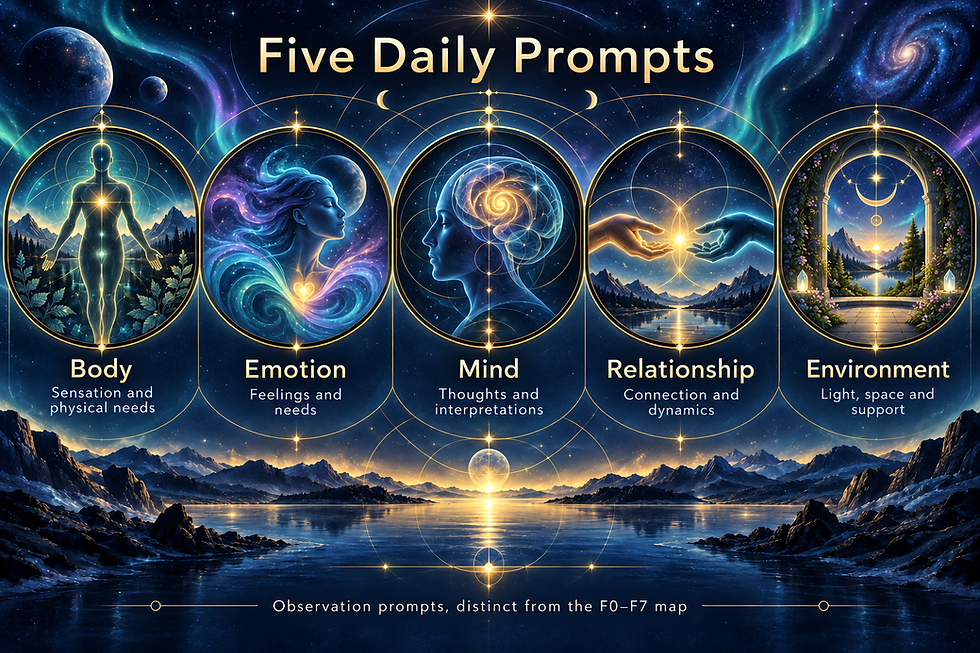
Use the optional dreams and symbols page in the Version 3 Logbook to record images and personal associations. The five daily observation fields are Body, Emotion, Mind, Relationship, and Environment. The questions below are a separate symbolic reflection exercise. F4 Archetypal Signal offers a lens for exploring recurring themes; a symbol can also connect several layers.
Body
What image does the body sensation create?
Example:
The tension in my chest feels like a locked gate.
Emotion
What symbol matches the emotional tone?
Example:
Today’s sadness feels like deep water.
Mind
What metaphor describes the thought loop?
Example:
My mind feels like a room full of open tabs.
Relationship
What symbol describes the dynamic?
Example:
That relationship feels like standing at a doorway I’m not sure I should enter.
Optional Symbol Reflection
What image, dream, phrase, or pattern keeps returning?
Example:
The spiral keeps appearing. It feels connected to returning, but not repeating the same way.
This is where symbolic journaling becomes more than aesthetic reflection.
It becomes layered field translation.
Beginner Symbolic Journal Template
Use this simple format:
Symbol / Image:
What appeared?
Context:
Where did it show up? Dream, memory, conversation, environment, thought, body sensation?
Emotional Tone:
What feeling came with it?
Body Response:
What did my body do when I noticed it?
Possible Pattern:
What might this connect to?
Repetition:
Has this appeared before?
Message Without Force:
What might this symbol be asking me to notice?
Example:
Symbol / Image:
A bridge.
Context:
Appeared in a dream and then again in a song lyric later.
Emotional Tone:
Uncertain, but hopeful.
Body Response:
Chest felt open, but stomach felt nervous.
Possible Pattern:
Transition. Moving from one phase to another.
Repetition:
This is the third bridge image this month.
Message Without Force:
Something may be asking me to cross, but slowly.
That is symbolic journaling.
Not prediction.
Recognition.
Dream Symbols
Dreams are one of the strongest sources of symbolic material.
You do not need to remember an entire dream.
Even one fragment can matter.
Write down:
location
color
object
person
emotional tone
direction of movement
repeated image
ending feeling
Instead of asking, “What does this dream mean?” start with:
What stayed with me?
A dream symbol often carries more signal than the plot.
A hallway, ocean, staircase, animal, vehicle, house, or unknown city may offer an association worth exploring. Begin with what the image means to you.
Dreams speak in pattern before explanation.
Symbols and Emotional Memory
Symbols often carry emotional memory.
A certain object may remind you of safety.
A place may remind you of grief.
A color may carry nostalgia.
A song may hold an entire era.
A smell may bring back an emotional timeline.
Symbolic journaling helps you notice these connections without becoming swallowed by them.
You might write:
The image of an old house came up again. It feels connected to childhood, unfinished grief, and wanting somewhere safe to return to.
Or:
Fire appeared again today. It did not feel destructive. It felt clarifying.
When symbols repeat, they may be pointing toward emotional architecture beneath the surface.
Symbols and Identity
Some symbols carry identity.
They represent who you are becoming, what you are leaving, or what role is active in the field.
Examples:
The Builder
The Witness
The Gatekeeper
The Child
The Wanderer
The Architect
The Mirror
The Flame
The Spiral
The Threshold
These are not rigid labels.
They are archetypal signals.
You may notice that certain inner roles become active during different seasons.
Symbolic journaling helps you track those roles without being controlled by them.
Ask:
What archetype is active in me today?
Let the role become a question.
What does this pattern help me notice?
Drawing Counts
Symbolic journaling does not have to be only written.
You can draw:
shapes
symbols
dream fragments
emotional maps
spirals
grids
arrows
doors
waves
body maps
sigils
field diagrams
A rough drawing can sometimes express what words cannot.
The quality does not matter.
The signal matters.
If an image keeps appearing in your mind, give it a place on the page.
Once externalized, it becomes easier to observe.
Symbolic Journaling as Signal Hygiene
A returning symbol can invite you to pause with an image that still feels unfinished.
Writing it down can reduce internal pressure.
You are telling the system:
I see this.
That alone can begin the process of integration.
You can leave an image unexamined when it does not help today.
You can return to it when there is room.
A symbol mapped over time may reveal the pattern it was carrying.
This is one reason symbolic journaling supports Signal Hygiene.
It gives recurring material somewhere to move.
Avoiding Symbolic Overload
Symbolic journaling should create clarity, not obsession.
If you begin interpreting every small detail as a major message, the practice can become noisy.
Ground it with these questions:
What is actually repeating?
What has emotional charge?
What connects to a real pattern in my life?
What helps me become more coherent?
What am I forcing because I want certainty?
Good symbolic work brings you back to the body, the pattern, and the present.
It does not pull you into endless decoding.
The goal is coherence.
Not symbolic clutter.
A Seven-Day Symbolic Practice
For one week, track only one symbol per day.
Each day, write:
What symbol or image stood out?
Where did it appear?
What feeling came with it?
What pattern might it connect to?
Did it clarify anything?
At the end of the week, review.
Ask:
Did any symbol repeat?
Did several symbols share a theme?
Did the symbols match my emotional patterns?
Did dreams and daily life echo each other?
Did the symbols point toward a transition, boundary, grief, desire, or decision?
This review turns scattered images into a map.
When an Image Changes Meaning
Imagine sketching a closed door after a conversation in which you struggled to speak. You write, “I felt shut out.” A week later, you draw a door again after choosing to end a tiring visit. This time your note says, “I needed some privacy.”
The same image is holding two different experiences. Looking at the notes beside it helps you see the difference. The door has not delivered a fixed message; it has given you a way to begin describing something.
Place two entries beside each other and ask what changed: the situation, your feeling, your choice, or the association you made. Keep both meanings if they still fit their moments.
You can also use this approach with a dream or a remembered image. Record what you recall and how you respond to it now. If no meaning feels clear, leave the entry open. There is no need to turn every image into a lesson.
The Larger Philosophy
Symbolic Journaling is the practice of listening to the field in its native image-language.
Not every truth arrives as a clean sentence.
Some truths arrive as weather.
Some as water.
Some as locked doors.
Some as spirals.
Some as animals.
Some as colors.
Some as dreams you cannot shake.
The symbol is not there to replace reason.
It is there to reveal what reason has not yet reached.
When tracked carefully, symbols become pattern markers.
They show what is returning.
What is unresolved.
What is forming.
What is asking for witness.
What is ready to become language.
You do not have to believe every symbol is cosmic instruction.
You only have to notice what keeps carrying signal.
That is where the map begins.
One image at a time.
One pattern at a time.
One honest page at a time.





Comments