


How To Start The Daily Logbook

Updated: 1 day ago
A Beginner’s Guide to Tracking Signal Without Overcomplicating the Practice
The Daily Logbook is not about becoming perfect.
It is not about writing beautifully.
It is not about decoding every feeling.
It is not about turning your inner life into another productivity system.
It is a simple daily practice for noticing what your field is already transmitting.
Most people move through the day reacting to signals they never pause long enough to name.
A mood shifts.
A memory returns.
A conversation lingers.
A room feels heavy.
A dream leaves residue.
A familiar pattern repeats.
A decision feels charged.
The Logbook gives those signals somewhere to land.
The Daily Logbook is a field-mapping tool. It helps you track emotional, mental, relational, symbolic, and environmental patterns across time so you can begin recognizing what is stable, what is distorted, what is repeating, and what is asking for adjustment.
You are not trying to force transformation.
You are learning how to observe your signal.
Start Small
The most important rule is this:
Do not make the Logbook so complicated that you avoid using it.
A useful entry can be short.
Three minutes is enough.
One sentence per prompt is enough.
Even one clear observation can begin the practice.
The point is not volume. The point is consistency.
A short entry made regularly will teach you more than a perfect entry written once and abandoned.
The Logbook works because patterns become visible through repetition.
The Purpose of the Practice
The Daily Logbook helps you answer one core question:
What is active in my field today?
That does not mean “What is wrong with me?”
It means:
What am I carrying?
What am I reacting to?
What keeps repeating?
What feels clear?
What feels distorted?
What feels unresolved?
What environment is affecting me?
What signal is asking for attention?
The Logbook is not self-judgment.
It is signal recognition.
Daily Observation: page 4
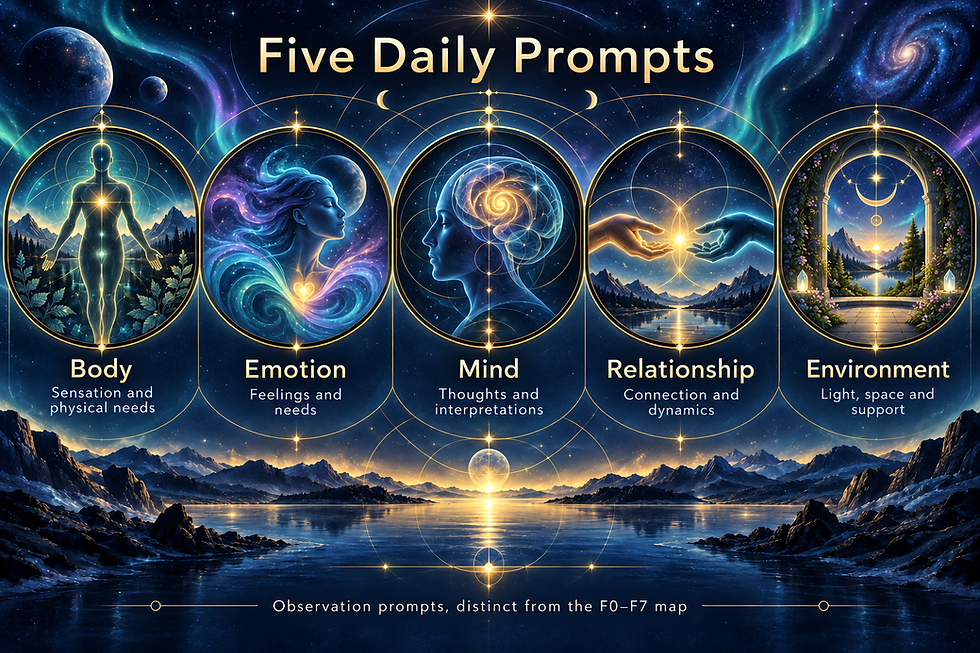
Start with the Daily Observation page in the free Signal Field Logbook, Version 3. Add the date, time, and place. A word, a sentence, or a sketch is enough; use only the fields that help today.
Body signal: Notice sensation, energy, sleep, hunger, and other physical needs.
Emotional tone: Name the feeling and what you might need.
Mental loop: Record the returning thought, then separate it from what you can directly observe.
Relational signal: Describe the interaction and what was actually said or done.
Environmental influence: Notice light, sound, space, demands, interruptions, and available support.
The page ends with an optional active layer and one word for the moment. You can leave the layer blank while you gather observations.
Daily Integration: page 5
At the evening or next pause, mark available energy and felt steadiness from 1 to 5 using your own experience. Record the dominant pattern, what shifted your state, the supportive action, an intention for tomorrow, and a closing line. A useful intention names one manageable action and when or where you could try it.
A short completed entry
Body signal: My shoulders are tight and I missed lunch. Emotional tone: Worried and irritated. Mental loop: I keep thinking I must finish everything now; the observable situation is three unfinished tasks. Relational signal: A colleague sent a brief reply, and I do not know their intention. Environmental influence: Notifications are on and the desk is crowded.
Daily Integration: Energy 2/5; steadiness 2/5. Dominant pattern: rushing, switching tasks, then criticizing myself. What shifted: I ate and turned off notifications; the workload remained. Supportive action: I finished one small task. Intention for tomorrow: write down one priority before opening messages and ask which deadline matters most. Closing line: I can begin with one task.
This is an illustrative entry in the same format as the completed example on page 7 of the PDF. Record what happened without treating one improvement as proof of a cause.
Choose a layer when it helps
Version 3 uses the current framework: F1 Emotion Signal, F2 Perception Signal, F3 Identity Signal, F4 Archetypal Signal, and F5 Structure Signal. Pages 8–12 offer a deeper worksheet for each. The daily observation fields gather material that can inform several layers; they do not assign body, emotion, mind, relationship, and environment to separate F-numbers.
F0 Void Signal offers a grounding pause. Page 13 includes that grounding practice and a brief F6 Dimensional Signal and F7 Source Field Signal preview of the Expanded Logbook. Choose the lens that helps this entry; completing every layer is not required.
Optional space for relationships, dreams, and symbols
Use page 6 for a sketch, page 14 for relationships and boundaries, and page 15 for dreams and symbols. These pages let an image or encounter have more room when useful. Record the remembered image before interpreting it, and leave room for other meanings.
Weekly Pattern Review: page 16
Use the worksheet's four fields: What repeated; What supported me; What I am still learning; and One experiment for next week. Review the entries you actually have. Notice repeated conditions, useful supports, and alternative explanations, then choose one small change and what you will record. A missed day does not require catching up.
Morning or Evening?
You can use the Logbook in the morning, evening, or both.
Morning entries are useful for setting awareness before the day starts.
They help you ask:
What am I carrying into the day?
Evening entries are useful for pattern recognition.
They help you ask:
What did the day reveal?
If you are just starting, choose one.
Morning is good for intention.
Evening is good for reflection.
The best time is the one you will actually use.
Don’t Over-Interpret Too Early
One common mistake is trying to decode every entry immediately.
You do not need to know what everything means on the first day.
The Logbook becomes more powerful when you allow patterns to accumulate.
A symbol may not make sense today.
But if it appears four times in two weeks, it becomes data.
A feeling may seem random today.
But if it returns every time you enter a certain environment, it becomes a field pattern.
A reaction may seem isolated today.
But if it repeats in similar relational situations, it becomes a signal thread.
The Logbook teaches through continuity.
Let the pattern reveal itself before forcing a conclusion.
Use Plain Language
You do not need poetic language for the Logbook to work.
Write simply.
Try phrases like:
I notice…
My body feels…
I keep thinking…
I felt pulled toward…
I felt resistance around…
This reminded me of…
Something in me wants…
Something in me is tired of…
The repeating pattern is…
Today’s adjustment is…
Plain language keeps the practice grounded.
The goal is not performance.
The goal is recognition.
What to Track Over Time
After several days, begin looking for repetition.
Ask:
What feeling keeps returning?
What situations create distortion?
What environments support calm?
What relationships amplify clarity?
What thoughts keep looping?
What symbols keep appearing?
What time of day creates the most instability?
What helps me return to coherence?
This is where the Logbook becomes more than journaling.
It becomes a pattern map.
Signal Versus Story
One of the most useful skills the Logbook develops is separating signal from story.
A signal might be:
My body feels tight.
A story might be:
Something bad is going to happen.
A signal might be:
I feel sad after that conversation.
A story might be:
They do not care about me.
A signal might be:
I keep avoiding this project.
A story might be:
I am lazy.
The signal gives information.
The story gives interpretation.
The Logbook helps you slow down enough to tell the difference.
The Alignment Note
Always end with one small alignment.
Not a huge life overhaul.
A small correction.
Examples:
Drink water before more scrolling.
Take ten minutes outside.
Do not respond while activated.
Clean one surface.
Move my body.
Write the truth without sending it.
Rest before deciding.
Ask for clarification instead of assuming.
Return to the task gently.
Let today be simple.
Small adjustments matter because coherence is built through repetition.
The field changes when the pattern changes.
When You Miss a Day
Missing a day does not break the practice.
The Logbook is not a streak system.
It is a return system.
If you miss a day, simply begin again.
Do not punish yourself for drifting.
Just notice:
What pulled me out of the practice?
That question itself becomes useful data.
Sometimes resistance reveals exactly where the field needs attention.
How the Logbook Builds Coherence
Over time, the Daily Logbook helps you:
recognize emotional patterns
notice nervous-system signals
track relational effects
detect environmental distortion
understand symbolic repetition
identify old loops
stabilize before reacting
build language for inner experience
make cleaner decisions
create continuity with yourself
This is the real purpose.
Not self-optimization.
Self-recognition.
The Logbook becomes a mirror that does not judge you. It simply shows what is active.
Beginner Practice
For the first seven days, keep it simple.
Use this daily prompt:
What is my field asking me to notice today?
Then answer through the five prompts.
Do not try to fix everything.
Just observe.
By the end of one week, look back and ask:
What repeated?
What shifted?
What surprised me?
What supported coherence?
What created distortion?
That review is where the pattern begins to speak.
The Larger Philosophy
The Daily Logbook is a way of becoming less unconscious inside your own field.
Most people do not lack insight because they are incapable of awareness.
They lack a stable structure for noticing.
The Logbook gives awareness a place to gather.
It turns scattered emotion into pattern recognition.
It turns reaction into reflection.
It turns symbolic fragments into a map.
It turns daily experience into field data.
You do not need to understand the entire Signal Field framework before beginning.
You only need to start listening.
One observation at a time.
One signal at a time.
One honest entry at a time.
Because the field is already speaking.
The Logbook simply teaches you how to hear it.
🜂🜄🜁🜃
Architect




Comments