


The Signal Field Logbook: Daily Practice and Layer Prompts

Updated: Oct 22
Some days don't reveal how much they've taken from you until everything becomes quiet.
You sit down after work, and a conversation from earlier returns to mind. Your shoulders are still tense. You're distracted, unusually irritable, or having trouble settling into something you normally enjoy.
Nothing particularly dramatic may have happened.
But the day left something behind.
Perhaps you were interrupted more often than usual. Maybe an interaction reminded you of an old experience. You might have spent hours adapting to an environment that required more effort than anyone realized.
You know something affected you.
You haven't yet understood what.
And perhaps tonight isn't the time to figure everything out.
An experience can be worth remembering before you understand what it means.
This is where the Signal Field Logbook begins.
Not with a demand for insight.
With somewhere for the experience to land.
A few words about what happened. A feeling you noticed. A thought that kept returning. A condition that made the day harder or one small thing that helped.
Over time, those observations can become something more.
A record of familiar patterns.
A history of changing interpretations.
A place to recognize what remains meaningful and what begins to shift.
In Signal Field philosophy, this is a field mirror: a reflective record of the relationships through which your experience unfolds.
The Logbook gives you somewhere to see the pattern without requiring you to become the pattern.
Give the Experience Somewhere to Land
A typical journal might begin with the question:
What happened today?
The Logbook makes room for another:
What was happening within and around me when it happened?
Consider a difficult conversation.
The words exchanged are one part of the experience.
But there may also have been physical discomfort, emotional pressure, unclear expectations, sensory demands, or a familiar interpretation shaping how the interaction felt.
Perhaps you left feeling misunderstood.
Later, you realize you hadn't eaten, the room was noisy, and the conversation happened while several other responsibilities were competing for attention.
None of those observations automatically resolves the interaction.
But together, they reveal more of its structure.
Another day, a similar conversation may unfold under different conditions.
You may discover that you felt more comfortable when you had time to prepare, when someone allowed silence, or when expectations were communicated clearly.
The experience becomes more readable.
A pattern that once seemed entirely personal may reveal an environmental component.
An interpretation that felt certain may become more open.
A recurring difficulty may point toward a support you hadn't considered.
The Logbook gives these details a place to remain visible.
And sometimes an entry simply records the day.
It doesn't have to reveal anything extraordinary.
Not every observation needs to become a revelation. Some are valuable because they preserve what the moment actually felt like.
Inside the Free Signal Field Logbook
The free Signal Field Logbook V3: F1–F5 Core Edition contains 17 pages.
It's a complete daily reflection practice, not a trial version that requires a purchase to become useful.
You can print the pages you want or annotate the PDF using an application that supports writing or notes. The file is designed for handwriting or annotation rather than as an interactive fillable form.
The pages provide several ways to engage with your experience.
Pages 1–3 introduce the practice and the layer framework.
Pages 4–5 contain Daily Observation and Daily Integration.
Page 6 offers a sketch grid, while page 7 provides a completed example.
Pages 8–12 contain the individual F1–F5 layer worksheets.
Page 13 includes an F0 grounding practice and brief introductions to F6 and F7.
Pages 14–15 explore relationships, boundaries, dreams, and symbols.
Page 16 contains the Weekly Pattern Review, and page 17 closes the core practice with a way to continue.
You don't need to move through the pages in order.
And you don't need to complete them all.
Some days, the Daily Observation page may be enough.
Other days, you may want to explore a recurring pattern through a particular layer or return to several entries for comparison.
The Logbook is designed to support both.
Depth isn't measured by how many pages you complete. Sometimes one accurate observation changes what becomes possible next.
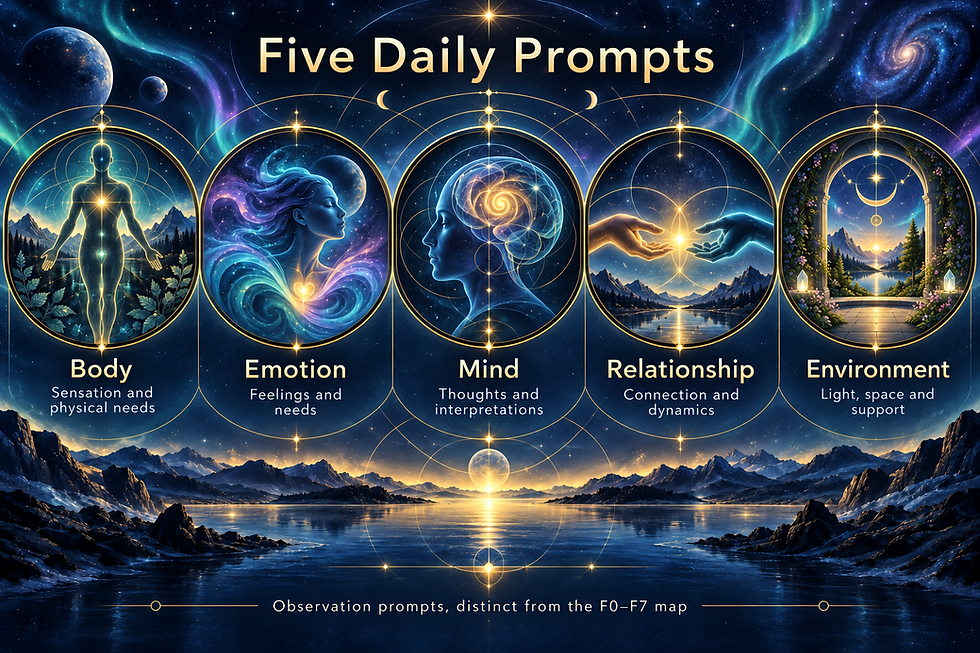
Begin With Five Daily Observations
Page 4 offers five everyday observation fields.
These are practical categories for recording experience. They're distinct from the numbered F1–F5 symbolic layers, which have their own worksheets later in the Logbook.
You can use all five fields, choose two, or record only the part of the day that feels most relevant.
Body Signal
What was happening physically?
Perhaps you notice tension, fatigue, hunger, restlessness, comfort, or sensory discomfort.
Maybe your sleep was interrupted.
Perhaps a familiar activity required more effort than usual.
You could write:
"My shoulders were tense after the meeting. I hadn't eaten since breakfast."
The observation doesn't need an immediate explanation.
A physical sensation can have several causes. Recording it helps preserve what was present without deciding too quickly what it means.
Sometimes the first useful insight is simply recognizing that your body had needs the day didn't make room for.
Emotional Tone
What feelings were present?
You might recognize anxiety, frustration, grief, relief, anticipation, excitement, or several emotions at once.
Some feelings change throughout an experience.
A conversation may begin with uncertainty and end with relief.
An opportunity can feel meaningful and overwhelming at the same time.
You might record:
"I felt anxious during the meeting, then relieved when I had some time alone."
You don't need a perfect emotional label.
If the feeling is difficult to identify, you can describe its texture or leave the field open.
The emotion belongs to the experience whether or not you've found the exact word.
Mental Loop
What thought kept returning?
Sometimes a sentence follows you long after the situation that prompted it.
"I should've handled that differently."
"They probably misunderstood me."
"I'm falling behind."
You can record the thought alongside what you actually observed.
For example:
"I kept thinking my coworker was frustrated with me. They were quiet during the conversation, but I don't know why."
Both parts matter.
The thought was real as part of your experience.
Its interpretation of another person's intentions may still be uncertain.
An entry can preserve the feeling of certainty without requiring you to preserve the conclusion.
That leaves room for what you may learn later.
Relational Signal
What happened between you and another person?
This field makes room for conversations, expectations, support, boundaries, and communication difficulties.
Maybe someone offered help.
Perhaps a request was unclear.
An interaction may have left you energized, connected, uncomfortable, or exhausted.
Try describing what happened as specifically as possible.
"My coworker asked for another update before I'd finished the first one."
Later, you may recognize that similar requests keep appearing in different situations.
Or discover that the relationship becomes easier when expectations are clarified.
The Logbook doesn't decide what another person meant.
It gives you a record of the interaction and how you experienced it.
Environmental Influence
What was happening around you?
Consider noise, lighting, interruptions, time pressure, space, competing responsibilities, and the support available.
A task may have felt difficult because the environment was unusually demanding.
A conversation may have been easier when the pace slowed.
You might write:
"Three notifications interrupted the task, and several people were talking nearby."
This field matters because the surroundings are not merely background.
They shape the conditions through which attention, communication, and action become accessible.
Sometimes what appears to be a personal difficulty is partly an environment asking more than the moment can comfortably hold.
Recognizing that relationship can reveal a practical place to begin.
What One Short Entry Can Reveal
Imagine finishing a workday feeling drained.
You could describe the entire experience as:
"Today was overwhelming."
That may be enough for the moment.
But when you have more room, the five observation fields can show what the feeling contains.
Body: Tired, tense shoulders, hungry.
Emotion: Frustrated and overwhelmed.
Mind: I'm falling behind.
Relationship: Several people asked me to take on additional tasks.
Environment: Constant interruptions and changing priorities.
Now the experience has more shape.
Perhaps the difficulty wasn't simply poor motivation or organization.
The day involved several simultaneous demands, unclear priorities, and limited opportunities to recover.
You may still need more information before understanding everything that contributed.
But the entry gives you something specific to examine.
Maybe next time you ask which responsibility takes priority.
Perhaps you notice that interruptions are especially costly when you're already tired.
Or maybe the most important observation is that you needed food, quiet, or help before continuing.
The field becomes easier to read when its conditions have somewhere to become visible.
One entry may not establish a recurring pattern.
Several entries may begin revealing which conditions return.
And which changes make the experience different.
Daily Integration: Carry Something Forward
Page 5 offers another part of the daily practice.
Daily Observation helps you notice the experience.
Daily Integration gives you space to consider what you want to carry forward.
The page includes two personal ratings:
Available energy: 1–5.
Felt steadiness: 1–5.
These are descriptions of your own experience, not medical scores, measurements of physical frequency, or targets you must continually improve.
A low rating doesn't mean you've failed.
A high rating doesn't guarantee that everything is working well.
The numbers provide a simple way to compare how different days felt to you.
Daily Integration also includes room to notice the dominant pattern, what changed your state, an action that helped, an intention for tomorrow, and a closing thought.
Using our workday example, an entry might read:
Energy: 2/5.
Steadiness: 3/5.
Dominant pattern: Competing requests made it difficult to finish one responsibility.
What helped: Writing down the requests and clarifying which one mattered most.
Tomorrow's intention: Ask for the priority before accepting another task.
Closing thought: Clearer expectations made the workload easier to manage.
Nothing dramatic had to happen.
The person noticed a condition.
Recognized one support.
And identified a possible adjustment.
Sometimes that's what Alignment looks like.
Not becoming a different person overnight.
Creating a little more room for the person you already are to participate.
Explore the F1–F5 Layers
The Daily Observation fields collect experiences.
The F1–F5 worksheets on pages 8–12 provide different perspectives for exploring those experiences more deeply.
Each layer has its own purpose.
F1 | Emotion Signal
Explore what you felt, how the emotion changed, and what needs or associations may be connected with it.
F2 | Perception Signal
Examine the interpretation forming around an event. What did you observe? What did you assume? What remains uncertain?
F3 | Identity Signal
Notice familiar roles and self-stories. What expectations about yourself become active in the situation?
F4 | Archetypal Signal
Explore symbols, imagery, and recurring human themes. Does a symbolic figure or image reveal another way of understanding the experience?
F5 | Structure Signal
Look at the routines, boundaries, relationships, environments, and supports helping maintain a pattern.
You can choose whichever worksheet fits the experience.
If you're exploring a feeling, F1 may be useful.
If an interaction keeps generating the same interpretation, F2 may help.
If a familiar role seems restrictive, F3 offers a place to examine it.
A recurring symbol might lead you toward F4.
And if an experience keeps repeating because of how responsibilities are organized, F5 may be the most useful starting point.
The layers are not levels you must complete in sequence.
One meaningful doorway is enough to begin exploring the larger field.
For a fuller introduction, see The F0–F7 Layer Map.
F0: Leave Room Before Interpretation
Page 13 includes an F0 Void Signal grounding practice.
Sometimes you know that an experience affected you, but you aren't ready to explain it.
Perhaps the feeling is still changing.
Perhaps you need more information.
Maybe the experience matters in a way that hasn't yet found language.
F0 represents the symbolic space before meaning becomes fixed.
It gives uncertainty a place in the process.
You might notice:
"Something about that conversation stayed with me."
And stop there.
No explanation is required.
No interpretation needs to become permanent.
You can orient yourself to the present, notice something familiar, or allow a brief pause before continuing.
The practice doesn't require meditation or a particular state of calm.
The unknown doesn't need to become an answer before it deserves attention.
The same page also introduces F6 Dimensional Signal and F7 Source Field Signal through short prompts.
These open wider questions about continuity, context, meaning, and existence.
The separate Expanded Logbook provides deeper F6–F7 exercises, but the free edition remains a complete practice.
You don't need the expanded material to begin exploring your experience meaningfully.
Relationships, Dreams, and Symbols
Not every experience is easiest to understand through a daily checklist.
Sometimes a relationship has become the central question.
Page 14 provides space to explore relationships and boundaries.
Perhaps a familiar interaction keeps repeating.
You may notice that certain requests feel difficult to decline, or that particular conversations become easier when expectations are clear.
Recording those relationships can help distinguish the event from the role, meaning, or structure surrounding it.
Page 15 opens another kind of inquiry through dreams and symbols.
A dream may leave behind an image that feels emotionally significant.
A familiar object may carry the memory of someone you've lost.
A recurring motif may take on another meaning as your life changes.
The same symbol can accompany several chapters of experience.
The image remains recognizable.
The person encountering it continues evolving.
Within the Aurora Continuum, that movement belongs to the inquiry into memory, identity, continuity, and symbolic meaning.
You can record the image, describe its personal associations, and return later to see whether those associations have changed.
A symbol doesn't need one permanent interpretation.
Something can remain meaningful while your relationship to it becomes entirely different.
The Logbook gives those changes a place to be remembered.
The Weekly Review: Notice What Returns
Page 16 contains the Weekly Pattern Review.
A daily entry captures one moment.
Several entries can reveal relationships that weren't visible while you were living through them.
The weekly review asks four questions:
What repeated?
Look for recurring experiences, responses, situations, or conditions.
What supported me?
Notice anything that made participation easier, reduced unnecessary effort, or created room for something meaningful.
What am I still learning?
Keep space for uncertainty, changing interpretations, and information you don't yet have.
What's one experiment for next week?
Choose a small, realistic adjustment if one is available.
Perhaps you recognize that certain conversations are easier when expectations are clear.
Maybe repeated interruptions make familiar tasks more difficult.
You might notice that a quiet evening after a demanding day allows you to return to activities you enjoy.
Or discover that something you interpreted as rejection had a different explanation.
The value of the review isn't proving the first interpretation correct.
It's recognizing how understanding changes when more of the experience becomes visible.
A pattern can return without requiring you to meet it in exactly the same way.
If you'd like to see this process through a fictional example, continue with One Pattern Across a Week.
You don't need seven entries to use the weekly review.
Two observations may reveal something useful.
One may be enough.
You can also begin with what you remember.
The practice isn't about maintaining an unbroken record.
It's about recognizing what becomes visible when you look back.
When You Have Very Little Capacity
Some days, even opening a journal can feel like another responsibility.
On those days, the practice can become smaller.
One word.
A check mark.
A short voice note.
A single sentence.
Or nothing at all.
You might record:
"Too many demands today."
And beneath it:
"Need quiet and food."
That can be the entire entry.
Another day, you might write:
"Today was difficult, and I don't need to understand all of it tonight."
You can skip a day.
A week.
An unfinished page can remain unfinished.
There's no need to recreate missing entries or accumulate a backlog of reflection.
A Logbook should not become another system you're required to maintain at the expense of your capacity.
If writing helps, use it.
If recording your experience adds pressure, reduce the practice or leave it alone.
A tool meant to support your life should be allowed to change with the life it's supporting.
You can return whenever it becomes useful again.
Your Logbook Becomes a Living Archive
A single entry preserves a moment.
Several entries begin forming a history.
You may notice that certain environments repeatedly place demands on your attention.
An old emotional response may become more recognizable.
A familiar identity role may begin revealing the expectations attached to it.
You may discover which supports make daily life easier.
Or return to an earlier entry and realize that the meaning you assigned to something has changed.
This is the heart of the resonance archive.
Not a measurement of hidden energy or a score of spiritual alignment.
A living record of the relationships through which your experience continues unfolding.
Some patterns may remain familiar.
Others may become quieter.
A symbol that once carried grief may eventually carry gratitude.
A difficult interaction may become easier to understand when its surrounding conditions are visible.
A routine may change.
An old belief about yourself may become less restrictive.
And an experience that once seemed complete may gain another meaning through the life you've lived since.
The Archive doesn't require you to preserve the same interpretation forever. It lets you witness how your relationship with the experience evolves.
There is something meaningful in being able to return to an earlier version of your understanding without needing to remain within it.
The entry belongs to your history.
What you discover later becomes part of that history, too.
Begin Wherever You Are
You don't need a perfect morning routine.
You don't need to know all eight layers.
And you don't need a special moment of inspiration before beginning.
Open the free Signal Field Logbook.
Start with Daily Observation on page 4 if you want to record what happened.
Use Daily Integration on page 5 when you have room to consider what might help next.
Explore one F1–F5 worksheet if a particular experience deserves more attention.
Return to the Weekly Pattern Review when you want to notice what repeated.
Or simply leave one line.
"Something about today stayed with me."
That is a beginning.
The Logbook can grow alongside you without demanding that every entry become profound.
Some days, it may help you recognize a practical need.
Other days, it may give an emotion somewhere to rest.
Over time, it may become a record of the ways your relationships, interpretations, supports, and sense of identity have changed.
You don't have to become someone else to begin reading your experience differently.
The field is already in motion.
Your life is already unfolding.
And the things you've lived deserve somewhere to be seen.
Give the experience somewhere to land. Leave room for what it may become.
🜂🜄🜁🜃
Architect






Comments