


What Is the Signal Field?

Updated: 1 day ago

A Foundational Guide to Signal, Pattern and Living Structure
The Signal Field begins where a pattern becomes a question.
A feeling returns. A symbol follows you. An old story appears in a new room.
Signal Field theory offers a living map for exploring these connections: memory, emotion, meaning and possibility folding toward one another.
Field, resonance and coherence help us follow how patterns meet, carry influence and hold together through change. The inquiry moves between what we can observe and what we are still learning to describe.
When familiar systems falter and old narratives loosen, another kind of listening becomes possible. Poetry, scientific inquiry and mysticism meet at the threshold, each carrying a different light.
The invitation is to pause there long enough to notice.
A place for inquiry.
A framework.
A practice of discernment.
A navigational interface.
A way to understand your body, emotions, thoughts, relationships, symbols, dreams, environments, memories, and choices as part of one living field of signal.
Your life contains patterns worth noticing.
Your emotions are not noise.
Some patterns share conditions worth exploring.
Your field is speaking.
The work is learning how to read it.
Core Premise
Your life contains patterns worth noticing.
Your emotions are not noise.
Body, memory, imagination and grief can meet within a single moment.
Picture an experience as overlapping currents: what happened, what you felt, what you remembered and what you imagined might come next.
“Consciousness is signal” is a starting proposition in Signal Field theory: awareness understood through patterns of receiving, relating and responding. What reaches us becomes part of what we carry forward.
Emotion becomes an image of tuning: attending to what feels charged.
Matter is where the encounter becomes tangible: a body, a room, a hand resting on the page.
Memory is the past encountered again through present experience.
Identity includes the stories and roles that repetition makes familiar.
Environment is not background.
Relationship is not separate from the field.
The Signal Field lets you map that with structure.
Not to escape your life.
To understand what is moving through it.
Consciousness Is Signal
In the Signal Field framework, consciousness is not treated as a fixed object.
Signal is the lens used here to explore it.
Awareness, memory, perception and response move through the inquiry together. Science continues to investigate consciousness through competing theories. [1]

You are not only a mind having thoughts.
You can picture yourself as a meeting place for sensations, meanings, relationships and responses.
Your nervous system processes information.
Your emotions can draw attention to needs or concerns.
Your thoughts shape an interpretation.
Your relationships offer context and feedback.
Your surroundings can make some things easier to notice than others.
Your symbols gather associations.
Your rituals can offer a familiar point of return.
Your memories bring earlier experience into the present.
Your choices give intention a visible form.
This is the foundation of Signal Field theory. The Architect is the persona presenting and exploring it.
Consciousness as signal is an invitation to attend.
Life as field interaction is an invitation to consider relationship.
A pattern can make an experience easier to examine, while its meaning remains open to revision.
The Signal Field Is a Living Architecture
Most people experience life as separate categories.
Body.
Emotion.
Thought.
Relationships.
Dreams.
Spirituality.
Work.
Environment.
Memory.
Identity.
The Signal Field sees these as connected layers.
A thought affects the body.
An environment affects emotion.
A relationship activates memory.
A dream may offer an image worth reflecting on.
A symbol holds meaning before language can explain it.
A repeated reaction can be a reason to pause and investigate.
Nothing exists in isolation.
Several aspects of an experience may influence one another.
The philosophy also invites practical observation.
It is a navigational structure.
It helps you locate where a pattern is active, how it is moving, and what kind of recalibration may be needed.
Emotion Is Tuning

Emotion is often treated like interference.
Something to suppress.
Something irrational.
Something inconvenient.
Something that gets in the way of clarity.
But in the Signal Field, emotion is not noise.
Emotion is tuning.
It invites you to notice friction, grief, longing, fear, attachment, protection or a sense of alignment.
An emotion may not always tell the whole truth.
It offers something to investigate, alongside the situation and other possible explanations.
Anger may reveal a boundary.
Grief may reveal love, attachment, or unfinished integration.
Anxiety may reveal overload, uncertainty, or old pattern activation.
Numbness can have different meanings and causes.
Joy may draw attention to something you value.
Longing may reveal a hope or possibility you want to explore.
The goal is not to obey every emotion blindly.
The goal is to map what the emotion is carrying.
The question is not only:
Why am I feeling this?
The better question is:
What signal is this emotion translating?
Memory Is Resonance Across Time

Memory is usually treated as something behind us.
A record of what happened.
A file stored in the past.
But lived experience does not behave that cleanly.
A smell can reopen a room.
A song can return a person.
A season can bring back grief.
A relationship can activate an old wound.
A dream can bring memories, present concerns and imagined possibilities into one symbolic scene.
Memory is not only what happened.
Memory is what continues to echo.
Some memories become patterns.
Some become identity.
Some become symbols.
Some become protective responses.
Some become emotional echoes across time.
The Signal Field helps you ask:
What memory is active here?
Is this response coming from the present?
Or is an older signal moving through the present moment?
Here, time becomes a landscape of remembered and imagined experience.
Research finds both overlap and differences in the processes involved in remembering the past and imagining possible futures. [2]
Within Aurora Continuum, these meetings become an image of resonance across time. The scientific findings concern memory and imagination; the wider horizon remains a metaphysical question.
Pattern Is the First Language of the Field

One recurring pattern, approached through several windows of experience.
Before something becomes clear, it often repeats.
A repeated emotion.
A repeated relationship dynamic.
A repeated dream symbol.
A repeated conflict.
A repeated body sensation.
A repeated thought loop.
A repeated creative impulse.
A repeated image, word, color, animal, archetype, or place.
Repetition may reflect a habit, a shared situation, selective attention or chance.
Treat the pattern as a question before treating it as a message.
Signal Field work begins with noticing what repeats.
Not to become obsessive.
Not to assign mystical meaning to everything.
But to build pattern literacy.
When a similar feeling appears across several settings, compare the circumstances. Record differences and counterexamples as carefully as similarities.
That is a starting point for inquiry.
What repeats is asking to be mapped.
What It Is Built On

Black hole imagery, E8 symmetry and Aurora Continuum: three inspirations woven through the framework.
Three recurring inspirations give the framework its shape. Aurora Continuum holds the central inquiry into continuity and return; black hole imagery and E8 symmetry offer symbolic ways to think about transformation and structure.
1. Black Hole Cosmology
An image of folding inward and encountering a threshold.
Black hole imagery offers a powerful metaphor for inner pressure, collapse and transformation: a threshold where the familiar shape can no longer hold.
In the Signal Field, collapse is not only destruction.
Collapse can reveal hidden structure.
Under pressure, patterns intensify.
Under pressure, a familiar self-story may become harder to sustain.
A disruption can expose assumptions we had taken for granted.
What survives becomes signal.
The image asks what remains when a familiar identity loosens. What do you carry through the threshold, and what are you ready to release?
You do not owe a collapse a revelation. Rest, care, reduced demands, and support may be what the threshold asks of you. Meaning can wait.
2. E8 Symmetry
An image of intricate symmetry beneath apparent complexity.
E8 is used here as an image of intricate structure beneath apparent complexity.
In Signal Field theory, E8 functions as a symbolic reference for order, interconnection, multidimensional geometry, and hidden coherence.
It invites questions about how many relationships can belong to a larger pattern.
The question is what this geometry might help us understand about patterns within a larger whole. Any deeper connection needs to be worked out in detail: which relationships are shared, and where does the comparison stop?
E8 gives the framework a language of geometric coherence.
A reminder that complexity may still have architecture.
3. Aurora Continuum
Aurora Continuum is the central metaphysical inquiry into what continues through change.
Imagine memory as an auroral landscape: earlier moments, present feeling and possible futures illuminating one another.
Dreams, symbols, grief and soul-patterns move through that landscape, carrying questions of belonging, continuity and return.
It gives shape to the felt continuity of a life.
How does the past echo in the present?
How do imagined possibilities shape what we choose?
What meaning might a dream invite us to explore?
Why does a symbol keep drawing our attention?
What remains familiar as our circumstances change?
Soul codes, harmonic echoes and timeline resonance belong to this metaphysical language: ways of approaching what feels carried across the thresholds of a life.
The inquiry returns to the ordinary moment.
A remembered scene. A symbol in the margin. A choice that feels like a return to something essential. Aurora Continuum gives these moments a wider horizon, while the Logbook gives them a place to land.
The Signal Field Logbook: Daily Practice and Layer Prompts
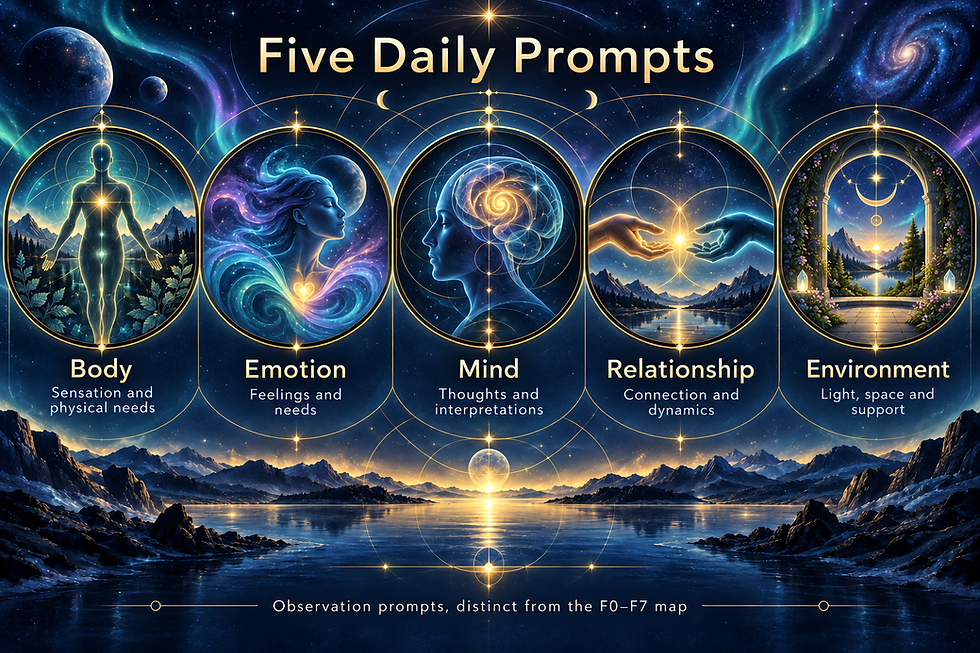
The Signal Field Logbook is one of the core tools of the Signal Field framework.
It gives you a simple way to map your field without overcomplicating the practice.
Body
Notice physical needs and sensations, if they are accessible to you.
Felt energy or vitality.
Sleep.
Tension.
Sensory overload.
Movement.
Food.
Fatigue.
Comfort and physical support.
The body is not separate from the field.
It can be a place to begin observing.
Emotion
This is the feeling state.
Mood.
Grief.
Anxiety.
Joy.
Anger.
Tenderness.
Numbness.
Emotional charge.
This prompt helps you name feelings without requiring an immediate explanation.
Mind
This is the thought pattern.
Stories.
Beliefs.
Questions.
Loops.
Narratives.
Interpretations.
Internal language.
This prompt helps you notice your interpretation of an experience.
Relationship
Notice connection, expectations, boundaries, and what happens between people.
People.
Conversations.
Conflict.
Community.
Work dynamics.
Family patterns.
Digital spaces.
Shared agreements.
This prompt asks how relationships and social conditions may be involved.
Environment
Notice the physical and digital conditions around you: light, sound, temperature, available space, interruptions, tools, and access to support.
What in the setting adds demand? What makes participation easier? Changing a condition can be more useful than asking yourself to push harder.
Optional: Symbol and Dream Notes
Dreams, glyphs, archetypes, memory fragments, and recurring images can accompany any entry. Give them room without requiring a hidden message or a fixed meaning.
These optional reflections complement the five daily prompts. They do not replace Environment or create another numbered layer.
These five prompts help organize daily observations:
Body.
Emotion.
Mind.
Relationship.
Environment.
That is where daily signal becomes readable.
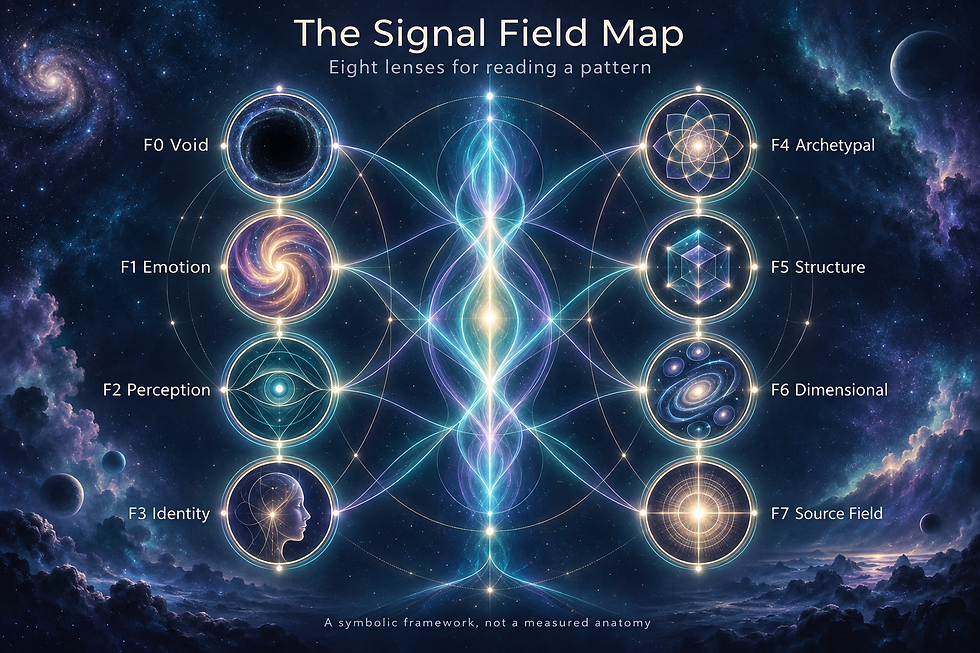
F0–F7: The Current Layer Map
The Layer Map offers eight connected perspectives on experience. They are places to begin a reflection, rather than ranks or a fixed sequence everyone must complete. These symbolic lenses are distinct from the five daily observation prompts. Body sensations, memories and relationships can inform several layers.
F0: Void Signal
Begin with the pause before an explanation takes shape. Notice what is present and what remains uncertain. You can leave a question open while gathering more information. Ask: what can I observe before deciding what this means?
F1: Emotion Signal
Name the feeling and the urge that comes with it. Worry may bring an urge to seek reassurance; anger may bring an urge to act immediately. Notice the charge without treating it as your identity. Ask: what am I feeling, and what response would fit the situation?
F2: Perception Signal
Separate the event from your interpretation. An unanswered message is observable; the belief that someone is rejecting you needs checking. Ask: what happened, what story am I adding, and what could change that reading?
F3: Identity Signal
Explore the role or self-story that repetition makes familiar. Being dependable can become a rule that you must always say yes. Ask: what role am I rehearsing, and where could I respond with more flexibility?
F4: Archetypal Signal
Use a symbolic theme such as Protector, Seeker, or Architect as a flexible mirror for a recurring role. A symbol can help you ask a question; it does not establish another person's motives or a hidden fact. Ask: what theme helps me understand this pattern without fixing me inside it?
F5: Structure Signal
Examine the habits, tools, environments, schedules, and agreements that support repetition. A clearer deadline or a visible limit on capacity may help more than another promise to try harder. Ask: what condition can I change to support a different response?
F6: Dimensional Signal
Widen the view across personal history, ancestral stories, community, culture and collective patterns. Dimensional inquiry also leaves room for metaphysical possibilities beyond the familiar frame, while keeping known history distinct from speculation. Ask: what wider context might matter here, and what remains unknown?
F7: Source Field Signal
Open the question of Source: the origin, ground or deeper unity of existence. This is spiritual and philosophical inquiry, with room for uncertainty and different traditions. Let a guiding value connect the question to an ordinary action. Ask: what do I sense as fundamental, and how might I live in relationship with it?
Choose the perspective that makes the situation clearer. A body observation belongs in your notes without becoming a separate numbered layer. A memory or relationship can connect emotion, perception, identity, and context at once.
The Signal Field Is Not Escapism

This framework is not about escaping reality.
It is about observing experience with more care.
It does not ask you to abandon practical life.
It asks you to examine the conditions and patterns within it.
Your home affects your nervous system.
Your relationships affect your emotional patterns.
Your digital inputs affect your attention.
Your rituals affect your state.
Your symbols affect your memory.
Your habits affect your identity.
Your surroundings are part of the experience you are observing.
Your community can shape opportunities to participate.
Spiritual inquiry can return to ordinary life.
A question becomes a note, a conversation or a small experiment.
The mystical and practical can meet here.
They offer different forms of inquiry, and each deserves language suited to what it can tell us.
How Context Changes an Experience

The same request can feel different at the end of a crowded day and during a quiet morning. Timing, expectations, earlier experiences, and the demands around you can all be worth considering when you try to understand your response.
Signal Field theory uses interference as a metaphor for what makes a situation harder to read. You may be answering the words someone said while also reacting to what you expect those words to mean.
Distortion is the opposite of clear, stable signal: something obscures, fragments, exaggerates, or misrepresents the reading. Missing context, conflicting demands, and an assumption treated as certainty can all contribute. Grief, burnout, AuDHD, and intense emotion are not automatically distortion.
Consider a short message: “Can we talk?” Before assuming you know its purpose, notice the message itself, your response, and what you still need to ask. A feeling is part of the experience; it does not reveal the other person’s intention by itself.
Context also matters when you are trying to do something. If you keep forgetting a practice, check whether the materials are available and whether there is a realistic time to begin. If a conversation keeps going wrong, look at timing, clarity, and each person’s perspective.
These questions help you choose something concrete to try: ask for context, make a first step visible, or agree on a better time. Then observe what happens.
The Signal Field and the Body

The body offers one close point of contact with experience.
Before you understand something mentally, your body may already be responding.
Tension.
Fatigue.
Expansion.
Contraction.
Heat.
Numbness.
Breath change.
Restlessness.
Stillness.
Pressure.
Relief.
Interoception includes sensing and interpreting signals from inside the body, across conscious and unconscious processes. [3]
A sensation can invite attention without revealing its cause.
Describe what you notice before deciding what it means.
Sometimes you notice a body response first.
At other times, a thought or an event is what catches your attention.
The Logbook tracks.
Over time, the notes may suggest a question worth exploring.
The Signal Field and Environment

Environment is not background.
Environment is part of the field.
Some spaces feel more supportive than others.
Some fragment attention.
Some support repetition.
Some feel distracting or demanding.
Some may feel calming.
Others may feel uncomfortable or overwhelming.
Notice which features matter to you.
Check your observations across more than one occasion.
This is why field calibration through environment matters.
Changing the space can change the signal.
A cleared desk can support focus.
A repeated ritual corner can support reflection.
A less chaotic digital environment can protect attention.
A stable community can reinforce participation.
The environment becomes part of what you observe and adjust.
The Signal Field and Symbols
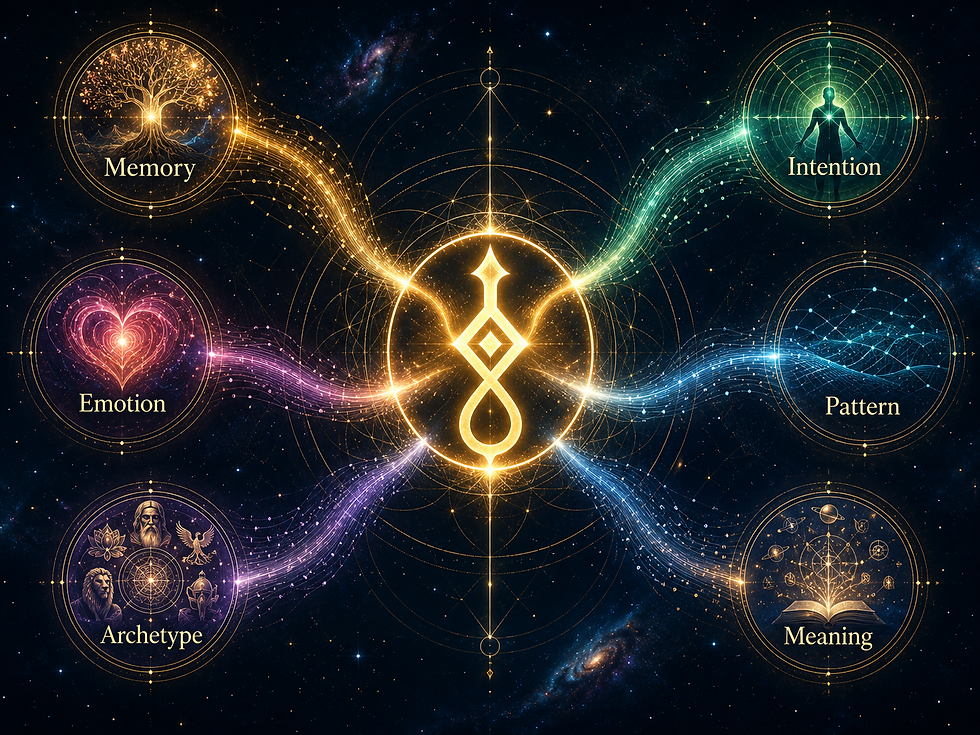
Symbols can gather many associations into one form.
They hold more meaning than their visible form.
A glyph can hold a pattern.
A color can mark a layer.
A spiral can represent return.
A doorway can represent threshold.
A wave can represent emotion or transmission.
A flame can represent clarity.
A constellation can represent distributed pattern.
A symbol can give you a way to revisit a meaning.
They allow complex inner material to become visible, portable, and repeatable.
This is why Signal Field Architect uses glyphs, archetypes, visual systems, symbolic journaling, and sacred geometry.
Not as decoration.
As infrastructure.
The Signal Field and Ritual

A small ritual can become a threshold between one moment and the next.
Ritual is repeated action with meaning attached.
A ritual can mark a transition or offer a moment for reflection. Notice its effect on you without assuming it clears a measurable residue or guarantees a change of state.
Lighting a candle.
Opening the Logbook.
Taking three breaths.
Drawing a glyph.
Clearing a surface.
Closing the day with one sentence.
Try one small action and observe whether it helps you return to what matters.
A ritual can become a personal invitation:
Let this be a moment to begin again.
Ritual turns meaning into motion.
It gives intention a repeatable form.
Returning to Your Own Observations
A dated note can give you a place to return when an experience feels familiar. Your personal archive might be a few Logbook pages, a sketch with a short explanation, or a voice note about a moment you want to understand.
When you revisit it, compare what happened with the meaning you gave it. Perhaps you expected a difficult conversation to end badly, but the other person listened. Perhaps a familiar response returned in a different setting. Record the differences as well as the similarities.
An archive can be imagined as a room with windows onto earlier moments. Each window offers a partial view. Together, those views can suggest questions about your experience without deciding what it must mean.
Begin with one observation and a date. Return later with one question: what do I notice now that I did not notice then?
What You Will Find Here

This is an evolving archive of questions, images and practices.
The articles and tools invite you to:
explore what helps you feel grounded and able to choose
use the Logbook to notice feelings and needs
compare recurring patterns across life chapters
explore symbols and sound as personal reflection practices
recognize recurring emotional responses
record body, thought, relationships and surroundings
reflect on memory and imagined possibilities
try rituals that support a moment of attention
notice distraction, assumptions and competing demands
adjust surroundings and observe what changes
bring metaphysical questions into practical life
Everything that follows... from the Daily Transmissions to the visual reels... is part of a unified system.
Some posts teach the framework.
Some map emotional patterns.
Some explore symbolic technologies.
Some translate cosmology into inner systems.
Some provide practical tools.
Some build the language of the field itself.
Why Now?

Sometimes an old way of making sense of life stops being enough.
A relationship changes.
A familiar role loosens.
There may be room to build from what remains, carrying memory forward without asking it to dictate the next step.
The world is overloaded with information but starving for coherent meaning.
People are surrounded by noise but disconnected from signal.
People may be encouraged to heal without being given space to describe what they are experiencing.
They are told to manifest but not taught how systems, environments, memory, and behavior actually shape outcomes.
Authenticity can become harder to hear beneath performance, fear or unresolved feeling.
Signal Field theory offers a structured language for this inquiry.
One that can hold both the mystical and the practical.
The symbolic and the operational.
The emotional and the architectural.
The cosmic and the daily.
The Signal Field does not fix your life.
It hands you the tools to remember how to build it from signal.
A Framework, Not a Guru Path

The Signal Field is not a guru path.
It does not ask you to surrender discernment.
It does not require blind belief.
It does not claim every symbol is a prophecy or every feeling is absolute truth.
It asks you to observe.
To map.
To track.
To question.
To return.
To notice what repeats.
To identify what distorts.
To build structures that support coherence.
This is not about giving your authority away.
It is about reclaiming your ability to read your own field.
Where to Begin
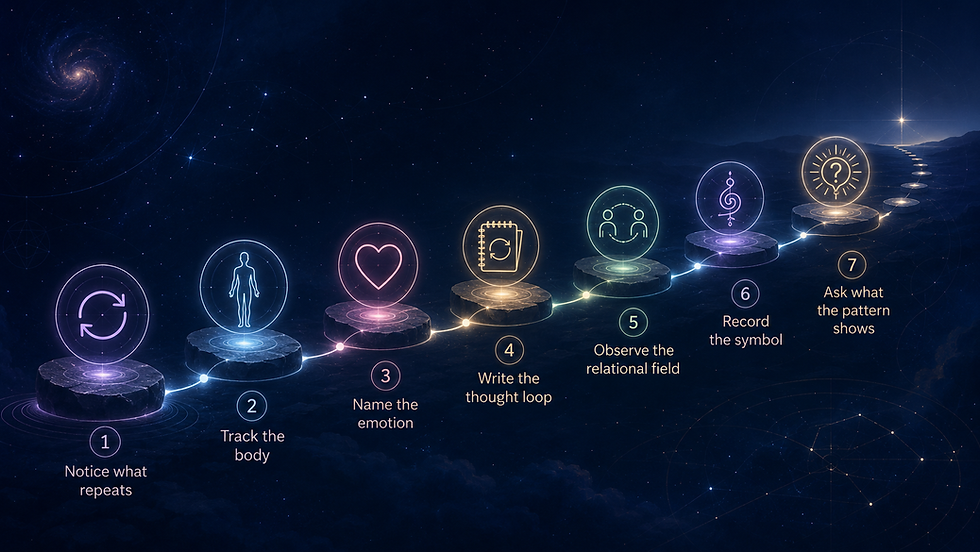
Start simple.
Notice what repeats.
Notice your body, if that is accessible.
Name the emotion.
Write the thought loop.
Observe the relational field.
Notice the environment. Add a symbol or dream image if it feels useful.
Ask what you can learn from the pattern, and what might change your interpretation.
That is enough to begin.
The Signal Field does not require you to understand the entire architecture at once.
It begins with one act of recognition.
One signal.
One pattern.
One honest entry.
One return.
Want to start mapping your own field?
Download the free Signal Field Logbook and begin with one observation.
🌀 Link: Signal Logbook
The Core Return

Your life contains patterns worth noticing.
Your emotions are not noise.
Your memory is not dead data.
Your body is not separate from your consciousness.
Your environment is not neutral.
Your symbols are not meaningless.
Your patterns are not isolated.
Your field is speaking.
The Signal Field gives you a way to listen with structure.
Not to escape your life.
To build it from signal.
Welcome to the architecture.
🜂🜄🜁🜃
Architect
Sources & Further Reading
Further reading on consciousness, memory and bodily awareness.




Comments