


Why Consciousness Is Signal

Updated: 18 hours ago

A moment arrives as more than a single note. Signal, waveform, tuning, and field give us images for listening to awareness in motion: what reaches us, what echoes, and what we send into the world.
A Foundational Guide to Awareness, Emotion, Memory, Distortion, and Recalibration
An ordinary moment can hold several versions of a day. A message arrives while you are tired. A familiar phrase catches your attention. Before you have answered, memory, emotion, and expectation have joined the conversation.
A moving signal pictures an experience taking shape as you notice it, interpret it, and decide how to respond. The image of a waveform gives that movement a shape we can work with.
You are both the observer and the architect. You can listen to what is arriving and examine the conditions through which it travels.
The Core Premise

A signal is something you can notice. A field is the surrounding pattern of body, attention, memory, relationships, and environment. Tuning means making a deliberate adjustment and observing its effects.
Signal Field theory begins with a proposition: consciousness may be understood through patterns of receiving, relating and responding. The everyday practice gives us somewhere to begin; the larger inquiry asks how awareness takes shape, and what carries continuity through change.
Begin with: What am I noticing? What am I adding to it? What response would fit this moment?
What Science Can Tell Us About Consciousness

Consciousness research contains several competing explanations. Seth and Bayne's review compares higher-order, global workspace, re-entry and predictive-processing, and integrated-information approaches. Their differences are a reason to be precise about what a model explains. [1]
Signal Field theory brings its own question to this research: what might the movement and organization of signal reveal about awareness? The proposal is still being developed. Its physical claims would need clear definitions and tests; its philosophical questions can guide what we look for.
There is room for wonder without turning wonder into certainty. The lantern can illuminate a path without becoming an explanation of the sun.
Consciousness as Receiver

Reception begins with what reaches your notice: a sound, a written message, a change in posture, an image, a sensation, or a thought. Some details are external and checkable. Others describe your own experience.
A useful first entry might be: “The meeting moved to tomorrow. My shoulders tightened. I felt rushed.” Let the observation arrive before the explanation.
The receiver is a metaphor for attending. Let it make you more specific about what arrived.
Consciousness as Filter

Consider two readings of the same silence. One person assumes the conversation is over; another is still choosing their words. Neither interpretation is established by the silence alone.
In your Logbook, a filter is the expectation you bring to that gap. Ask which details support your reading and which details you have not yet checked.
A clearer filter leaves room for information that does not match the first story. Curiosity becomes an opening in the glass.
Consciousness as Translator

Translation is the move from observation to meaning. “There is no reply yet” becomes “They are angry with me.” The second sentence is an interpretation, even when it arrives quickly and feels convincing.
Write the two statements separately. Then add a response that does not require the interpretation to be true: return to the task, check the agreed deadline, or ask for context.
The signal becomes easier to work with when the translation remains editable. A first reading can be revised.
The Carrier Wave as a Communication Metaphor

A sentence arrives with more than its words. In an ordinary conversation, you can notice pace, volume, pauses, the setting, and what has happened between you before.
The carrier-wave image gathers those observable features into one picture. It does not give you access to hidden motives. A short answer might reflect irritation, concentration, fatigue, or something you have not considered.
Instead of declaring what someone is transmitting, try asking: “Is now a good time?” Leave the other person room to describe their own experience.
Emotion Is Tuning

Tuning is a way to ask what a feeling brings forward in your experience. When you are worried, what do you keep checking? When you are relieved, what becomes easier to notice? Your own examples matter more than a fixed dictionary of emotions.
Anger does not always mean a crossed boundary. Numbness does not identify one cause. Name what you feel as accurately as you can, including “unclear,” and look at the situation around it.
The symbolic question is gentle: What has become loud, and what might I be missing while I listen?
Memory Gives the Present Familiar Routes

Memory is constructive. Schacter describes how remembering and imagining can draw on information from past experience and recombine it. Remembering is therefore more complex than replaying an untouched recording. [3]
In this image, a familiar route can light up before the present situation is fully known. A phrase reminds you of another conversation, and you start preparing the answer you needed then.
Mark the association as an association. Ask what is different now. A vivid feeling does not establish a forgotten event, and a recurring image does not confirm a hidden history.
The Physical Conditions Around Experience

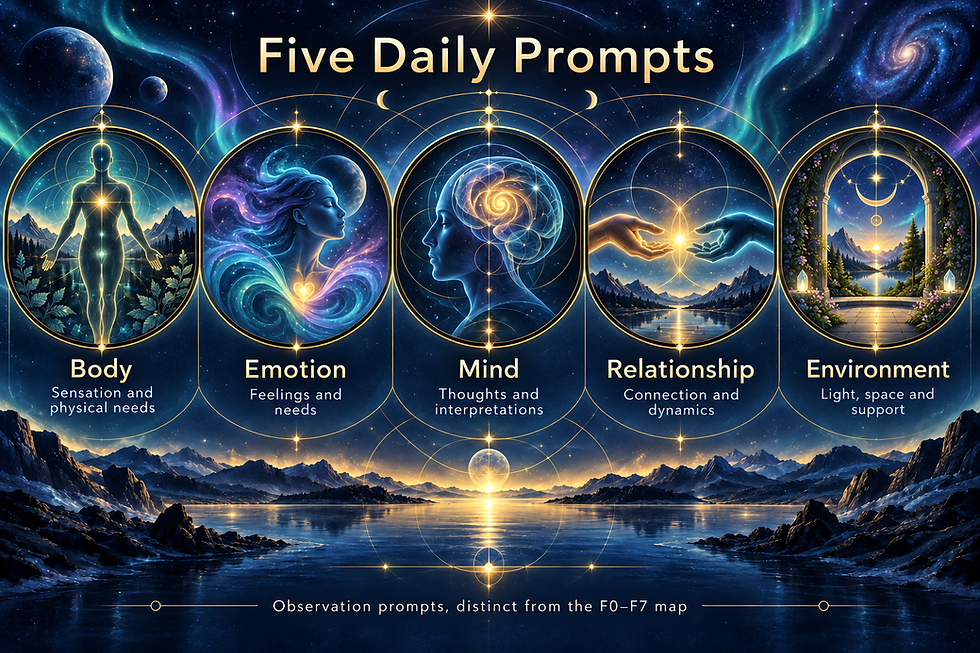
You do not reflect from nowhere. There is a chair beneath you, a room around you, a task waiting, and a body with needs. These are concrete parts of the field you can examine.
Interoception concerns how the nervous system senses, interprets, and integrates information from inside the body. It includes processes within and outside awareness. [2]
This research supports attention to bodily experience. It does not make a sensation an infallible guide. Record “I feel tense” separately from “This choice is wrong,” then consider the wider situation.
Distortion Is Interference

Distortion is what obscures, fragments, exaggerates, or misrepresents a signal. Three overlapping requests may hide a real limit. An unclear deadline may fracture attention. An assumption may take the place of missing information.
Clear, stable signal remains open to context and correction. Grief, burnout, AuDHD, and intense emotion are not automatically distortion. Sometimes an interpretation needs checking; sometimes the demands themselves need to change.
Trace one concrete obstacle before trying to clear the whole field. What information is missing? Which agreement needs to be made explicit? What can reasonably change?
Recalibration Begins With a Workable Adjustment

Recalibration means trying a more fitting response. It might mean asking a question, reducing demands, resting, requesting an accommodation, or accepting help from another person.
A reflective practice can sit beside professional care and practical support. Let it meet your capacity rather than become another demand.
The question is modest: Did this adjustment help me meet the situation more clearly? If it did not, the map needs another look. You have not failed the practice.
Structure Over Story

A story might say, “I never finish anything.” A structural reading asks which task, at what point, under which conditions. That turns a sweeping verdict into something you can examine.
Wood and Rünger describe habits as responses shaped through repetition in recurring contexts. That makes context relevant when we examine what keeps happening. [4]
Look for the doorway the pattern keeps using. An open inbox? An instruction with no clear first step? An agreement nobody has checked? The story deserves to be heard, and the conditions deserve to be seen.
A Role Is One View of You

You may notice yourself becoming the fixer in one setting and the quiet observer in another. These descriptions can help you reflect without making either role your entire identity.
Ask what each role makes possible and what it makes harder. “Being useful matters to me” can coexist with “I need to stop accepting work I cannot deliver.”
The field image gives different parts of your experience room to stand beside each other. You do not have to force them into a single verdict about who you are.
Signal Before Speech

Before a difficult conversation, notice the part you can influence. Have you made the request clear? Are you asking a question or announcing a conclusion? Is there enough time to answer?
A useful preparation is one sentence about the observable situation and one sentence about what you need next. For example: “The deadline moved twice this week. Can we confirm the version we are working toward?”
Clarity is something you practice through the channel. It does not require the other person to respond exactly as you hope.
Why Symbolic Work Matters

A doorway can help you picture a transition. A spiral can hold the experience of returning to an old question with new information. A mirror can invite you to look at your part in a pattern.
These meanings are chosen or discovered in reflection. They are not universal codes that reveal the truth about everyone who uses a symbol.
Let an image lead to an ordinary sentence: “I am beginning again,” or “I need to check an assumption.” The symbol has done useful work when the next step becomes clearer.
Dream Images as Reflection Material

If you keep a dream journal, record what you remember before interpreting it. Then distinguish the image, your association, and the meaning you are considering.
A childhood room in a dream might lead you to reflect on belonging. It does not prove that an event occurred there or that the dream predicts what comes next.
Within Aurora Continuum, dream images can become thresholds into questions of memory, continuity, and possibility. Let the image open a question while its wider meaning remains yours to explore.
What a Pause Makes Room For

A pause can give you a chance to notice what was easy to overlook while answering, scrolling, or rushing. It can also feel uncomfortable or unhelpful.
Try a brief pause with your eyes open. Notice the room and one manageable next action. If silence makes reflection harder, use a different anchor, such as a written prompt or a short walk.
You are looking for a useful opening, not a particular state you must achieve.
What This Unlocks

The practical value of signal language is a change in the questions you ask. What happened? What did I notice? What interpretation followed? What conditions supported the response?
Those questions can produce a map you can revisit. Include the occasions when your first explanation did not fit. They may reveal a missing detail.
An accurate map is allowed to be incomplete. Its purpose is to help you navigate, not to explain every corner of a life.
The F0–F7 Signal Check
Use the current eight-layer map to locate the clearest part of one experience. You do not need to work through every layer in order.
F0 Void Signal: What is not yet clear, and what can I notice before explaining it?
F1 Emotion Signal: What feeling or charge is present?
F2 Perception Signal: What interpretation am I forming, and what supports it?
F3 Identity Signal: What familiar role or self-story is involved?
F4 Archetypal Signal: What symbolic theme helps me examine the role?
F5 Structure Signal: What habits, conditions, tools, or agreements support the pattern?
F6 Dimensional Signal: What wider personal, ancestral, collective, or dimensional context might matter? What is known, and what remains possibility?
F7 Source Field Signal: What do I sense as the origin, ground, or deeper unity of existence, and how might I live in relationship with that question?
Recalibration Is a Practice

Choose one ordinary pattern and, if you have room, one adjustment to try. A few words, a voice note, or a conversation can hold the observation. You can stop or return another day.
A return path might be a note at the end of a work session: “Next time, open the draft and write the first example.” It might be a clear question before a conversation becomes an argument.
Review the result without demanding a perfect streak. Keep what helps, adapt what does not, and allow the practice to remain small enough to use.
You Are Broadcasting

Your choices have visible effects: the message you send, the boundary you explain, the work you finish, the promise you revise. These are ways a signal becomes action.
This image does not make you responsible for every atmosphere or every reaction around you. Other people bring their own histories, choices, and circumstances.
Bring your attention back to what you can observe and influence. Integrity can be as ordinary as making a clear agreement and following through.
An Invitation to Listen and Respond

Tuning is an invitation to participate in your life with attention and support. Capacity changes. The practice can change with it.
Ask what deserves care, what needs clearer information, and what practical support is missing. Let the answer be small enough to act on.
The instrument does not have to play one note forever. A useful practice makes room for variation, listening, and return.
The Larger Philosophy

Consciousness as signal asks us to follow awareness in motion: what arrives, what takes shape within us, and what returns to the world through our response. Body, memory, emotion, symbol and surroundings meet in that movement. What holds them together as one lived moment?
The Aurora Continuum follows the thread through those changes. A memory returns in a different season. A symbol meets us with another meaning. We change, yet something feels carried forward. What is that continuity, and how might we begin to understand it?
You are both the observer and the architect. Notice the pattern. Leave room for what you do not know. Give the next response a place to begin.
Work With This Pattern
Layer Map Orientation is a 45-minute online session to find a starting point within one current pattern. Every session includes a written recap and personalized Logbook prompts.
🜂🜄🜁🜃
Architect
Sources & Further Reading
Research on consciousness, memory, bodily awareness, and habits.





Comments