


What Is Resonance?

Updated: 2 days ago

Pattern, Perception, and the Architecture of Interaction
The word resonance is often used loosely.
People use it to describe emotions, ideas, music, spirituality, attraction, intuition, relationships, aesthetics, energy, and even truth itself. Something “resonates” when it feels meaningful, recognizable, emotionally charged, or internally aligned.
But beneath the metaphorical use of the word is a real structural principle.
For a driven mechanical oscillator, resonance is a strong response when a periodic driving frequency is near a natural frequency of the system. Damping influences the size of that response.
A tuning fork vibrates when exposed to the right tone.
A swing can gain amplitude when repeated pushes arrive at a suitable rhythm.
The timing of the input matters, as does the energy lost along the way.
Resonance is not random agreement.
It is patterned responsiveness.
Signal Field theory also uses resonance symbolically: the felt recognition that can arise when an image, encounter or idea meets something already alive within us.
emotional
psychological
symbolic
environmental
social
informational
behavioral
The framework treats resonance as a recognition process between interacting systems.
Resonance in Physics

In this physical example, resonance concerns a system's response to periodic driving.
The response depends on the driving frequency, the system's natural frequencies and damping.
Small inputs can suddenly create large effects when the receiving system is tuned to respond.
This principle appears throughout nature:
sound
electromagnetism
orbital mechanics
acoustics
biological rhythms
harmonic systems
Resonance does not create structure from nothing.
It amplifies existing compatibility.
That distinction matters.
Resonance in Human Experience

Human beings are also pattern-sensitive systems.
We respond continuously to:
environments
emotional states
social behavior
language
symbolism
repetition
stress
music
imagery
narratives
group dynamics
Certain places feel calming.
Certain people feel destabilizing.
Certain symbols feel emotionally charged.
Certain memories carry lasting energetic weight long after the original event has passed.
Signal Field theory explores these interactions through the lens of resonance.
That symbolic inquiry asks what an experience stirs, what it recalls, and what meaning gathers around it.
Repeated emotional exposure shapes nervous-system expectations.
Repeated narratives shape worldview structures.
Repeated environmental conditions shape identity, behavior, and psychological adaptation.
Over time, people begin synchronizing with the systems surrounding them.
Resonance Is Not Blind Agreement

One of the biggest misunderstandings about resonance is the idea that resonance means:
“Whatever feels good must be true.”
That is not the framework being proposed here.
Resonance is not automatic truth.
People can resonate with:
fear
propaganda
chaos
trauma patterns
manipulation
groupthink
nostalgia
distortion
unhealthy attachment
Human systems are highly influenceable.
This is why repetition matters so much.
The more a signal is reinforced emotionally, socially, symbolically, or environmentally, the more normalized it becomes inside the receiving system.
Resonance simply describes responsiveness and reinforcement.
Not moral correctness.
Emotional Resonance
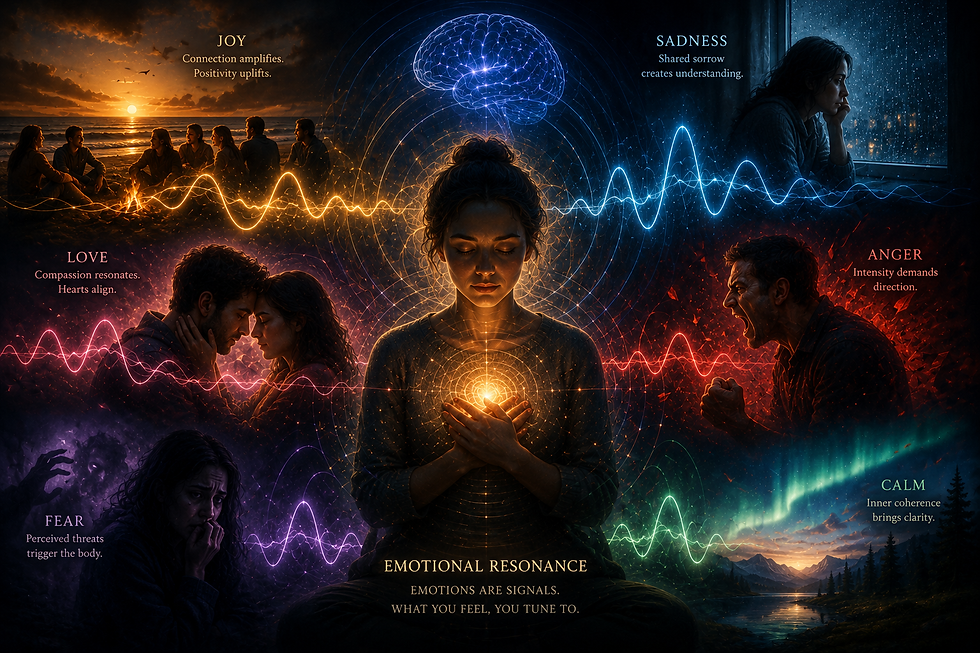
Emotion functions as a powerful amplification mechanism.
Experiences that carry emotional intensity tend to persist longer in memory and perception because emotional activation increases pattern significance.
This is why:
music can trigger memories instantly
symbolic imagery can feel deeply personal
traumatic experiences can reshape identity
repeated stress alters nervous-system behavior
emotionally charged environments affect long-term perception
Emotional resonance can become a doorway into memory, attention and meaning: an invitation to notice what an encounter awakens.
Over time, emotional resonance shapes internal architecture.
Symbolic Resonance

Humans are symbolic creatures.
Flags, religious imagery, logos, mythology, language, rituals, archetypes, architecture, and visual systems all influence perception beyond their literal function.
A symbol is not just an image.
A symbol acts like compressed meaning.
It stores associations, emotional responses, historical memory, identity structures, and psychological narratives inside recognizable forms.
This is why symbolic systems appear across:
religion
governments
corporations
mythology
media
tribal identity
advertising
art
social movements
Signal Field theory studies symbolic resonance as a form of pattern interaction between perception and meaning.
Coherence and Distortion

Some systems stabilize themselves through coherence.
Others destabilize through contradiction, overload, fragmentation, or environmental pressure.
Within the framework:
coherence refers to stable internal alignment
distortion refers to fragmentation, overload, or conflicting pattern reinforcement
A coherent system does not necessarily mean a perfect or enlightened system.
It means the system maintains recognizable structural integrity under pressure.
Distorted systems often exhibit:
emotional volatility
compulsive reaction
contradictory identity structures
chronic overload
fragmented attention
unstable perception
environmental dependency
Resonance offers a symbolic lens for asking which patterns seem to grow stronger over time.
Why Resonance Matters

Modern society is built on competing signal environments.
People are constantly exposed to:
algorithmic reinforcement
emotional media cycles
symbolic persuasion
ideological pressure
social synchronization
information overload
identity performance systems
Most people dramatically underestimate how much repeated exposure shapes perception and behavior.
Signal Field theory uses resonance language to help map these interactions more consciously.
Begin with one encounter.
Notice what it stirred and what you actually observed.
Then explore:
pattern reinforcement
environmental influence
emotional conditioning
symbolic architecture
internal stabilization
conscious participation
The goal is not escaping influence entirely.
That is impossible.
The goal is becoming more aware of what shapes you, what destabilizes you, and what helps restore coherence.
Resonance as Recognition

At its deepest level, resonance is recognition.
A system encounters a pattern and responds because something within it recognizes compatibility, familiarity, amplification, or alignment.
Sometimes that recognition is healthy.
Sometimes it is destructive.
Sometimes it reveals hidden structure.
Sometimes it reveals unresolved fragmentation.
The encounter may leave traces.
It shapes memory.
Attention.
Emotion.
Behavior.
Identity.
Meaning.
Signal Field theory explores these interactions as part of a larger attempt to understand consciousness, symbolic systems, perception, and the architecture of human experience.
Not as rigid doctrine.
But as an evolving map of patterned interaction.
🜂🜄🜁🜃
Architect






Comments