


Glyphs And Pattern Recognition

Updated: 2 days ago
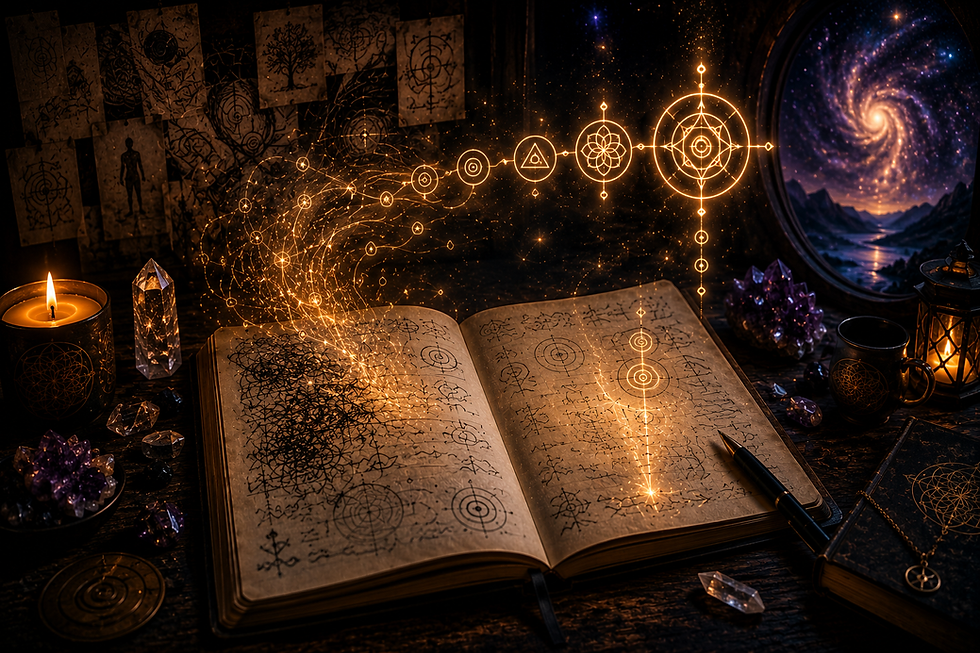
How Repeating Forms Become Signals Before They Become Language
A glyph is more than a mark.
It may look simple.
A line.
A spiral.
A triangle.
A circle.
A crosspoint.
A wave.
A gate.
A star.
A repeated curve.
A symbol drawn without knowing why.
But glyphs often appear where language has not caught up yet.
They are compact pattern forms... small visual structures that can hold emotion, memory, orientation, intention, and recognition before the mind can explain them clearly.
Within Signal Field theory, glyphs are treated as pattern recognition devices.
They help make invisible structure visible.
They give the field a shape to work with.
They turn repetition into signal.
A Glyph Is a Pattern Marker
A glyph is not just decoration.
It is a visual anchor.
It can mark:
a feeling
a memory
a threshold
a recurring dream
a personal pattern
a field state
a protection boundary
a transition point
a symbolic instruction
a repeating emotional structure
The value of a glyph is not only in how it looks.
The value is in what it helps you recognize.
A glyph becomes useful when it gives form to something that keeps returning.
Pattern Recognition Comes First
Before you can change a pattern, you have to see it.
Glyph work can sit alongside journaling, noticing recurring patterns and emotional reflection.
Most patterns do not announce themselves clearly at first.
They appear as fragments.
A repeated feeling.
A recurring phrase.
A dream image.
A familiar reaction.
A body sensation.
A relational loop.
A symbol you keep drawing without planning to.
At first, these fragments seem separate.
Pattern recognition is the moment you realize they are connected.
A glyph can become the shape that holds that recognition.
Why the Mind Uses Shape
The mind does not only organize reality through words.
It also organizes through form.
Circles, arrows, spirals and thresholds may call up associations shaped by experience, culture and context.
A spiral feels different from a straight line.
A closed circle feels different from an open gate.
A jagged line feels different from a soft curve.
A triangle feels different from a cloud.
These forms communicate before explanation.
That is why glyphs can help translate subtle inner material into something visible.
The shape becomes a bridge between sensation and language.
Glyphs Compress Recognition
A glyph works because it compresses a pattern into a mark.
Instead of writing an entire paragraph every time a pattern appears, you can begin to recognize its symbol.
A spiral may mark return.
A wave may mark emotional movement.
A gate may mark transition.
A circle may mark protection.
A fractured line may mark distortion.
A star may mark orientation.
A root form may mark grounding.
A flame may mark purification or clarity.
The glyph becomes shorthand.
Not to avoid deeper reflection, but to make recognition faster.
When the symbol appears again, the field remembers.
Personal Glyphs Versus Universal Symbols
Some glyphs carry broad symbolic meaning.
The circle.
The spiral.
The tree.
The flame.
The moon.
The eye.
The doorway.
The bridge.
These forms appear across myths, dreams, religions, art, and architecture because they represent recurring human patterns.
But personal glyphs are different.
A personal glyph may only make sense to you.
A specific curve.
A shape from a dream.
A mark you keep drawing unconsciously.
A symbol that appeared during grief.
A pattern connected to a relationship or season of your life.
Both matter.
Shared symbols can connect you with traditions of meaning, while their interpretation varies across people and cultures.
Personal glyphs connect you to your own field.
Glyphs and the Daily Logbook
Glyphs are an optional addition to the Daily Logbook. Keep the five daily fields: Body, Emotion, Mind, Relationship and Environment. Add a mark beside an entry or explore it on the separate dreams and symbols page.
At the end of an entry, ask:
What shape matches today’s signal?
Do not overthink it.
Draw the first simple form that fits.
It might be:
a spiral for returning
a square for containment
a wave for emotional movement
a cracked circle for interrupted coherence
a small flame for clarity
a doorway for transition
a knot for entanglement
a vertical line for alignment
an eye for witnessing
a root shape for grounding
Over time, you may notice certain glyphs repeat.
That repetition is something to examine alongside the rest of your notes.
Ask whether the same situation returned, whether your attention changed, or whether the mark has become a habit.
Glyphs Reveal Emotional Architecture
Emotions often have shape.
Anxiety may feel like static.
Grief may feel like water.
Anger may feel like heat or sharp lines.
Numbness may feel like fog.
Pressure may feel like compression.
Hope may feel like light breaking through a boundary.
When you turn an emotional state into a glyph, you are not reducing the emotion.
You are giving it architecture.
A feeling that seemed shapeless becomes something you can observe.
You can place it on the page.
You can compare it to yesterday.
You can notice when it softens, tightens, expands, repeats, or changes form.
This is emotional mapping through symbol.
Glyphs and Repetition
A glyph becomes more powerful when it repeats.
The first time you draw a symbol, it may simply be an image.
The fifth time it appears, it becomes a pattern marker.
The tenth time, it may reveal a deeper structure.
For example:
You draw a locked door after a dream.
Then a few days later, you draw another door after a difficult conversation.
Then you notice doorway imagery appearing in music, memory, and writing.
Eventually, the pattern becomes clear.
The door becomes a question worth exploring.
It may represent hesitation, transition, protection, fear, or readiness.
The glyph becomes a thread you can follow.
Glyphs Are Not Predictions
Glyphs are not fortune-telling devices.
They are recognition tools.
A glyph does not tell you exactly what will happen.
It helps you notice what is active.
That distinction matters.
A glyph can show:
what pattern is repeating
what feeling is unresolved
what transition is forming
what boundary is needed
what memory is surfacing
what energy is organizing
what part of the field wants attention
It is not there to control the future.
It is there to make the present more readable.
Drawing Without Skill
You do not need to be an artist.
Glyph work is not about aesthetic perfection.
A useful glyph can be rough.
A circle with a break in it.
Three lines crossing.
A spiral with a dot.
A wave inside a square.
A triangle over a path.
A doorway under a moon.
The question is not:
Does this look impressive?
The question is:
Does this help me recognize the pattern?
The field does not require perfect art.
It requires honest form.
The Glyph Creation Process
Start with a pattern.
Not a design goal.
Ask:
What keeps repeating?
Then move through five steps.
1. Name the Pattern
Choose one active pattern.
Examples:
overthinking
emotional shutdown
returning grief
fear of visibility
relational entanglement
transition
protection
clarity
exhaustion
new beginning
2. Feel the Shape
Ask:
If this pattern had a shape, what would it be?
Sharp or soft?
Open or closed?
Heavy or light?
Spiral or line?
Contained or expanding?
3. Draw the First Form
Make a simple mark.
Do not edit too early.
Let the first version appear.
4. Refine the Signal
Remove anything unnecessary.
A glyph works best when it is clear.
Not crowded.
Not over-explained.
Condense the pattern.
5. Assign Meaning
Write one sentence beneath it.
Example:
This glyph marks the moment I recognize a loop before entering it.
Or:
This glyph represents protection without withdrawal.
Or:
This glyph means I can return without restarting from zero.
Now the glyph has function.
Glyphs as Field Anchors
A glyph can become a field anchor when used consistently.
You might place it:
in your journal
on a sticky note
on your altar
as a phone wallpaper
inside a blog image
in a sigil card
on a printed logbook page
beside a weekly intention
at the bottom of a reflection entry
The glyph reminds the system of the pattern you are tracking or the signal you are choosing to stabilize.
It becomes a visual return point.
A symbol you can recognize when language becomes too slow.
Glyphs and Signal Hygiene
Glyphs can help clear distortion because they externalize internal material.
When a pattern remains vague, it can feel overwhelming.
When it becomes visible, the system can relate to it differently.
You might draw a glyph for:
anxiety
grief
boundary repair
digital overload
emotional residue
unfinished conversations
repeated triggers
feeling overwhelmed
Then ask:
What does this glyph need?
More space?
A boundary?
A softer line?
A closing circle?
A release mark?
A stabilizing center?
This transforms journaling from analysis into visual recalibration.
Glyphs and Pattern Interruption
Once a glyph becomes associated with a pattern, it can help interrupt the loop.
For example:
You create a glyph for over-explaining.
Whenever you notice yourself about to defend, justify, or over-clarify, you draw the glyph or imagine it.
That small act creates a pause.
The pause creates awareness.
Awareness creates choice.
Let the mark become a small ritual of return.
Its usefulness lies in whether it helps you pause, notice and choose your next action.
A Small Mark in an Ordinary Day
Imagine drawing an open circle beside a question in your Logbook. For you, it means “I do not know yet.” Later, when you feel tempted to settle on an explanation, the mark reminds you that the question is still open.
You add a line about what you actually noticed. Perhaps a friend was quieter than usual. You also write what you guessed: that they were upset with you. The circle holds space for information you do not have.
If you later learn that your friend was tired, add that detail. The mark has helped you keep an observation separate from an assumption. It did not interpret the situation for you.
Try choosing one simple mark for one useful purpose: a pause, an unanswered question, or something that helped. Write its meaning beside it. When you review your notes, ask whether the mark made the entry easier to understand. Change it if it did not.
Glyphs as Interfaces
A glyph is an interface between the visible and the invisible pattern.
It lets the internal field communicate with the external world.
It gives the body something to recognize.
It gives the mind something to organize.
It gives memory something to attach to.
It gives emotion something to move through.
It gives intention something to return to.
This is why glyphs appear in spiritual systems, scientific diagrams, navigation marks, alphabets, maps, brands, rituals, and technology.
They are not only aesthetic forms.
They are functional compression structures.
They help systems communicate.
When Glyph Work Becomes Too Much
Glyph work should create clarity, not obsession.
If you start turning every mark into a command, the practice becomes distorted.
Use grounding questions:
Does this glyph help me recognize a real pattern?
Does it create clarity or confusion?
Does it support coherence?
Does it connect to repeated experience?
Does it help me respond differently?
Am I using this symbol to avoid direct action?
A healthy glyph practice supports awareness.
It does not replace discernment.
The symbol points to the pattern.
You still have to live the correction.
Beginner Practice
For seven days, create one small glyph per day.
Use this template:
Today’s Active Pattern:
What kept repeating?
Emotional Tone:
What feeling came with it?
Body Signal:
Where did I feel it?
Glyph:
Draw one simple form.
Meaning:
What does this glyph help me recognize?
Alignment:
What small action does this pattern ask for?
At the end of the week, look back.
Ask:
Which glyph repeated?
Which shapes felt familiar?
Which emotions had similar forms?
Which patterns became easier to see?
Which glyph felt like an anchor?
This is how a symbolic language begins.
Not from theory.
From repetition.
The Larger Philosophy
Glyphs are the marks left behind when pattern becomes visible.
They are small structures that help consciousness recognize itself.
They translate emotion, memory, repetition, and intention into form.
A glyph does not need to explain everything.
It only needs to hold enough of the pattern for awareness to return.
That is the power of symbolic work.
The field speaks in repetition before it speaks in certainty.
A glyph gives that repetition a shape.
And once the shape is visible, the pattern can no longer hide entirely beneath the surface.
You can see it.
You can name it.
You can track it.
You can change your relationship to it.
That is where recognition begins.
Not in perfect language.
In the first mark that tells the truth.
🜂🜄🜁🜃
Architect





Comments