


Symbols As Compression Devices

Updated: 2 days ago
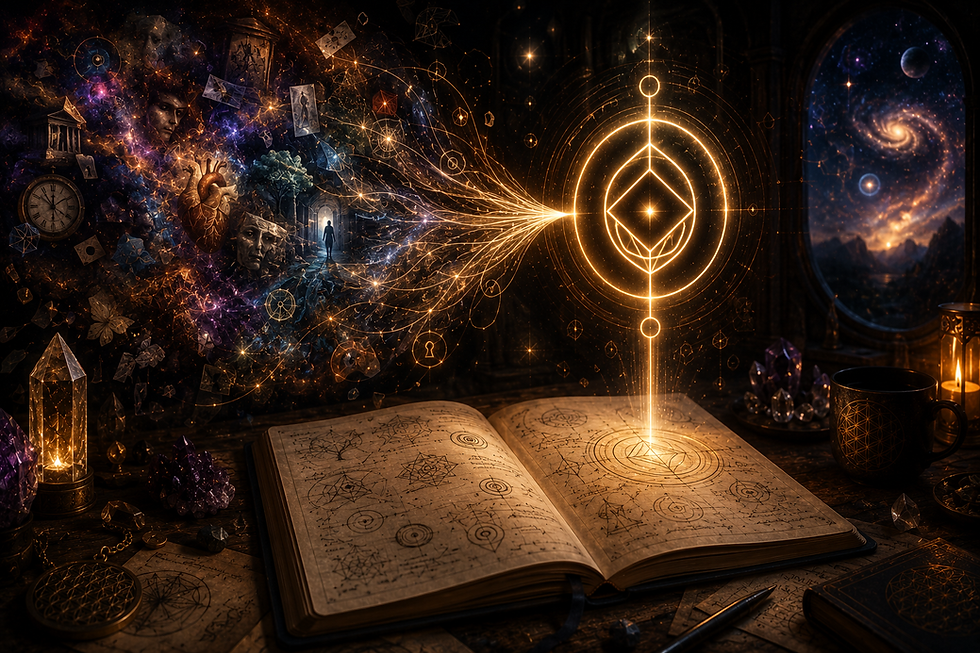
How Meaning, Memory, Emotion, and Pattern Collapse Into Form
A symbol is never just a symbol.
It may look simple.
A spiral.
A door.
A flame.
A circle.
A key.
A tree.
A star.
A wave.
A sigil.
A mark on a page.
But a symbol can hold more than its shape.
It can carry memory.
It can carry emotion.
It can carry identity.
It can carry pattern.
It can carry instruction.
It can carry a whole inner world in one condensed form.
Within the Signal Field framework, symbols function as compression devices.
They take something too large, layered, or subtle to hold in ordinary language and compress it into a form the mind, body, and field can recognize.
A symbol is meaning folded into shape.
Compression Is Not Reduction
When something is compressed, it is not necessarily made smaller in importance.
It is made more portable.
A song can compress an entire season of your life into three minutes.
A photograph can compress a relationship, a memory, a grief, and a timeline into one image.
A word can compress a wound.
A name can compress a history.
A symbol can compress an entire field pattern.
This is why symbols matter.
They do not always explain.
They contain.
The meaning is not erased.
It is folded.
Why Symbols Carry So Much
The human system does not process reality only through direct language.
It processes through:
image
pattern
metaphor
memory
emotion
repetition
body sensation
association
dream logic
archetypal recognition
environmental imprint
A symbol can touch several of these layers at once.
This is why one image can affect you faster than a full paragraph.
A familiar symbol may bring an association to mind before you have put it into words.
You do not have to explain why a locked door feels different from an open road.
Your own experience helps shape the difference you feel.
The Symbol as Container
A symbol acts like a container.
It gives form to something that might otherwise remain scattered.
Grief may become water.
Transition may become a bridge.
Protection may become a circle.
Transformation may become fire.
Return may become a spiral.
Choice may become a forked path.
A locked room may give uncertainty or privacy a shape.
The symbol does not replace the experience.
It gives the experience a shape.
Once the feeling has shape, it becomes easier to witness.
This is why symbolic work can be stabilizing.
It takes emotional material that feels infinite and gives it a boundary.
Symbolic Compression in Everyday Life
People use symbolic compression constantly without realizing it.
A wedding ring compresses commitment, memory, identity, promise, and relationship into one object.
A flag compresses history, belonging, territory, sacrifice, identity, and conflict.
A family photo compresses time, lineage, grief, love, and absence.
A tattoo compresses story, transformation, survival, or devotion into the body.
A logo compresses an entire brand identity into a mark.
A symbol is not powerful because it is complicated.
It is powerful because it holds layered meaning in a recognizable form.
Meaning Folded Into Form
A symbol can gather several associations into one recognizable form.
It can hold:
emotional charge
memory residue
pattern recognition
identity code
archetypal meaning
relational imprint
field instruction
future orientation
That is the economy of symbolic language.
They carry more information than their visible shape suggests.
They allow the field to store, retrieve, organize, and transmit meaning through form.
Symbols and Memory
Memory is rarely stored as clean narrative.
Often, memory returns as fragments.
A smell.
A color.
A room.
A song.
A season.
A texture.
A place.
A single object.
These fragments are symbolic compression points.
They hold more than they appear to hold.
A childhood street may compress belonging and loss.
A certain scent may compress safety.
A hospital hallway may compress fear.
A family object may compress lineage.
A beach may compress freedom, grief, or return.
The symbol becomes a doorway into the memory field.
Not because the object itself contains the memory, but because the system has linked meaning to form.
Symbols and Emotion
Emotion often becomes easier to understand when symbolized.
Instead of saying:
I feel overwhelmed.
You might write:
I feel like I am standing under rising water.
Instead of saying:
I feel stuck.
You might write:
I keep seeing a locked gate.
Instead of saying:
I feel like something is changing.
You might write:
The image of a bridge keeps returning.
The symbolic image gives emotional experience an architecture.
It lets the feeling be seen without needing to solve it immediately.
This is where symbolic journaling becomes useful.
The symbol turns emotion into a mappable form.
Symbols and the Body
The body often speaks symbolically.
Pressure in the chest may feel like a stone.
Anxiety may feel like electricity.
Grief may feel like a heavy ocean.
Anger may feel like heat or fire.
Numbness may feel like fog.
Exhaustion may feel like sinking.
These are not random metaphors.
They are the body translating internal state into image-language.
When you track these symbolic body impressions, you begin to understand how your system represents signal.
This matters because the body often knows the pattern before the mind can explain it.
Why a Symbol Can Change the Field
A symbol can affect the field because it changes how attention organizes around an experience.
Before the symbol, the experience may feel vague, overwhelming, or scattered.
After the symbol, the experience has form.
That form allows you to relate to it differently.
A fear becomes a shadow at the edge of the room.
A transition becomes a threshold.
A conflict becomes crossed wires.
A healing process becomes a spiral.
A grief becomes a river.
Once symbolized, the experience is no longer just inside you as pressure.
It becomes something you can observe, draw, write, name, hold, or transform.
That is field movement.
The Symbol as Interface
A symbol is also an interface.
It allows communication between layers.
Between body and mind.
Between emotion and language.
Between memory and awareness.
Between dream and waking life.
Between the personal and archetypal.
Between the visible and invisible pattern.
A symbol is where layers meet.
This is why symbols appear so often in dreams, rituals, art, myth, and design.
They function as translation points.
They allow complex inner material to become visible enough to work with.
Compression and Archetype
Some symbols carry archetypal weight because they appear across cultures, myths, dreams, and stories.
The tree.
The serpent.
The flame.
The ocean.
The mountain.
The cave.
The tower.
The mirror.
The sun.
The moon.
The child.
The gate.
These symbols endure because they compress recurring human experiences.
Growth.
Danger.
Illumination.
Depth.
Ascent.
Descent.
Power.
Reflection.
Life.
Cycle.
Innocence.
Threshold.
Archetypes are not just old stories.
They are persistent pattern structures.
Symbols give those structures a visible body.
Symbols and Identity
People often carry identity through symbols.
The clothes they wear.
The colors they choose.
The objects they keep close.
The art they collect.
The names they use.
The icons they return to.
The places they feel drawn toward.
These symbols reflect and reinforce identity.
Sometimes they support who you are becoming.
Sometimes they keep you attached to who you were.
This is why symbolic environment matters.
Your surroundings may be filled with compressed identity signals.
Some remind you of strength.
Some remind you of grief.
Some remind you of limitation.
Some remind you of possibility.
Some remind you of a version of yourself you are ready to outgrow.
Field calibration includes noticing which symbols are still aligned.
Sigils as Intentional Compression
A sigil is a symbol created intentionally to compress meaning, desire, focus, memory, or alignment into form.
A sigil gives an intention a visible form.
It is symbolic compression made deliberate.
A sigil can hold:
intention
boundary
identity
protection
transition
grief
focus
release
remembrance
field direction
The value of a sigil is not only in the final shape.
It is in the compression process.
You take something complex and refine it into a mark.
That process forces clarity.
What am I actually trying to hold?
What am I releasing?
What pattern am I stabilizing?
What signal am I choosing to reinforce?
The symbol becomes a container for the answer.
Compression Can Clarify or Distort
Symbols are powerful because they compress meaning.
But compression can also distort.
A symbol may become too loaded.
A label may oversimplify a person.
A logo may hide complexity.
A political symbol may flatten reality.
A spiritual symbol may become performance.
A personal symbol may keep an old wound active.
This is why symbolic literacy matters.
You need to ask:
What is this symbol carrying?
Who assigned the meaning?
Does the symbol clarify or manipulate?
Does it open awareness or close it?
Does it stabilize the field or distort it?
Not all symbols are clean.
Some compress truth.
Some compress propaganda.
Some compress trauma.
Some compress belonging.
Some compress control.
Discernment matters.
The Danger of Over-Decoding
Symbolic work becomes distorted when every image is forced to mean something.
Not every bird is a message.
Not every number is a prophecy.
Not every dream is instruction.
Not every coincidence is a command.
Healthy symbolic practice requires grounding.
Look for:
repetition
emotional charge
relevance
body response
pattern connection
clarity after reflection
coherence, not obsession
A useful symbol helps you understand the field more clearly.
A forced symbol creates more noise.
The goal is not endless decoding.
The goal is recognition.
Symbols in the Daily Logbook
Use the optional dreams and symbols page in the Version 3 Logbook to record symbolic pattern markers. The five daily observation fields remain Body, Emotion, Mind, Relationship, and Environment.
At the end of the day, ask:
What image stayed with me?
What metaphor described the day?
What object felt charged?
What dream fragment remained?
What shape, color, or scene repeated?
What symbol matches my emotional state?
Then record it simply.
Example:
Symbol:
A cracked bowl.
Possible signal:
I feel like I have been holding too much without repair.
Pattern connection:
Over-responsibility and emotional fatigue.
Alignment:
Do less. Repair before carrying more.
That is symbolic compression turned into field awareness.
How to Work With a Symbol
When a symbol appears, do not rush.
Use this process:
1. Notice it
What symbol appeared?
2. Describe it
What does it look like? What stands out?
3. Feel it
What emotional tone comes with it?
4. Locate it
Where does it live in the body?
5. Contextualize it
What situation, dream, memory, or pattern does it connect to?
6. Track it
Has it appeared before?
7. Ask gently
What might this symbol be helping me recognize?
The symbol does not need to answer everything.
It only needs to open the next layer.
Symbols as Field Anchors
A symbol can become a field anchor when used consistently.
For example:
A spiral may remind you that return is not failure.
A circle may remind you to protect the field.
A flame may remind you to clarify intention.
A tree may remind you to root before expanding.
A bridge may remind you that transition is allowed.
A mirror may remind you to observe before reacting.
The symbol becomes an anchor because it condenses a practice into an image.
You do not need to reread an entire philosophy.
You see the symbol and remember the signal.
That is the power of compression.
Symbolic Compression in Design
Design depends on symbolic compression.
A good visual identity communicates complex values quickly.
Color, shape, typography, spacing, texture, and iconography all compress meaning.
Signal Field Architect's visual language uses recurring motifs to express ideas from Signal Field theory:
spirals
glyphs
resonance rings
aurora color fields
cosmic-neon gradients
observer figures
portals
field maps
geometric overlays
luminous pathways
These visuals are not random aesthetic choices.
They compress the framework into a recognizable language.
Consistent use helps these motifs carry a recognizable visual identity.
The Larger Philosophy
A symbol is a doorway made of form.
It allows memory, emotion, identity, and pattern to become visible.
It compresses what cannot yet be fully explained.
It gives the field a shape to work through.
This is why symbols appear wherever human beings encounter meaning that exceeds ordinary language.
In dreams.
In rituals.
In art.
In grief.
In love.
In myth.
In design.
In personal memory.
In collective identity.
Symbols help consciousness hold complexity without collapsing under it.
They do not replace truth.
They carry it in compressed form.
And when you learn to read them with discernment, symbols become more than decoration.
They become maps.
They become anchors.
They become interfaces.
They become compression devices for the signal beneath the surface.
🜂🜄🜁🜃
Architect





Comments