


Living the Spiral

Updated: 1 day ago
Dimensional Embodiment as a Practice of Returning to the Body, the Field, and the Self

We are not here to escape the body.
We are here to inhabit it.
Fully.
Consciously.
Honestly.
As a vessel of signal.
Embodiment is where the field becomes lived. In Signal Field theory, it is an invitation to meet experience through the body, relationships, and conditions of an ordinary day.
The body is where emotion registers.
Where memory leaves traces.
Where intuition becomes sensation.
Where overwhelm becomes pressure.
Where grief becomes weight.
Where a tightening, opening, pulse, or release may invite a question. Sensation is not a verdict about truth.
The spiral is the shape of this process.
Not because life moves in a straight line.
Because it returns.
Again and again, we meet the same themes from different layers of awareness.
A pattern may be noticed in the body.
Or in emotion.
Or in relationship.
Or in memory.
Or in identity.
Or in the environment around us. There is no required order.
Each return gives us another chance to read the signal more clearly.
This is dimensional embodiment:
learning to live inside the layers of your own field without abandoning the body that carries them.
The Aurora Continuum holds the spiral as an image of connection across scales of life. You remain part of that wider weave when your capacity changes, when grief returns, or when the next movement is rest.
What Is Dimensional Embodiment?

Dimensional embodiment is the practice of recognizing yourself as a multilayered field, not a static identity.
You are not only your thoughts.
You are not only your emotions.
You are not only your body.
You are not only your memories.
You are not only your roles, reactions, dreams, beliefs, or behaviors.
You are a living system where all of these layers interact.
Dimensional embodiment asks you to notice how experience moves through the field.
A sensation may become an emotion.
An emotion may become a behavior.
A behavior may remind you of an earlier experience.
A memory may activate an identity story.
An identity story may shape how you move through the world.
The environment may reinforce or disrupt the entire pattern.
This is why embodiment cannot be reduced to “just calm down” or “just be present.”
Presence is important.
But dimensional embodiment goes further.
It asks:
What layer am I present with?
The body?
The emotion?
The thought?
The relationship?
The memory?
The identity?
The environment?
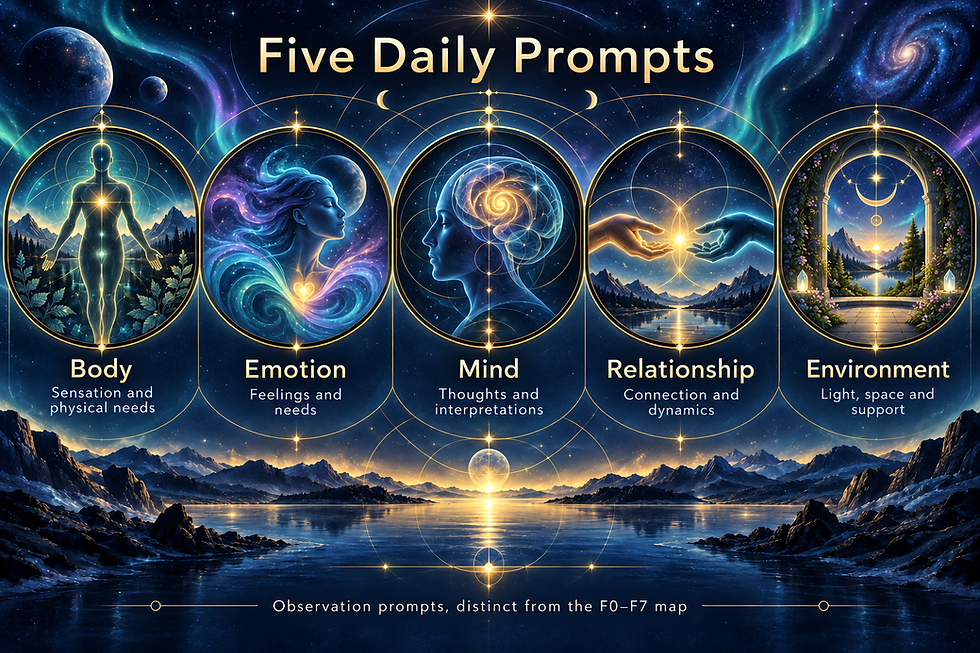
Several aspects may be present together; “I do not know yet” is also a valid observation. Body, Emotion, Mind, Relationship, and Environment are the five daily observation prompts. Memories and identity can inform them, while the F0–F7 Layer Map offers a separate set of symbolic perspectives.
The Spiral Is Not a Straight Path

Most people imagine growth as a ladder.
You start low.
You climb higher.
You leave the old version behind.
But healing rarely works that way.
Growth is usually more spiral than ladder.
You may revisit the same fear, but with more awareness.
You may meet the same grief with more capacity, or with less.
You may face the same pattern, but with a clearer boundary.
You may return to an old wound and need more care than before.
You may recognize a familiar role and still need help to respond differently.
That does not mean you are failing.
It means the spiral has returned you to the pattern from a new angle.
Repetition is not always regression.
Sometimes it is recognition.
A pattern may return because conditions persist, support is missing, or life has changed. It does not prove that the universe has assigned another lesson.
The Body as One Gate

Sometimes sensation is the first thing you notice. Sometimes a thought, conversation, or change around you comes first.
Interoception includes sensing and interpreting signals from within the body, through conscious and unconscious processes. Attention to a sensation is only one part of that wider process. [1]
The jaw tightens.
The stomach drops.
The chest contracts.
The shoulders rise.
The breath shortens.
The hands go cold.
The body wants to move, hide, speak, freeze, or leave.
Such experiences can have many causes.
They may not always mean what the mind assumes they mean, but they are still information.
The body is one gate into the field.
You do not have to find a clear signal inside it on demand.
This is why embodiment is not decoration in Signal Field theory.
It is foundational.
You can begin with what is accessible: a need, a thought, the light in the room, or a trusted person's support.
You may think the issue is mental when the body is overloaded.
You may be trying to solve a story while immediate practical needs deserve attention.
You may think the issue is spiritual when your system needs rest, food, water, movement, silence, or safety.
The body does not explain everything.
It can have a place in the conversation without carrying the entire explanation.
Emotion as Signal

Emotion is often treated as a problem to control.
But in dimensional embodiment, emotion is read as signal.
Not absolute truth.
Not identity.
Signal.
Fear may point to threat, uncertainty, memory, or protection.
Anger may point to boundary, grief, injustice, or exhaustion.
Sadness may point to loss, longing, or release.
Shame may accompany exposure, earlier expectations, or harsh self-judgment.
Joy may accompany connection, pleasure, or aliveness. It does not by itself establish safety.
These are possibilities, not an emotional dictionary. The same feeling can arise in different circumstances.
Dimensional embodiment offers a third path:
listen without being consumed.
You can ask:
What is this emotion showing me?
Where does it live in the body?
What behavior does it want to create?
Is this emotion about the present moment, an old imprint, or both?
What care or space might help, whether or not the feeling changes?
When emotion is read clearly, it becomes part of the map.
Relationship as Mirror
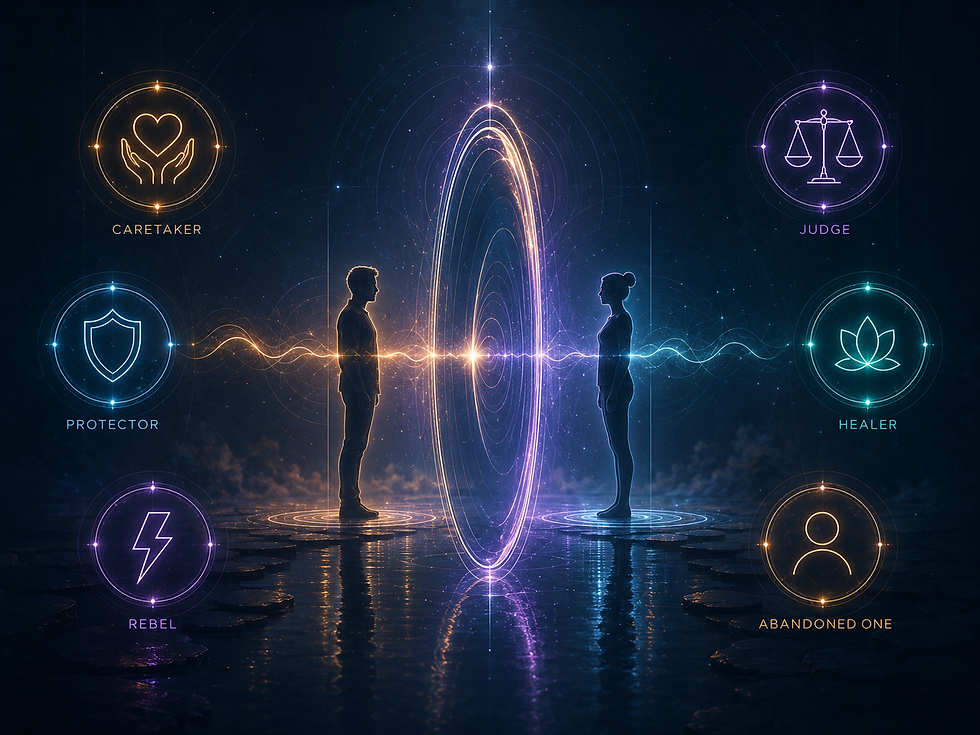
Embodiment does not happen in isolation.
Other people activate the field.
A conversation can change your breathing.
A tone of voice can activate an old memory.
A delayed reply can trigger a familiar story.
A conflict can pull you into a role you thought you had outgrown.
A safe presence can help the body soften before the mind knows why.
This is the relational layer of embodiment.
Relationships mirror patterns that may be hard to see alone.
Sometimes the mirror is uncomfortable.
You may notice protection, performance, withdrawal, overexplaining, or an unmet need.
But a mirror is not the same as a verdict.
Other people's behavior is real information too. Mistreatment is not evidence that you failed to heal an inner pattern.
Dimensional embodiment asks you to notice what role gets activated in relationship.
The caretaker.
The protector.
The rebel.
The abandoned one.
The judge.
The healer.
The one who disappears.
The one who tries to earn safety.
Naming a role can create room to reflect, but you do not have to give up a needed protection or boundary.
Memory as a Living Layer

Memory is not only stored in the past.
Memory continues to shape the present.
A smell can bring back a whole season of life.
A room can reactivate an old version of you.
A song can open grief you thought had settled.
A dream can reveal a symbol before the mind understands it.
A familiar dynamic can make the body respond as if history is happening again.
This is why memory matters in dimensional embodiment.
The past does not always return as a thought.
Sometimes it returns as sensation.
Sometimes as emotion.
Sometimes as avoidance.
Sometimes as a dream.
Sometimes as a repeated choice.
Sometimes as a relationship pattern.
Memory becomes dimensional when you realize it is not locked behind you.
It is woven into the way your field interprets the present.
You can acknowledge a memory without investigating it further. Dreams, sensations, and symbolic images do not establish that a particular past event occurred. Painful material can be left alone or approached with appropriate support.
Environment as Scaffolding

Your environment is part of your embodiment.
The room matters.
The lighting matters.
The soundscape matters.
The feed matters.
The people around you matter.
The pace of your day matters.
The objects you see every morning matter.
The amount of clutter, noise, pressure, and interruption matters.
The field does not live in abstraction.
It lives in conditions.
Ongoing demands can make room for rest harder to find.
Access to support and workable conditions matters.
Needing those conditions is not a failure of awareness, and change does not require a perfect environment.
This does not mean your space has to be perfect.
It means your space is communicating with your body.
Dimensional embodiment asks:
What environment helps my system return?
What environment keeps my system bracing?
What small change would make coherence easier to access?
Sometimes a small act of care is enough: adjust a light, use headphones, ask for help, leave something unfinished, or rest. A tidy surface is an option, never a measure of your worth.
Embodiment Is Not Performance

Embodiment is often sold as an aesthetic.
Perfect morning rituals.
Perfect meditation spaces.
Perfect breathwork routines.
Perfect calm.
Perfect posture.
Perfect wellness identity.
But real embodiment is not performance.
It is honesty.
It is noticing when the body says no.
It is noticing when the nervous system is overwhelmed.
It is noticing when you are pretending to be fine.
It is noticing when your environment is too loud.
It is noticing when your body needs care before your mind needs answers.
It is noticing when a pattern has returned and choosing not to attack yourself for it.
Embodiment is not proving that you are healed.
It is learning how to stay in relationship with yourself while you are still becoming.
How to Practice Dimensional Embodiment

You do not need a complex ritual to begin.
Start with one moment of contact.
Begin with the body if that feels useful, or with something outside you.
Ask:
What is present right now?
Choose any one of these questions:
What is my body showing me?
What emotion is moving?
What story is forming?
What relationship pattern is active?
What memory might be involved?
What identity is trying to emerge?
What environment is shaping this?
Do not force an answer.
Do not try to solve every layer.
Just notice what speaks first.
If possible, choose one supportive adjustment.
Letting breathing remain comfortable, without forcing a pattern.
A hand on the chest, if touch feels welcome.
An accessible movement, change of position, or rest.
A glass of water.
A pause before replying.
Moving one object, or asking someone else for practical help.
A softer sound.
A sentence in a journal.
A boundary.
Stillness, stimming, familiar sound, or company, according to your needs.
You can stop at any point. During AuDHD burnout, grief, or collapse, reducing demands may matter more than adding a practice.
The Return Path

The return path is not about becoming perfectly regulated.
It is about learning what helps you come back when you lose balance.
Back to the body.
Back to the breath.
Back to the present layer.
Back to the signal beneath the reaction.
Back to whatever support is available, including when witnessing feels impossible.
Coherence does not require calm or perfection. A clear, stable signal can include pain, grief, anger, and uncertainty.
Distortion enters when context is lost, an assumption becomes certainty, or competing demands make the signal hard to read. It is not a judgment on the person having the experience.
You return by listening.
You return by adjusting.
You return by noticing what layer is asking for care.
You return by giving the system a signal it can follow.
This is how embodiment becomes architecture.
Not a concept.
A lived structure.
Field Practice

If useful, try one part of this today:
Pause for a moment, without needing to time it.
Notice one accessible detail inside or around you.
Ask:
Where is the strongest sensation?
What emotion is closest to the surface?
What story is forming around it?
What does my environment feel like right now?
What is one small adjustment that would help my system return?
Try that if it is within reach, or ask for help.
Not everything.
One coherent adjustment.
That is enough to begin.
Field Reflection

What helps you feel accompanied when life becomes overwhelming?
Is there a need that has been hard to recognize or make room for?
Which layer do you usually try to solve everything from: body, emotion, thought, relationship, memory, identity, or environment?
What would change if you treated embodiment as listening instead of performance?
What small return signal can you give your system today?
The Larger Philosophy

You are not separate from the spiral.
You are living it.
Every sensation, emotion, relationship, memory, and environment is part of the way your field learns itself.
The spiral does not ask you to escape the body.
It leaves room to return with the capacity you have today.
Not to become perfect.
To become coherent.
Not to rise above being human.
To inhabit being human more fully.
The body is not the obstacle to consciousness.
The body is where consciousness becomes real.
🜂🜄🜁🜃
Architect
Sources & Further Reading
Research context for interoception. The spiral and Aurora Continuum are philosophical and symbolic frames.




Comments